

Vancouver Canucks
Hall of Famer
The Stanchies: Canucks nearly ruin the perfect tank game, still find a way to lose 5-3 to Sabres
Source: https://canucksarmy.com/news/stanch...k-game-still-find-way-lose-5-3-buffalo-sabres
The Buffalo Sabres represent the world in which the Vancouver Canucks make a spirited run for the playoffs. Coming off a 10-game winning streak that was stopped by Brendan Gaunce, as expected, the Sabres have just now put themselves within a point of a Wild Card spot. Which is the reality the Canucks would face should they ever decide to go on a spirited run of their own, that even after racking up all those dubs, it still takes even more spirited winning on top of that to leapfrog enough teams to even stay in conversation with the playoffs.
And after watching the Sabres defeat the Canucks 5-3, it just gets harder and harder to envision a scenario in which Vancouver finds a way to stay hot long enough to start stringing together victories. PDO benders aside, the Canucks just have no juice. No aura. No moxie. No tenacity. No vigour. No fortitude. No pluck. No spunk. No oomph. No pep. Not even a little vim. Certainly no mettle. Surely no zing. Never zing.
The point is, watching the Canucks is downright depressing right now. And while adding up the losses in their thirst for first is clearly the right move at the moment, when you hear talks that the Canucks might be looking to extend Kiefer Sherwood, it feels rather deflating.
Which isn’t to say I don’t appreciate Kiefer Sherwood, as he’s a very easy player to enjoy. In a perfect world, he would very much be part of an elite third line for a playoff-contending team.
But Vancouver is in a position where there is just such a dour cloud hanging over the team that they should truly be looking to trade anyone and anything with a pulse, save for a handful of the younger players. “Signing veterans for the culture” is a proud tradition in hockey, but when you’re dealing with a team that had a generational locker room divide that single-handedly took down the Quinn Hughes era, I don’t know how you don’t just try and trade as many of the veterans as you can in an attempt at a total restart.
Hand the keys over to the kids and see what vibe they can generate. Bring in new veterans when the time comes and have them walk into the culture your new core created. I know “But the Sabres!” was the boogeyman for a total rebuild for years, but if your pro scouting is on the ball, and you have enough lottery tickets in the form of draft picks, how is that not the right way forward with this team?
Because the truth of the matter is this team’s future isn’t with Brock Boeser, or Elias Pettersson, or Thatcher Demko. The retool of a two-year turnaround is quaint, but the reality is this team will be struggling for many years while they try to inject enough talent to be consistent contenders for the postseason.
So until then, nobody should be safe. Every option should be explored. And extending veterans’ contracts should be the last thing on your mind going forward.
I am at the point where it feels like even the veterans themselves would prefer a fresh start elsewhere, as I cannot think of a less motivating line in the NHL than Evander Kane, Brock Boeser and Elias Pettersson. And I don’t say that to be mean! I am not using snark! I just, man, when I watched that line against the Sabres in the third period, it just felt so underwhelming. I could almost feel the lack of excitement and energy oozing off of them through the screen.
I just don’t know if the Canucks have ever felt less dynamic than they do right now. What I do know is that when Kiefer Sherwood and Drew O’Connor are your most consistent, exciting offensive players at even strength, then your roster is problematic.
So while the Canucks may have fallen one Brendan Gaunce short of beating the Sabres, it doesn’t change the fact that this isn’t a retool year; it should be a full-on rebuild.
Otherwise, we are just doomed to repeat ourselves, forever stuck in the time loop of “man so tight, almost like a playoff game.”
Best showing your intentions earlyU.S. Olympian Thompson pounces on loose puck in slot and quickly whips home 21st goal of season and ninth in last 13 games to open scoring. #Canucks #Sabres
— Ben Kuzma(@benkuzma) January 7, 2026
Tage Thompson is a giant man who scores a lot of goals, with hands so soft they should be illegal on someone like him. It’s the “Todd Bertuzzi” white unicorn all general managers chase, that really big beefy boy who can destroy people equally with a big hit as well as a deft dangle.
So it was not too surprising when Thompson was the guy who opened the scoring for Buffalo, when a fortuitous bounce saw the puck land in his feet after a nice rush from Bowen Byram:
Marcus Pettersson tries his best to handle Tage, and while I won’t bemoan someone losing that battle, we still have to point out that ultimately, MP3 failed on his assignment. I give him credit for trying to take away Tage’s stick for as long as possible, but ultimately, the ogre who haunted the halls of Hogwarts is able to shield him off the puck and snipe one past Demko.
The good news is that it wasn’t an egregious defensive breakdown that caused this goal. The bad news is that some of those come later.
Best cursed image
Much like Chuck McGill, Brock Boeser lives and dies by lighting the lamp, something he has struggled with as of late. He did manage two assists in this contest, which is a nice showing for a top player in dire need of points, but ultimately, his whole thing is shooting the puck real good and stuff. This continues to escape him due to a variety of bad luck, uninspired play at times, and, of course, bees.
He did almost score on the Canucks first power play of the game when he had Ukko-Pekka Luukonen swimming in his crease for a rebound, before ultimately shuffling a backhander wide of the net:
We all kind of knew that Quinn Hughes elite puck control hid the impact having so many passenger players had on the Canucks, and as much as JT Miller remains a hotly debated player in this town, his absence is felt in that regards as well. Add in Elias Pettersson losing his swag/mojo/whatever fun name for confidence you want to assign, and you have a team that just lacks play drivers.
You see flashes of it in Liam Ohgren, Elias Pettersson does something once in a while to remind you that he’s still inside there somewhere, and Conor Garland is probably their best puck on the stick guy right now, but ultimately this is a team that doesn’t have the horses to play any kind of hockey but work the puck down low and feed it to the point or throw it in front.
Actually, oddly enough, Evander Kane is one of their more dynamic forwards in that I think he makes some of the better passes on the team. It’s just the whole lack of defense thing kind of takes away from it.
Which is why Kiefer Sherwood and Drew O’Connor probably stand out in this system. They have the speed and effort to get in on the forecheck and force their way to the net, which is what Sherwood did on the Canucks first powerplay of the game:
He fights off a check, gets the puck back and feeds the point, then gets off a shot in the bumper spot before collecting his rebound and getting that on net as well.
Even though all the Canucks goals came late in the game, I would say the first period was their best effort of the night. They generated their most amount of high danger chances in the opening frame and generally looked like they had some energy to their efforts. They actually generated five shots on that first power play and if it weren’t for the high level play of Luukkonen, the Canucks most likely score there.
You at least felt like it was a possibility they might get a goal in the first period, which is something I didn’t feel for a single moment during the second period.
Best double Dion homageKrebs with a hit in the Dzone that wiped out two #Canucks like they were bowling pins. Sheesh. #Sabres
— Mike Harrington (@ByMHarrington) January 7, 2026
Peyton Krebs threw the best hit of the night when he ordered the two for one special after he landed a hit on Nils Höglander that then took out Liam Öhgren, thus proving my theory that Krebs hates umlauts more than any other player in the NHL:
You may laugh at this, but which diacritical marks are next? The Trema? The circumflex? The tilde??
I swear to god, if you touch the cedilla…
Where does it stop, Peyton?
Where. Does. It. Stop.
Best if it doesn’t work, try try againThe Canucks constantly feed the puck back to their points. How often do those points score on their shots? One percent? Two percent? #Canucks
— Kerry Banks (@bad_kicker) January 7, 2026
The Canucks second power play did not go nearly as well as their first, as not only did they generate zero shots on net, they also gave up a a goal on an odd-man rush counter attack:
Tom Willander manages to not play neither the shot nor the pass, which allows Alex Tuch to find Cody McLeod for the clinical finish. Willander probably needs to play that with more patience, as you can see the second he lunges for the puck Tuch passes around him with ease, almost as if he was waiting for that movement, so mark this down as another one of those “Welcome to the NHL, kid” moments for the young defenseman.
Best keeping up with the BuffalosBuff speed is much better than #canucks .. not enough speed on the team.
— Robbie Mann (@RobbieMann77) January 7, 2026
While Vancouver did genuinely play well in the first period, it did feel like Buffalo was getting the more dynamic chances. Which again, that’s sort of been the storyline all season long, that’s kind of how you get to the bottom of the standings. You work your bag off, but you simply aren’t good enough to create enough offense. You live your life off of thoughts, prayers, PDO and lucky bounces, which doesn’t make for the most exciting hockey in the world.
Meanwhile Buffalo was able to cycle the puck in the offensive zone and almost find Josh Doan for the tap in at the side of the net:
Chalk that up to another blown defensive moment for the Canucks as well, though, because for reasons (bees?) unbeknownst to me, Tyler Myers moves off of Doan to try and close the gap on Mattias Samuelsson, putting Höglander in the awkward spot of having to try and jump up to take his previous check.
Is this the complicated hockey Adam Foote talks about that we wouldn’t understand? Where you play man to man, but you can change which man if you’re feeling it, even if it means confusing your teammates into blown coverage all season long? Perhaps.
Alex Tuch then almost made it 3-0 after a diving Josh Norris got the puck out of the zone and sent the Sabres on an odd man rush adventure:
First off, absolutely love that effort from Norris. Dude dives twice to get the puck out and that is the kind of stuff you can inject straight into my veins.
Secondly, I think Zeev Buium plays this a little too aggressive, as he jumps up to make a play on Jason Zucker, but again a Buffalo veteran uses that to his advantage by feeding the puck over to Tuch to skate into a breakaway in the space behind Zeev. Kiefer Sherwood is around the area, but he has to absolutely hoof it to try and get back into the play, now that Buium has left the scene.
To make matters worse, both Buium and Sherwood track Zucker after the breakaway instead of Tuch, leading to Owen Power skating right into a terrific scoring chance set up by that same Tuch, forcing Demko to make a tremendous stop.
If anything it was one of the more entertaining first periods of the season from Vancouver at least.
Best shorthanded kingsTurned the game on just in time to watch Sherwood pass the puck to Connor who’s 2 feet in front of the night and still manages to miss.
Please stop passing to DOC
— Farine (@_Farine) January 7, 2026
DOC and Sherwood are not only the even strength kings, but they are now the shorthanded kings as well. Long gone are the days of Elias Pettersson and JT Miller using shorthanded odd man rushes as the only place in the world they could still connect as humans, now we live in the reign of the cowboys:
The reason you feed DOC there is because Kiefer had nowhere else to shoot. Maybe you can pop a low shot for a rebound, but man alive, in a season like this go for the pomp and circumstance. If you’re going to lose a game, give me a clean one timer shorthanded finish versus banging in a greasy one.
The only other option would have been to swing to his backhand and go top shelf like a young Igor Chernyshov, but that would require multiple draft picks and rebuilding and such.
The Sabres would then almost score on a Noah Östlund scoring chance after Brock Boeser deflected a pass behind his own defense:
I am mostly showing this because I want to believe in a world in which Noah Östlund joins Liam Öberg and Jonathan Lekkerimäki on Vancouver, proving some sort of HUT based chemistry bonus that pushes their OV up to like 96 or whatever.
The Kyle Wellwood rejoins the team after the Canucks pull him from a special throwback pack and he’s like 99 OV, and now we’re talking about a proper rebuild.
That’s how the NHL works, right?
Best the Big ShortSherwood having a tough game, that stock keeps plummeting #Canucks
— TheCanucksCurse (@TheCanucksCurse) January 7, 2026
The Sabres would then make it 3-0 on another Byram assisted rush, as this time he purposely found his target in the form of one Alex Tuch, who was able to lift the puck up high despite being in tight on Demko:
Byram basically walks around Drew O’Connor and PO Joseph, before finding a wide open Tuch after Kiefer Sherwood kind of goes full JT Miller on his defensive coverage.
Which again, that’s sort of a staple of this team. Losing their man, leaving guys open, the GOTI system Tocchet left in place is long gone as not a game goes by where you don’t see multiple Canucks looking lost and confused in their own end.
Don’t believe me? Here’s Jake DeBrusk, someone who has played better since the fear of the healthy scratch was instilled upon him, just sort of floating away from Zach Benson despite being the first forward back:
He ends up chasing the puck far side, which leads to a lot of open ice as the Sabres rush the puck forward on net.
Then you had Alex Tuch almost scoring again, this time after Jason Zucker finds him all alone in front after Evander Kane and Brock Boeser combine to both blow coverage:
Tuch literally just skates in a giant circle and finds himself open right between the veteran wingers and easily gets a dangerous shot on net.
You then had Andre the Giant Tage Thompson showcasing the joys of big beefy centers, as he absolutely bodied Elias Pettersson off of the puck behind the net before finding Doan for another scoring chance in the crease:
It was just another night in which you found yourself watching another team in the middle of the pack with more weapons, leaving you nervous about what this management might do if this team does happen to go on a little bit of a hot streak before the trade deadline.
Surely you can’t watch the Avalanche and think this year is your year. Surely.
Best veteran presenceDon’t worry, folks, a Kiefer Sherwood contract extension will cure all! #Canucks
— Grady Sas (@GradySas) January 7, 2026
Leave it to Sherwood and O’Connor to generate the best scoring chance of the second period, as this time Kiefer spins and puts the puck wide of an open net:
I think Luukkonen tries to sell the Drew O’Connor body contact a little too hard, as he flops forward and ends up stuck in a save animation while facing backwards, so he’s lucky Sherwood just missed on the 360 no scope shot.
Best hold on thereYou cannot watch this #Canucks team play and tell me honestly that there’s a credible path to turning it around quickly without a period of disciplined rebuilding.
— Thomas Drance (@ThomasDrance) January 7, 2026
Spoke like a man who didn’t see this tip pass from Karlsson, that’s the kind of play you can retool with:
Fil Hronek to Linus Kalrsson to Liam Ohgren, that my friends was the first shot five minutes into the third period and what a shot it was.
If it wasn’t for the flurry of last minute goals from the Canucks, this game felt like it had slipped into a coma as Buffalo looked to coast out the rest of the game.
Best why not make it four
Why waste time defend when few defend do trick?
Yes, that’s Planet Ice Evander Kane just sort of vibing in his own zone as Zach Metsa floats by him to score his first career NHL goal, as the Sabres fourth line makes the Canucks pay with their top line on the ice.
I will say it again, there is just something about the combination of Kane, Boeser and Pettersson that I do not enjoy together. Whatever it was the Lotto Line had, this is the opposite of that. It’s like watching your parents divorce on ice or something.
Kane basically stops skating and hands the open lane to Metsa, making it 4-0 Sabres and all I will say is I saw Andrei Kuzmenko get traded for less.
Best I didn’t hear no bell
The Canucks got a bit of a break when Jake DeBrusk got high sticked, giving his team a four minute powerplay to work with, resulting in DeBrusk scoring the first goal of the game for Vancouver:
Nothing fancy, just some old fashioned get the puck on net and see what happens type of hockey, and it works. DeBrusk uses some nifty hand-eye coordination to bat the puck in out of the air, but that’s sort of his thing, the guy excels in the blue paint game because of that.
DeBrusk would almost score again on the second powerplay, this time after once again setting up shop in Tim Hortons and almost deflecting a puck passed the Sabres goaltender:
I will say that the healthy scratch seems to have done wonders for Jake, so maybe the Canucks should start using that punishment/motivation technique more liberally with every player?
Best what’s good for the goose
In what looked like a mirror image of the Sabres first goal, Elias Pettersson found himself in between the faceoff circles after some fortuitous bounces gifted him the puck in his feet:
EP40 spins it to wins it, and of course a game in which the Canucks looked as dead as the Dread Pirate Roberts have now managed to make it a two goal lead.
But surely it stops there.
Best it doesn’t stop thereLiam Ohgren took a big hit to make a play in his own zone and gets rewarded by scoring a goal. Tough kid
— Satiar Shah (@SatiarShah) January 7, 2026
Liam Öhgren would then make it 4-3, leaving you enough time to ponder “if only Evander Kane had tried to play actual defense on that fourth goal” before we watch some Liam clips.
I want to say that Liam Öhgren has impressed me the most from the players who joined from Minnesota. That’s not to say Buium won’t develop into a top player or that Marco Rossi won’t end up being a top six producer, but just as it currently stands, Liam is my boy.
I just like the way he plays, and you can tell a lot about a hockey player by the way they pick themselves up off the ice after a hit.
Some players get trucked into the boards, and they look like they really struggle to get to their feet. You can just tell they didn’t like that hit one bit, no sir, and they would like it if that never happened again.
With Liam, though, he eats the hits and tends to bounce back up.
Just before his goal, Liam races back hard to win a chase for the puck, knowing he is going to pay the price physically:
You see him land on the ice, take a split second to make sure he isn’t broken in half, then jumps up and gets back into the play.
Eventually this leads to Linus Karlsson making a fantastic forecheck behind the net, getting the puck back to the point to Marcus Pettersson, who then finds Liam who shoots through the screen of Max Sasson to make it a one goal game:
I don’t know the ceiling for Liam’s NHL career, but I will say that I just really like the way he plays the game. I just think this is one of those guys you can win hockey games with, where the moment is never too big, and he’s willing to do whatever it takes to win.
Best fun while it lasted
Canucks take the win in life, that is. The thirst for first won on the day, as the Sabres would score on the empty net fairly quickly after Demko was pulled:
Which left the Canucks just enough time for Buium to shine a little bit, as he almost scored on a rush to the net in the dying seconds of the game:
And then Zeev almost set up Boeser for a goal moments later after another slick offensive move in the slot:
Which is pretty much all you are hoping for at this point. The Canucks continuing to improve their drafting odds, while some of their younger players have some big moments to shine in.
It might not be fun to watch at times, but at least it’s trending in the right direction.
Sponsored by bet365


 (@CanucksIn4)
 Source: https://canucksarmy.com/news/stanch...k-game-still-find-way-lose-5-3-buffalo-sabres
 Lankinen
 : Sportsnet |
  CANUCKS GOAL


 (@didntkiss234)
  (@empathytweets_)
 (@SadClubCommish)


 (@izzycheung37)


 |
|  .
.

 Romani
 (@RobHodkinson)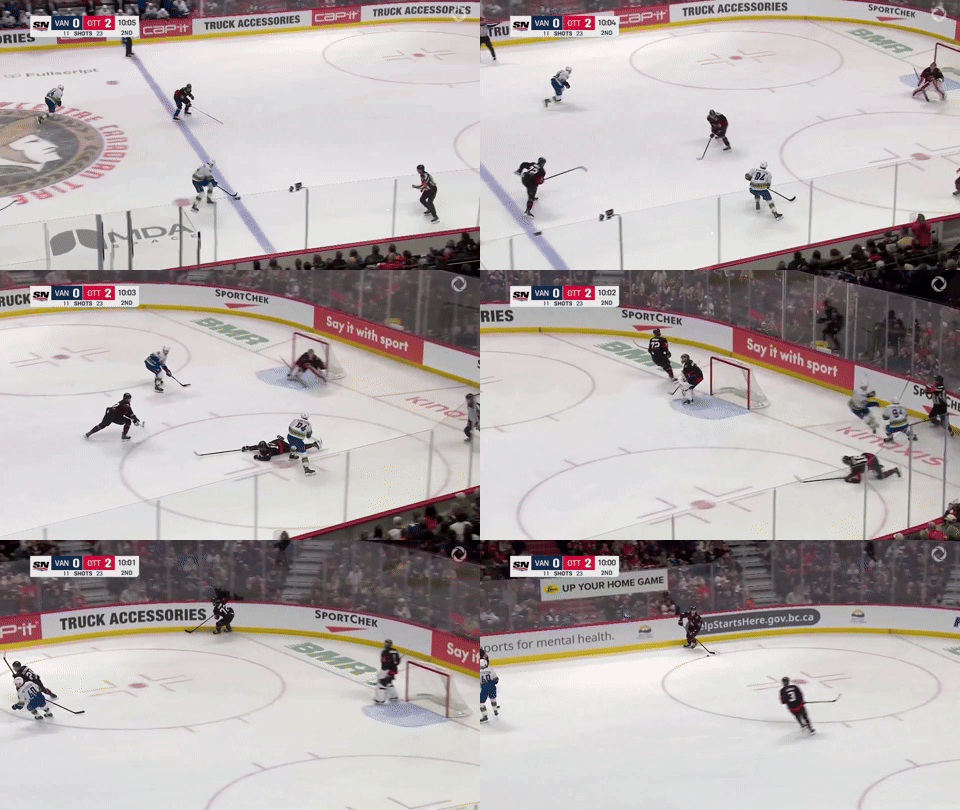




 (@simonplittle.ca)
 ️
️
 (@HuggyxHoggy)