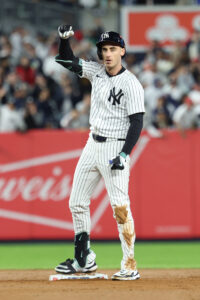
Latest On Yankees, Cody Bellinger

The biggest offseason question for the Yankees has been whether they’ll re-sign Cody Bellinger. General manager Brian Cashman is on record about the club’s interest in doing so, and they’ve reportedly made at least two formal contract offers.

It doesn’t appear that Bellinger is on the verge of accepting a deal, however. Brendan Kuty of The Athletic wrote this morning that the sides don’t seem close to an agreement, though talks are continuing. Contract length could be a holdup. Kuty wrote that Bellinger and his representatives at the Boras Corporation were likely looking for a six- or seven-year contract. In an MLB Network appearance, Jon Morosi also suggested that Bellinger continued to seek a deal in the seven-year range. Morosi added that the Yankees unsurprisingly preferred a four- or five-year commitment.

Most external projections forecast a five- or six-year deal. MLBTR predicted a five-year, $140MM contract at the beginning of the offseason. Bellinger is headed into his age-30 season. There’s precedent for players commanding seven-plus years at that age, but the most recent free agent hitter to do so was Brandon Nimmo in 2022. There hasn’t even been a six-year contract for a free agent bat in his 30s since the Nimmo deal, but Alex Bregman (who was a year older at the time) rejected a six-year offer from the Tigers last winter.

Bellinger is coming off a fantastic first season in the Bronx. He hit .272/.334/.480 with 29 home runs across 656 plate appearances. He cut his already low strikeout rate to a personal-best 13.7% clip. Bellinger’s bat speed and exit velocities — which prevented him from commanding a long-term contract two years ago — remain middling. His left-handed bat was perfectly suited to Yankee Stadium, where he hit .302/.365/.544 with 18 of his home runs. His .241/.301/.414 batting line on the road is essentially league average.

While that wouldn’t be much of an issue for the Yankees, they may feel that’ll give other teams pause. We’re only a year removed from Bellinger having essentially no trade value when he was signed for two years and $52.5MM. New York acquired him from the Cubs for journeyman pitcher Cody Poteet, whom Chicago cut at the end of Spring Training. The only cost for the Yankees was taking on all but $5MM on Bellinger’s deal. Trade talks were complicated by an opt-out clause in his contract, but it’s notable that teams weren’t eager to sign up for even two years at $25MM annually last offseason. A six-plus year commitment at a similar annual value is a significant ask.

Do teams other than the Yankees feel Bellinger is a dramatically different player than he was a year ago? His camp will surely argue that his success in New York — on top of his previous work in big markets in Los Angeles and Chicago — should move the needle. Bellinger also isn’t attached to draft compensation, as he was in 2023 when he declined a qualifying offer from the Cubs.

His results have outpaced his more middling batted ball metrics in three consecutive seasons. Bellinger is never going to recapture the ferocious power he had before he injured his right shoulder during the 2020 postseason. He has reinvented himself as an elite contact bat, and while his home/road splits aren’t encouraging, his platoon numbers are more impressive.

Bellinger is a .329/.371/.546 hitter against left-handed pitching over the past three seasons. Among lefty hitters with 250+ plate appearances in that time, only Yordan Alvarez has a superior slugging mark. Bellinger trails only Alvarez and Juan Soto in on-base percentage. Teams can comfortably pencil Bellinger in as an everyday player in either corner outfield spot, and he’s an option for at least semi-regular center field work.

Source: https://www.mlbtraderumors.com/2026/01/latest-on-yankees-cody-bellinger.html
 
Yankees’ Offer To Bellinger Reportedly Above $30MM AAV

The Yankees have made multiple offers to Cody Bellinger in recent weeks. Brendan Kuty of The Athletic reports that the most recent had an average annual value north of $30MM. However, the sides are still held up on contract length.

Kuty writes that Bellinger’s camp continues to push for a seven-year contract. It’s not known how many years the Yankees are willing to go, but it has thus far apparently been less than seven. Jon Morosi of The MLB Network suggested earlier this week that the team was more comfortable with a four- or five-year commitment.

The rumored proposal from New York would put Bellinger in the range of the most expensive bats to sign this offseason, at least on an annual basis. Kyle Schwarber re-signed with the Phillies for five years and $150MM. Pete Alonso received a five-year, $155MM deal from Baltimore. If the Yankees get their wish regarding the contract length, Bellinger’s deal likely ends up looking a lot like the Schwarber and Alonso pacts. MLB Trade Rumors settled on a five-year, $140MM contract in our list of the top 50 free agents.

As Kuty notes, a contract exceeding $30MM a year would make Bellinger one of the highest-paid outfielders in the league. Juan Soto, Aaron Judge, Mike Trout, and Mookie Betts (if he still counts) are the only outfielders making more than $30MM per season. It would also be a significant jump from his recent contracts, as the market has treated him with trepidation in previous years.

After the Dodgers moved on from Bellinger following the 2022 season, the Cubs scooped him up on a one-year, $17.5MM deal. Bellinger rewarded Chicago with a 20/20 campaign, but it wasn’t enough to land a long-term contract. He ended up back with the Cubs on a three-year, $80MM deal with opt-outs after each season. Bellinger didn’t opt out after a middling 2024 and was then traded to New York. The Yankees were able to land him just by sending over Cody Poteet and agreeing to pay all but $5MM left on Bellinger’s contract.

Bellinger unsurprisingly opted out of the final year of his deal after a strong season in New York. Regardless of where he ends up, he should be able to top the $25MM he was slated to make in 2026. Bellinger slugged 29 home runs last year, the most since his NL MVP campaign in 2019. He added 13 steals and nearly drove in 100 runs. Bellinger also provided stellar defense, with both Defensive Runs Saved (+11) and Outs Above Average (+7) praising his work in the field. Bellinger logged 300+ innings at all three outfield positions. He also made a handful of appearances at first base. The Yankees didn’t need his services in the infield with Paul Goldschmidt on board, but he could be an asset there if needed.

In addition to the considerable counting stats, Bellinger also made some improvements under the hood in 2025. He bumped his hard-hit rate to 37.9%. That mark is just above league average, but it’s a big improvement from recent seasons. Bellinger’s 31.4% hard-hit rate in 2023 was among the reasons he failed to secure a long-term deal after his first year with the Cubs. While he hit .307 that season, it was likely fueled by a career-high .319 BABIP. His xBA (.268) was nearly 40 points lower than his actual mark. Bellinger’s hard-hit rate improved to a still-underwhelming 32.9% in 2024, while his bat speed slipped to 69 mph, which ranked in the 13th percentile.

Bellinger also made more contact this past season. His 13.7% strikeout rate was the best mark of his career, as was his 7.6% swinging-strike rate. Bellinger ranked 26th among all qualified hitters with a 91% zone contact rate. He’d only been above 87% once in his career before 2025. Average batted ball metrics combined with elite contact skills could portend continued success for the 30-year-old Bellinger, particularly if he stays in New York. He slashed an uninspiring .241/.301/.414 on the road last year.

Source: https://www.mlbtraderumors.com/2026/01/yankees-offer-to-bellinger-reportedly-above-30mm-aav.html
 
Yankees Claim Kaleb Ort

The Yankees announced that they have claimed right-hander Kaleb Ort off waivers from the Astros. The move was reported by Yankees Never Win prior to the official announcement. Houston recently designated Ort for assignment when they signed Tatsuya Imai. The Yanks had multiple 40-man vacancies and don’t need to make a corresponding move.

Ort, 34 in February, has pitched for the Red Sox and Astros over the past five seasons. He has shown some intriguing stuff but without fully harnessing it for good results. He averages in the upper 90s with his four-seamer while also throwing a cutter, slider and changeup.

Through the end of the 2023 season, he had thrown 51 2/3 innings for the Red Sox with a 6.27 earned run average. Boston put him on waivers in October of 2023 and he bounced around the league that winter, going to the Mariners, Marlins, Phillies and Orioles via waivers or cash deals. Baltimore kept him on optional assignment early in 2024, exhausting Ort’s final option year in the process. They put him in waivers in May of that year, which is when the Astros grabbed him.

He had his best run of major league success with the Astros. After that claim, he gave Houston 22 innings with a 2.55 ERA, 28% strikeout rate and 4.3% walk rate. That impressed the Astros enough that Ort held a roster spot through 2025 despite being out of options, but he couldn’t keep the results at that level. He tossed 46 innings last year with a 4.89 ERA. His 25.3% strikeout rate was still good but he gave out free passes at a 13.9% clip. He spent most of September on the injured list due to right elbow inflammation.

For the Yankees, there’s no real harm in a waiver claim for now. As mentioned, they had multiple open roster spots. Ort still doesn’t have enough service time to have qualified for arbitration. They can bring him into camp to compete for a bullpen spot.

It’s also possible they put him back on waivers later, after they make more moves and fill out the roster. If he were to pass through waivers unclaimed, they could keep him in a non-roster capacity. Ort doesn’t have a previous career outright and is shy of three years of service time, meaning he doesn’t have the right to reject an outright assignment in favor of free agency.

Photo courtesy of Thomas Shea, Imagn Images

Source: https://www.mlbtraderumors.com/2026/01/yankees-claim-kaleb-ort.html
 
Yankees Avoid Arbitration With Jazz Chisholm Jr.

The Yankees announced they’ve reached an agreement with infielder Jazz Chisholm Jr. for the 2026 season. It’s a one-year, $10.2MM deal, reports Jack Curry of the YES Network. Chisholm is a client of Roc Nation Sports.

New York settled all eight of its remaining arbitration cases today. Chisholm was the only one to crack eight figures, though closer David Bednar ($9MM) wasn’t far behind. MLBTR contributor Matt Swartz nailed both numbers. The 27-year-old Chisholm is in his final year of arbitration and will head to free agency next offseason.

Chisholm put together a massive 30/30 campaign in his first full season in pinstripes. He struck out at an above-average clip, but also pushed his walk rate to a career-best 10.9%. Chisholm’s 126 wRC+ was his best mark since the 134 he posted in an abbreviated 2022 season, when a back injury limited him to 60 games. Health issues hindered Chisholm for much of his tenure in Miami. That hasn’t been the case in New York. Aside from a minimum IL stint in 2024 and a one-month absence this past year, Chisholm has been a fixture in the Yankees’ lineup. He’s played at least 130 games in back-to-back seasons.

After making the move to third base when he first joined the team, Chisholm was locked in at second base after New York traded for Ryan McMahon. He should reprise that role in 2026, assuming he’s still on the team. Rival clubs have checked in with the Yankees about Chisholm. The pending free agent is interested in a contract extension, but New York hasn’t been as keen on the idea. There’s been no indication that the Yankees are actually considering trading Chisholm. He’s more than likely going to be back in the middle of a formidable New York lineup next year.

Photo courtesy of Vincent Carchietta, Imagn Images

Source: https://www.mlbtraderumors.com/2026/01/yankees-avoid-arbitration-with-jazz-chisholm-jr.html
 
Yankees, Cody Bellinger “At An Impasse” In Negotiations

The Yankees’ attempt to reunite with free agent Cody Bellinger seems to have hit a wall. ESPN’s Buster Olney reports the two sides are “at an impasse.” New York is moving forward as if Bellinger is signing with another team and will look to make additions elsewhere, adds Olney.

Brendan Kuty of The Athletic reported on Thursday that the Yankees had an offer in to Bellinger for more than $30MM a year. Olney reiterated that figure, while also mentioning that the proposal on the table was for five years. Bellinger and his team (he’s a Boras Corporation client) have been pursuing a deal for seven years, while reports had New York preferring something in the four-to-five range.

A contract of five years at more than $30MM per season would be right in line with the deals inked by the top free agent bats this offseason. Pete Alonso got five years and $155MM from Baltimore. Kyle Schwarber returned to Philadelphia on a five-year, $150MM deal. The length of New York’s most recent reported offer would be an obvious sticking point for Bellinger’s camp, given their known preferences, but Olney added that they’re also looking to do better than the $30MM AAV.

Bellinger seemed to be New York’s main priority this offseason. Kyle Tucker is the premier hitter on the market, but reports suggested he was the Yankees’ backup plan to Bellinger. The club was only recently linked to Bo Bichette and has not been significantly connected to Alex Bregman.

The now 30-year-old Bellinger excelled in his lone season in the Bronx. He slashed .272/.334/.480 with 29 home runs across 152 games. Bellinger made the most of the friendly confines of Yankee Stadium, hitting .302 with 18 home runs at home. His OPS slipped by nearly 200 points on the road.

The Cubs were the most recent team to join the lengthy list of Bellinger suitors. The Dodgers, Giants, Mets, Angels, Blue Jays, and Phillies have all been connected to the free agent outfielder at various points this offseason. A return to Chicago would be fitting after the club twice gave Bellinger a home when the market went cold on him.

After the Dodgers cut ties with the 2019 NL MVP, the Cubs added him on a one-year, $17.5MM pact for 2023. Bellinger hit a career-high .307 and posted a 135 wRC+ in his first year in Chicago, but it wasn’t enough to garner a long-term deal from other teams the following offseason. The Cubs brought him back late in the winter on an opt-out-laden three-year deal. The club would ship him to the Yankees after just a season in what amounted to a salary dump, so maybe it isn’t a perfect homecoming.

Photo courtesy of Brad Penner, Imagn Images

Source: https://www.mlbtraderumors.com/2026/01/yankees-cody-bellinger-at-an-impasse-in-negotiations.html
 
Latest On Yankees’ Pitching Search

The Yankees were known to be one of the teams talking with the Marlins about a possible Edward Cabrera trade, but with Cabrera now in a Cubs uniform, the New York Post’s Joel Sherman reports that the Bronx Bombers are looking elsewhere for rotation help. The NY Post’s Jon Heyman reiterates that the Yankees continue to have trade interest in the Brewers’ Freddy Peralta and the Nationals’ MacKenzie Gore, and the chances of a Tarik Skubal trade with the Tigers seems remote due to Detroit’s huge asking price.

As per offseason norms, the Yankees have been routinely connected to several major players on the free agent and trade markets, though the club has yet to swing a big transaction. New York did bolster its pitching depth by re-signing Ryan Yarbrough and Paul Blackburn, but those aren’t the types of arms that would provide the certainty or the upside of a true front-of-the-rotation arm.

Sherman outlines the situation facing the Yankees’ rotation, as technically the team has enough starters between Max Fried, Luis Gil, Cam Schlittler, Will Warren, and Yarbrough to cover innings until Carlos Rodon is back from elbow surgery (in late April or early May), and Gerrit Cole and Clarke Schmidt are back from Tommy John surgery. Of course, any injuries to the healthy pitchers or setbacks for the injured pitchers could throw this entire plan awry, and Schmidt’s availability for any of the 2026 season isn’t a sure thing since he underwent his TJ procedure last July.

Bringing in not just a depth starter, but a pitcher that could conceivably start a playoff game would naturally be a nice boost to the rotation picture. Such an addition provides cover against not just injuries, but (as Sherman notes) the possibility that Schlittler might struggle in his first full Major League season, or that Fried might feel some wear after a career-high 195 1/3 innings pitched in 2025.

Interestingly, almost all of the starting pitchers linked to the Yankees on the hot stove this offseason have been trade targets, rather than free agents. Given how Cody Bellinger seemingly remains New York’s top overall priority, it would seem like the Yankees are allocating their free agent dollars in that direction….or perhaps towards another top-tier option like Bo Bichette if a deal can’t be reached with Bellinger.

While the Yankees were reportedly interested in Tatsuya Imai earlier this winter, Heyman writes that the team was looking at Imai more as a reliever than as a starting pitcher. As such, the Yankees didn’t make Imai an offer, since presumably the bidding got beyond New York’s comfort range for a relief pitcher. Imai’s market ended up being narrower than initially thought, and the righty ended up signing with the Astros on a three-year, $54MM deal that includes opt-outs after each of the first two seasons.

Heyman also provides some details on the Cabrera negotiations, as such New York prospects as right-hander Ben Hess and outfielder Dillon Lewis were mentioned, along with “a third lower-level prospect.” It isn’t specified if these three players were all included in one offer to Miami, but the Marlins instead opted for the Cubs’ three-prospect mix of Owen Caissie, Cristian Hernandez and Edgardo De Leon. The highly-regarded Caissie is the highest-ranked prospect of the group and he has already made his MLB debut, so he could be in Miami’s outfield as soon as Opening Day. It is easy to see why the hitting-needy Marlins might’ve preferred Chicago’s offer, especially since the Yankees weren’t willing to include their own top hitting prospect in George Lombard Jr.

In what might be an interesting tidbit to file away for any future Yankees/Marlins trade talks, Heyman writes that “Miami loves the super talented Lewis,” a 13th-round pick in the 2024 draft who finished his first full season of pro ball at high-A Hudson Valley. Baseball America ranks Lewis as the eighth-best prospect in New York’s farm system, with Hess clocking in fifth place.

Source: https://www.mlbtraderumors.com/2026/01/latest-on-yankees-pitching-search.html
 
Yankees Have Shown Interest In Nico Hoerner, Luis Robert Jr.

At the start of the offseason, it felt inevitable that the Yankees and Cody Bellinger would reunite. That may still happen but it seems up in the air at the moment. Talks between the two sides have seemingly stalled out. Jon Heyman of The New York Post reports today that both sides have been exploring alternatives lately. Bellinger has interest from other clubs. Meanwhile, the Yankees have been touching base with free agents Bo Bichette and Kyle Tucker, who they have been connected to previously. They’ve also checked in on trade candidates Luis Robert Jr. of the White Sox and Nico Hoerner of the Cubs. The Yanks’ interest in Hoerner was first reported by Pat Ragazzo of SI.

Bellinger spent 2025 in the Bronx and it seemed to go well. He hit 29 home runs and slashed .27/.334/.480 for a wRC+ 125. He stole 13 bases and played all three outfield slots as well as first base. He appeared to be especially comfortable in Yankee Stadium, slashing .302/.365/.544 there. He opted out of the final season of his contract, taking a $5MM buyout and leaving a $25MM salary on the table. At the start of the offseason, MLBTR predicted Bellinger to have enough juice for a five-year, $140MM deal.

It was reported on New Year’s Day that the Yanks had made an offer to Bellinger. A few days later came reports of a second offer. No details of either offer were initially revealed but further reporting indicated the sides weren’t close to a deal. Subsequent reporting has put the Yankee offer at five years and over $30MM annually, putting the guarantee somewhere in the vicinity of $155MM. That hasn’t been enough to get a deal done with Bellinger hoping to get to seven years.

It seems the two sides have taken a break from the staredown to look elsewhere. Heyman says they continued talking over the weekend but each party is considering alternatives. Heyman mentions the Dodgers, Giants and Mets as clubs believed to have interest in Bellinger. Those clubs have all been tied to Bellinger via rumors earlier this winter but are imperfect fits. All three could use outfield help to varying degrees but they also appear to be trying to avoid long-term commitments at the moment.

Since the hold-up between the Yankees and Bellinger appears to be the length of their offer, it’s hard to envision any of these clubs outbidding the Yankees. Any of the three could perhaps change their stance to take advantage of this opportunity but it also could be more likely that those clubs would prefer to get Bellinger via another short-term, opt-out laden deal. It’s unclear if he would want to do that after going down that road a couple of years ago, but it presumably depends on where things go in the next few weeks.

The Blue Jays have also been connected to Bellinger this winter but it seems they are more focused on Bichette and Tucker with Bellinger perhaps a backup plan. The Cubs were also connected to their old friend Bellinger this winter but signing Alex Bregman is presumably their big splash of the winter.

For the Yankees, they could perhaps increase their offer but are also seeing what else is on the menu. With Hoerner, it’s unclear if the Cubs have any interest in trading him but he has been in rumors and it’s arguable they should consider it. Hoerner is a good player but is a free agent after 2026. With the Cubs recently signing Bregman, their infield is now a bit cluttered. Putting Bregman at third bumps Matt Shaw to the bench.

If they wanted to, the Cubs could trade Hoerner and then move Shaw to second base. That would declutter things a bit and also should bring back something of note. Hoerner’s $12MM salary this year is very affordable considering his production. He doesn’t hit a ton of home runs but rarely strikes out, relying on his contact, speed and defense to provide value. It’s a combination that works, as FanGraphs has credited him with 3.9 wins above replacement or more in each of the past four years.

It could also give the Cubs a bit more breathing room in terms of the competitive balance tax. The Cubs went narrowly above the CBT in 2024 but have otherwise stayed under the line in each season from 2021 to the present.

RosterResource currently estimates them for a CBT number of just over $243MM, putting them less than a million from this year’s line. A team’s CBT number isn’t calculated until the end of the year, so in-season moves can move a club up or down. If the Cubs want to avoid the tax in 2026, creating some space now could be something they consider to give them more ability to make moves at the deadline.

For the Yankees, Hoerner wouldn’t help replace Bellinger in the outfield but he should make the team better. Though he has largely been a second baseman for the Cubs, he is considered good enough to be a shortstop. He has just been on the other side of the bag in deference to Dansby Swanson.

The Yanks have an uncertain shortstop situation at present, hence their previous connection to Bichette. Anthony Volpe is coming off a down year and may not be ready for Opening Day 2026 as he recovers from shoulder surgery. José Caballero currently projects as the top shortstop for the early season, though he has mostly been a utility guy in his career. If the Yanks add a shortstop, then he could return to that role.

The thinking with signing Bichette had a couple of attractions. He could upgrade the shortstop position now, then second base in the future. Jazz Chisholm Jr. is currently the club’s second baseman but he is slated for free agency after the upcoming season. With the Yanks having shortstop prospect George Lombard Jr. waiting in the wings, Bichette could cover short for a year and then slide to the other side of the bag with either Lombard or a resurgent Volpe at short.

Hoener wouldn’t be quite the same acquisition, barring an extension, as he is only signed through 2026. Still, that would likely have appeal for the Yankees in a different way. They could upgrade the middle infield for now without making a huge commitment. After 2026, depending on how things go with Lombard, Volpe, Hoerner and Chisholm, they could then decide about how to invest in the middle infield for the long term.

They would, however, have to give the Cubs something of value in return. As mentioned, it’s unclear if the Cubs have any interest at all in flipping Hoerner. Even if they do, they would presumably be looking for some kind of win-now upgrade, likely on the pitching staff. With the Yanks looking for pitching help themselves, it may be challenging to line up a deal that makes sense for both sides.

As for Robert, he is surely available but also tricky to value. He has shown borderline MVP upside but is coming off two years marred by injuries and underperformance. In 2023, he hit 38 home runs and stole 20 bases, slashed .264/.315/.542 and got strong grades for his center field defense. But since then, he has made a number of trips to the injured list while slashing .223/.288/.372 for a wRC+ of 84.

The White Sox are rebuilding and will surely trade Robert but are seemingly hoping to trade him at peak value. He wasn’t moved in 2025 even though it was the final guaranteed year of his contract. They picked up a $20MM option for 2026. Teams like the Yankees and others might want to buy low but the Sox are likely motivated to wait. After his down year, it would make sense to hold him until the deadline, with the hope of him getting back in form and therefore increasing his trade value.

The Yankee outfield currently projects to include Aaron Judge and Trent Grisham in two spots. If the season started today, Jasson Domínguez and Spencer Jones would battle for a third. Domínguez is coming off a rough year in 2025, with an average bat and poor defense. Jones hit 35 home runs in the minors last year but also struck out 35.4% of the time, creating some doubt about how viable his bat will be in the majors.

Acquiring Hoerner wouldn’t do much to change that picture but perhaps the Yanks would be more comfortable with the uncertainty of the Domínguez/Jones combo with a stronger infield. Bringing back Bellinger, signing Tucker or acquiring Robert would strengthen the outfield group, bumping Domínguez to more of a part-time role and keeping Jones in Triple-A.

There are many moving pieces here as the offseason moves into the final weeks before pitchers and catchers report to spring training. Tucker, Bichette and Bellinger are the top position players still out there, with a lot of overlapping interest. The Jays are seemingly in on all three, considered by some to be the favorites for Tucker but a Bichette reunion also makes sense. Like Bellinger, Bichette is considering other options. He is meeting with the Phillies today, although that is a bit complicated, as Philadelphia would seemingly have to move on from both J.T. Realmuto and Alec Bohm to fit Bichette onto the roster and into the budget. The Red Sox just missed on Bregman and could turn to Bichette but they don’t seem too keen on big long-term investments. The Dodgers, Giants and Mets may be looking to get opportunistic if a nice short-term opportunity becomes possible.

It’s a bit of a game of musical chairs with the Yankees and Bellinger some of the key participants. Bregman just found a seat in Chicago but others will have to sit soon. Pitchers and catchers report to spring training in about a month, so the music is slowing down.

Photo courtesy of Sergio Estrada, Imagn Images

Source: https://www.mlbtraderumors.com/2026...-interest-in-nico-hoerner-luis-robert-jr.html
 
Yankees Open To Including Opt-Outs In Bellinger Offer

The Yankees reportedly have a five-year offer at more than $30MM annually on the table to Cody Bellinger. ESPN’s Buster Olney nevertheless wrote over the weekend that New York was preparing for the possibility that the outfielder could head elsewhere, potentially on a six-plus year contract.

Brendan Kuty of The Athletic added a few specifics on the Yankees’ position in a report this evening. Kuty writes that the five-year proposal came with a “true” $31-32MM average annual value, as it did not include any deferred money. He adds that the Yankees are willing to discuss opt-out possibilities as well, though it’s not known if their most recent offer actually included such a clause. Jon Heyman of The New York Post similarly suggested that some kind of opt-out was a possibility.

Contract length appears to be the significant stumbling block. Bellinger’s camp at the Boras Corporation is reportedly looking for a seven-year guarantee. Olney suggested over the weekend that he also wanted more than the Yankees were offering on an annual basis, yet the extra year or two seems the bigger hurdle. Bellinger is entering his age-30 season (though he turns 31 in July, less than two weeks after the unofficial July 1 cutoff for a player’s seasonal age).

As shown on MLBTR’s Contract Tracker for Front Office subscribers, Brandon Nimmo signed the most recent six-plus year free agent deal for a hitter in his 30s. That eight-year pact was one of four such contracts over the 2022-23 offseason, but there hasn’t been one within the last two offseasons. Alex Bregman rejected a six-year offer from Detroit last winter in advance of his age-31 campaign. Bregman went on to agree to a five-year deal last week that’ll run through age-36, the same age at which a seven-year deal for Bellinger would conclude. Kyle Schwarber signed a five-year contract covering ages 33-37 last month.

Bellinger went short term with opt-outs during his last free agent trip. He signed a three-year, $80MM guarantee with outs after each of the first two seasons. After foregoing the first opportunity, he returned to the market on the heels of a .272/.334/.480 season in the Bronx. He’s unattached to a qualifying offer this time around and already seems assured of a much more lucrative guarantee than he commanded on his previous free agent deal.

Source: https://www.mlbtraderumors.com/2026/01/yankees-open-to-including-opt-outs-in-bellinger-offer.html
 
Marlins Trade Ryan Weathers To Yankees

The Marlins moved another starter, trading Ryan Weathers to the Yankees for four prospects: outfielders Dillon Lewis and Brendan Jones and infielders Dylan Jasso and Juan Matheus. New York already had two openings on the 40-man roster, so no corresponding moves were necessary. Both teams have announced the deal.

It’s the second significant rotation move in as many weeks for Miami. The Fish swapped Edward Cabrera to the Cubs for a package led by rookie outfielder Owen Caissie on Wednesday. It’s surprising to see them pull the trigger on another deal to subtract a controllable starter. Cabrera and Weathers have each had trouble staying healthy, and Miami evidently preferred to stockpile position players over the pair of talented but risky starters.

Weathers, a 26-year-old lefty, is the son of longtime big leaguer David Weathers (who coincidentally was traded from the Florida Marlins to the Yankees at the 1996 deadline). This is the second time that Ryan Weathers finds himself on the move. The Padres selected him with the #7 overall pick in the 2018 draft. He made it to the majors within three years, no small feat for a pitcher who signed out of high school, but struggled in scattered looks with San Diego. The Friars dealt him to Miami at the ’23 deadline for first baseman Garrett Cooper.

The Weathers acquisition came a few months before Miami installed Peter Bendix atop baseball operations. Weathers has shown mid-rotation potential over the past couple seasons but hasn’t been able to put together a full showing. A strained index finger on his throwing hand cost him three months in 2024. He missed the first six weeks last year after suffering a forearm strain during Spring Training. Weathers returned and pitched well over five starts before going down again — this time with a lat strain that knocked him out into September.

Weathers has been limited to 24 starts and 125 innings over the past two years. He turned in a 3.74 earned run average with a solid 22% strikeout rate and lower than average 6.8% walk percentage. Weathers has pushed his average fastball into the 96-97 MPH range and can miss bats with his changeup and sweeper. At full health, he has looked like a potential third or fourth starter. He hasn’t been healthy for more than a couple months at a time since 2023.

USATSI_26348317-300x200.jpg


Miami and Weathers settled on a $1.35MM salary last week. This offseason was his first of arbitration eligibility. He’ll go through the process at least twice more and won’t hit free agency until the 2028-29 offseason at the earliest. The Yankees are currently in the third tier of luxury tax penalization and taxed at a 95% rate on spending up to $304MM. Weathers’ modest salary means New York only takes on roughly $1.3MM in taxes to add him.

There’s also some roster flexibility, as the southpaw has one minor league option remaining. Weathers should break camp in Aaron Boone’s rotation assuming he gets through Spring Training healthy. Gerrit Cole and Carlos Rodón will open the season on the injured list, while Clarke Schmidt could miss the entire year after last July’s Tommy John procedure. Weathers slots alongside Will Warren and Luis Gil as their projected third through fifth starters behind Max Fried and Cam Schlittler. Any of Weathers, Warren or Gil could be optioned to Triple-A if everyone’s healthy once Rodón and/or Cole return.

The trade should increase Miami’s urgency to add an affordable starter via free agency. Eury Pérez and Sandy Alcantara are the only two locks for Clayton McCullough’s season-opening rotation. Braxton Garrett (internal brace) and Max Meyer (hip surgery) missed most or all of the 2025 season. They’re expected to be ready for Opening Day but should be on innings limits. Journeyman Janson Junk was a decent fifth starter, while Ryan Gusto and Adam Mazur have limited MLB experience.

There’s more upside coming through the pipeline. Highly-regarded prospects Thomas White and Robby Snelling have reached Triple-A. Snelling dominated over 11 starts there and has a strong chance to win a rotation spot out of Spring Training. Former second-rounder Dax Fulton is on the 40-man roster and has also reached Triple-A, though he’s coming off a less impressive season in the high minors.

It remains a high-ceiling group, especially once White and Snelling take the mound at loanDepot Park. They’re short a veteran at the back end whom they can rely upon for some innings. It’s likely they’ll dip into free agency for a starter on a one-year deal, as they did last winter with the Cal Quantrill signing. They should aim a little higher this time around since it’s not out of the question they compete for a playoff spot in 2026. Maybe a multi-year deal candidate like Zack Littell or Nick Martinez winds up dropping into their price range as Spring Training approaches. Jose Quintana, Martín Pérez and former Miami draftee Chris Paddack are all locks for one-year deals and would be more comparable to the Quantrill pickup.

Lewis is the biggest get of the four prospects. Jon Heyman of The New York Post reported last week that Miami evaluators were particularly bullish on the 22-year-old outfielder. His name came up in conversations between the teams when New York was pursuing Cabrera. While they didn’t find an agreeable package in those conversations, the Marlins found another way to add Lewis to the system.

A right-handed hitter, Lewis was a 13th-round pick in 2024 out of Queens University of Charlotte. While he didn’t enter pro ball with a ton of fanfare, he impressed pro scouts during his first full season. Baseball America recently ranked him eighth among Yankees prospects, while he slotted 16th in the system at MLB Pipeline.

Evaluators praise his center field defense and big exit velocities that hint at the raw power upside in his 6’3″ frame. He’s coming off a .237/.321/.445 slash with 22 home runs and 26 stolen bases in a pitcher-friendly setting in the low minors. Lewis struck out at a higher than average 23.5% rate, which is concerning for a college draftee who has yet to advance beyond High-A. There’s a decent amount of risk with questions about his hit tool and distance from the majors, but he’s another toolsy outfield pickup for a club that added Caissie last week.

Jones was another late-round college pick in 2024. A left-handed hitting center fielder out of Kansas State, he combined for a .245/.359/.395 line between High-A and Double-A. Jones walked in almost 15% of his plate appearances and stole 51 bases in 60 attempts. He’s listed at 5’10” and doesn’t have Lewis’ physical upside, but scouts praise his approach and speed. Baseball America ranked him 13th in the Yankees system, while he landed 15th on Pipeline’s ranking. There’s a decent chance he ends up as a fourth outfielder.

Jasso, 23, is a right-handed hitting corner infielder who spent last season in Double-A. He had a solid year, batting .257/.326/.400 with 13 homers. Jasso was a 2023 undrafted free agent whose minor league performance landed him in the back third of New York’s top 30 prospects. He should begin the season at Triple-A Jacksonville and could find himself in the MLB mix by the end of the year. He’ll be eligible for the Rule 5 draft next winter.

Miami rounds out the return with Matheus, a 21-year-old shortstop/third baseman out of Venezuela. The switch-hitter put together a .275/.365/.376 line with a 12.3% walk rate and 18.5% strikeout percentage in A-ball last year. Matheus is on the smaller side at 5’10” and hasn’t hit for more than five home runs in a season. He’s a lottery ticket potential utility player who’ll also be eligible for the Rule 5 draft after the ’26 season.

Jack Curry of The Yes Network first reported the Yankees were acquiring Weathers for four prospects. Craig Mish of SportsGrid had the full return. Image courtesy of Jim Rassol, Imagn Images.

Source: https://www.mlbtraderumors.com/2026/01/marlins-to-trade-ryan-weathers-to-yankees.html
 
Yankees To Sign Seth Brown To Minor League Deal

The Yankees and first baseman/outfielder Seth Brown have agreed to a minor league deal, reports Aram Leighton of Just Baseball. The Klutch Sports client will presumably be in big league camp during spring training.

Brown, 33, has had some big league success with the Athletics but is coming off a few uneven years. Over the 2021 and 2022 seasons, he stepped to the plate 862 times for the A’s. His 27.3% strikeout rate in that time was certainly high but his 8.6% walk rate was close to average and he hit 45 home runs. He had a combined .22/.294/.457 batting line for those two years, leading to a wRC+ of 111, indicating he was 11 percent better than the league average hitter.

But his production tailed off from there. Over the next two campaigns, he took 778 plate appearances with a 7.1% walk rate and 28 home runs. His .227/.284/.392 line for those two years led to a 91 wRC+, putting him nine percent below average. Since he’s not a burner on the basepaths nor an amazing defender, the lack of offense put him on thin ice.

Last year was even worse. He struggled enough to get designated for assignment in May, clearing waivers a few days later. He crushed minor league pitching for a few games and got called back up in early June, but then hit the injured list due to left elbow lateral epicondylitis. At the end of June, he was released. He signed a minor league deal with the Diamondbacks and spent just over a month with their Triple-A team. He opted out of his deal in early August but then didn’t sign anywhere else.

Around those transactions, he took 76 big league plate appearances for the year with a dismal .185/.303/.262 line in those. His minor league production was far better, as he slashed .352/.416/.697 in 161 plate appearances at the Triple-A level. That was in the hitter-friendly Pacific Coast League and he was helped by a .376 batting average on balls in play but his 159 wRC+ was impressive nonetheless.

For the Yankees, there’s little harm in bringing him aboard via a minor league deal. He doesn’t have a great path to big league playing time at the moment. The Yanks project to have Ben Rice at first base, Aaron Judge in one outfield corner, Jasson Domínguez in another, with Giancarlo Stanton in the designated hitter slot. Outfield prospect Spencer Jones could push for a job in spring training. The Yankees are also trying to re-sign Cody Bellinger. If they succeed, that would further crowd the outfield and first base charts.

All clubs make non-roster additions like this for extra depth, however, as twists and turns are inevitable over a long season. Stanton is 36 years old and hasn’t avoided the injured list over a full season since 2018. Judge is about to turn 34 and would ideally get some time in the DH slot himself. Domínguez hasn’t really established himself as a viable big leaguer yet and still has options. Rice could end up behind the plate if a catcher gets hurt. Jones hit 35 homers last year but also struck out in 35.4% of his plate appearances. The standoff with Bellinger might lead to him signing elsewhere.

Photo courtesy of Ed Szczepanski, Imagn Images

Source: https://www.mlbtraderumors.com/2026/01/yankees-to-sign-seth-brown-to-minor-league-deal.html
 
Carlos Beltran, Andruw Jones Elected To Hall Of Fame

The Baseball Writers Association of America announced that Carlos Beltrán and Andruw Jones have been elected to the Hall of Fame. They’ll be inducted into Cooperstown alongside Jeff Kent, who was elected by the Era Committee, on July 26. Beltrán appeared on 84.2% of ballots, while Jones got to a 78.4% vote share.

Beltrán gets the honor in his fourth year. The switch-hitting outfielder was the only player who fell between 70% and 75% on last year’s ballot. His positive trend lines made it a near lock that he’d surpass the 75% threshold this winter.

The Royals drafted Beltrán, a native of Puerto Rico, in the second round in 1995. He reached the big leagues as a September call-up three years later and ranked as one of the sport’s top prospects going into his first full season in 1999. Scouting reports projected him as a potential five-tool center fielder, and Beltrán lived up to that billing immediately.

He hit .293/.337/.454 with 22 homers and 27 stolen bases during his debut campaign. Beltrán was the runaway choice for American League Rookie of the Year, the first of many accolades he’d accrue over the next two decades. Injuries and a sophomore slump limited his playing time in 2000, but Beltrán reestablished himself as one of the sport’s best outfielders the following year. He’d hit above .300 in two of the next three seasons, earning his first top 10 MVP finish behind a .307/.389/.522 showing in 2003.

The roster around Beltrán was not nearly as strong. A small-market Kansas City franchise was unlikely to re-sign him, making him a top trade chip as he entered his final season of club control. The Royals dealt Beltrán, a first-time All-Star, to the Astros midway through the ’04 season. He appeared on the National League roster — Houston was then an NL team — and finished 12th in MVP balloting despite spending the first three months in the American League. Beltrán hit .258/.368/.559 with 23 homers in 90 regular season games for Houston.

USATSI_23624114-227x300.jpg


His introduction to the postseason couldn’t have gone any better. Beltrán batted .435 with eight homers in 12 playoff games, helping Houston to within one game of a trip to the World Series. The Astros would go on to win the pennant one year later, but Beltrán had moved on in free agency by that point. He signed what was then a franchise-record deal with the Mets: seven years and $119MM.

Beltrán’s first season in Queens was a bit of a disappointment, but he rebounded with arguably the best season of his career in 2006. He hit a career-best 41 home runs and drove in a personal-high 116 runs with a .275/.388/.594 slash line. Beltrán won his first Gold Glove and Silver Slugger awards while finishing fourth in MVP voting. Baseball Reference credited him with eight wins above replacement, the best mark of his career. He remained a force into the playoffs, batting .278 with a .422 on-base percentage over 10 games.

For the second time in three years, Beltrán’s team lost the seventh game of an NLCS battle with the Cardinals. The ’07 Mets famously melted down in September to squander the NL East title to the Phillies. They wouldn’t return to the playoffs during Beltrán’s tenure, yet there’s no doubt they got their money’s worth from the free agent investment. Beltrán played in 839 games while hitting .280/.369/.500 with 149 homers over six and a half seasons in a Mets uniform.

The club also netted a top pitching prospect named Zack Wheeler when they traded the impending free agent to the Giants in 2011. He raked down the stretch with San Francisco, but they narrowly missed the postseason between their World Series wins in 2010 and ’12. Beltrán signed a two-year deal with the Cardinals the following year. He hit .282/.343/.493 over his time in St. Louis, but his impact again was brightest in the postseason. Beltrán was a stellar playoff performer in both years.

Beltrán signed a three-year contract with the Yankees over the 2013-14 offseason. He remained an above-average hitter over his time in the Bronx, albeit without the defensive value he’d had for the majority of his career. He made it back to the playoffs in 2016 after being dealt to the Rangers at the deadline. Beltrán finished his career on a one-year contract to return to the Astros.

The final season in Houston wound up leaving Beltrán with a complicated legacy. He was an integral part of the team’s sign-stealing operation that wasn’t publicly revealed until a few seasons thereafter. Beltrán wasn’t much of an on-field contributor at age 40, but he collected his first World Series ring when the Astros won their first title in franchise history.

Beltrán’s role in the sign-stealing scandal became public over the 2019-20 offseason. He had just been hired by the Mets as manager a few months earlier. He stepped down and forfeited his salary once the operation became public. Beltrán has remained involved in the game in less prominent roles, working as a television analyst with the YES Network and spending the past few seasons as a special assistant in the Mets’ front office. He’s also in charge of building the roster for the Puerto Rican national team at the upcoming World Baseball Classic.

The sign-stealing scandal probably delayed Beltrán’s entry to Cooperstown. His statistical résumé made him a very strong candidate to get in on the first ballot. He finished his playing days with a .279/.350/.486 batting line. He hit 435 home runs, stole 312 bases, and drove in nearly 1600. Baseball Reference valued his career at 70 WAR, which doesn’t even account for his playoff excellence. Jay Jaffe’s JAWS metric has him as a top 10 center fielder of all time. Whatever trepidation some voters may have had about honoring him within the first couple years on the ballot, the end result is that he’s headed to Cooperstown to cement his legacy as one of the best center fielders to play the game.

That’s also the case for Jones, who ranks 11th among center fielders by the same JAWS calculation. He gets in on his ninth year on the ballot, one season after receiving 66% of the vote. A native of Curacao, Jones signed with the Braves as an international amateur and flew through the minor leagues. He was the #1 prospect in the game when he reached the majors in the second half of the 1996 season. Jones stepped seamlessly onto a loaded Atlanta roster that was midway through their run of dominance in the National League. They were coming off a championship and would head back to the Fall Classic in ’96.

A 19-year-old Jones embraced the big stage, hitting .345 with a trio of home runs in October. That included a two-homer showing in Game 1 against the Yankees, and he remains the youngest player ever to hit a World Series home run. The Braves won the first game but wound up dropping the series in six.

Jones played mostly right field during his first full season. He hit .231 with 18 homers in 153 games and finished fifth in NL Rookie of the Year balloting. He really took off the following year, kicking off a decade-long run as the sport’s best defensive outfielder and a premier power threat. Jones hit 31 homers while batting .271/.321/.515 and earning his first Gold Glove in 1998. That was his first of seven 30-homer campaigns and, more remarkably, the start of a streak of 10 consecutive Gold Glove awards.

USATSI_8484016-208x300.jpg


He’d start all 162 games for the Braves in 1999, playing elite defense while batting .275/.365/.483 with 26 homers and 35 doubles. The Braves made it back to the World Series after losing the NLCS in the prior two seasons. They were again knocked off by the Yankees, this time in a sweep. Jones didn’t have great playoff numbers over that stretch but remained one of the league’s best players in the regular season. He hit 36 homers in a 2000 season which Baseball Reference valued at eight wins above replacement, a career high that ranked fourth in MLB among position players.

Jones earned an eighth-place MVP finish in 2000 and very likely would have finished higher had today’s defensive metrics been around at the time. He reeled off another three 30-plus homer seasons after that, narrowly dropping below that cutoff with a 29-homer showing in 2004. He rebounded with his most impressive offensive performance in ’05, as he slugged an MLB-best 51 longballs and led the National League with 128 runs batted in. Jones won a Silver Slugger for the first and only time and finished as the MVP runner-up behind Albert Pujols. It was a narrow split, as Pujols received 18 first-place votes against Jones’ 13. (Third-place finisher Derrek Lee received the other one.)

The righty hitter remained an impact run producer the following season, as he slugged 41 more home runs with a career-high 129 RBI. That was his last impact season, as his rate stats dropped in 2007. The Braves let him depart in free agency at season’s end, and he was essentially finished as an everyday player at age 31. Jones played parts of five more seasons between the Dodgers, Rangers, White Sox and Yankees. He didn’t record more than 64 hits in any of his final five campaigns.

While it was a precipitous decline, Jones had one of the more impressive peaks in baseball history. He hit 368 home runs with a .263/.342/.497 batting line between his debut and the end of his age-30 season. Retroactive defensive metrics come with significant error bars, but FanGraphs estimates he was roughly 134 runs better than an average defender during that stretch. That’s 25 runs clear of the second-place finisher at any position (Adrian Beltré) and certainly aligns with both his impressive accolades and scouting evaluations that consider him among the best outfield defenders in MLB history. Jones is one of six outfielders to win 10 Gold Gloves. He’s alongside Roberto Clemente, Willie Mays, Ken Griffey Jr., Al Kaline and Ichiro in that company and now, in Cooperstown.

Jones finished his career as a .254/.337/.486 hitter. His 434 homers place him one behind Beltrán for sixth among center fielders and tied with Juan González for 49th regardless of position. He nevertheless had a lengthy stay on the ballot as some voters struggled with his lack of production after he left Atlanta. Others may have withheld a vote on moral grounds, as Jones pleaded guilty to domestic battery charges and paid a fine after his wife alleged that he put his hands around her neck in December 2012. That came after the end of Jones’ MLB career, though he subsequently played two seasons in Japan to finish his professional playing days.

While Jones will certainly go into the Hall as a Brave, Beltrán had a nomadic enough career to consider a few options for his plaque. The Hall of Fame has final say but works with the player to choose which cap they’ll don. Beltrán tells Bob Nightengale of USA Today that while no decision has been finalized, he’s likely to go into Cooperstown as a Met.

Looking further down the ballot, Chase Utley’s 59% vote share was the highest among the candidates who were not elected. That’s up 20 points relative to last winter. It puts Utley, who has been on the ballot for three years, on track for eventual enshrinement — with an outside chance that he gets in as soon as next year. No other candidate appeared on more than half the ballots.

Of this year’s first-time candidates, only Cole Hamels (23.8%) received more than the 5% necessary to remain under consideration. All but one player who fell off the ballot was up for consideration for the first time. The lone exception is Manny Ramírez, who drops off after coming up short in his 10th year. Ramírez’s history of performance-enhancing drug use (including a failed test) made him a non-starter for many voters, and he appeared on fewer than 40% of ballots in his final year. His only path to enshrinement is via the Era Committees, and their decision last month on Barry Bonds and Roger Clemens makes it difficult to see a scenario where Ramírez ever gets in.

Next year will be the final consideration for Omar Vizquel, who has no chance of jumping from 18% to induction. Buster Posey and Jon Lester headline a class of first-time candidates that’ll also include Ryan Zimmerman, Kyle Seager, Brett Gardner and Jake Arrieta. Posey seems likely to get serious consideration for first-ballot induction, while Lester should easily have enough support to get more than 5% and remain on the ballot for future seasons.

Full voter breakdown courtesy of BBWAA. Respective images via USA Today Sports.

Source: https://www.mlbtraderumors.com/2026/01/carlos-beltran-andruw-jones-elected-to-hall-of-fame.html
 
Rich Hill Not Planning To Play In 2026

Left-hander Rich Hill doesn’t want to use the word but it seems to be leaning towards retirement. Appearing on the Baseball Isn’t Boring podcast, Hill was asked by host Rob Bradford if he was retiring and said “I don’t have any plans on playing next year.” The situation is somewhat analogous to that of Joe Kelly, who announced on the same podcast last month that he didn’t want to use the word “retire” but wasn’t planning on playing anymore.

“I’m looking for open possibilities to stay in the game of baseball and be a contributory factor,” Hill continued. “I enjoy the work aspect of whatever it might be that’s next. I think that’s one thing that… why athletes get hired in other positions and other… outside of sports is because they are highly-driven people that want to succeed. And that’s something that I’m looking forward to.”

It’s not shocking that Hill is slowly wafting into the next stage of his career. Though he did pitch in the 2025 season, he was easily the oldest player in the league. He was 45 years old when he suited up for the Royals and will turn 46 in March. Though he has continued pitching to an age when most other players have called it quits long ago, he did so with some unconventional approaches. He waited until midseason to sign in 2024 in a deliberate attempt to be more fresh for a stretch run.

If this is indeed the end, it will wrap up one of the more unique arcs of a player in recent history. Hill was drafted by the Cubs way back in 2002 and made his major league debut in 2005. He didn’t find immediate success but had a really good season in 2007, posting a 3.92 earned run average over 32 starts.

But from there, he went into a really challenging period of his career. He struggled with results and health for many years, leading him to be bounced between the majors and minors and between various different organizations. From 2008 to 2014, he tossed a total of 153 innings split between the Cubs, Baltimore, Boston, Cleveland, the Angels and Yankees. He posted a 5.41 ERA over that stretch.

2015 would turn out to be an incredible comeback season. He started the year on a minor league deal with the Nationals. He opted out of that contract in June and signed with the Long Island Ducks of the independent Atlantic League. He made just two starts for that club but struck out 21 opponents in 11 innings. That was enough to get him back into affiliated baseball via a minor league deal with the Red Sox.

Boston called him up in September and he made four starts as the season was winding down. In those, he logged 29 innings with a 1.55 ERA. He had a mammoth 34% strikeout rate, a tiny 4.7% walk rate and a strong 48.4% ground ball rate. That was a tiny sample size but the Athletics made a bet on it, signing Hill to a one-year, $6MM deal for 2016. That wager paid off handsomely, with Hill giving the A’s 14 starts with a 2.25 ERA.

At that year’s deadline, he was traded to the Dodgers alongside Josh Reddick, with the A’s getting Frankie Montas, Grant Holmes, and Jharel Cotton in return. Hill gave the Dodgers six starts with an ERA of 1.83 and then three postseason starts with a 3.46 ERA.

The Dodgers were happy enough with that showing to bring Hill back via a three-year, $48MM contract. That was a pretty staggering deal for a 37-year-old who was not too far removed from being in indy ball but it worked out well. He logged 327 innings over those three seasons with a 3.30 ERA, plus 37 postseason innings with a 2.43 ERA.

After that deal ran its course, Hill went into his 40s and mercenary mode. He signed a series of one-year deal with the Twins, Rays, Red Sox and Pirates. In 2023, he seemed to wear down as the season went along, not surprising for a 43-year-old. His 4.76 ERA with Pittsburgh was still respectable but he collapsed after a deadline deal to the Padres, posting an 8.23 ERA after the swap.

As mentioned, he then tried to think outside the box to continue as an effective big league pitcher. He planned to intentionally sign at midseason in 2024 in order to spend more time with his family and also save his bullets for the second half and postseason. He stayed unsigned until inking a minor league deal with the Red Sox in August. He did get called up but only for four relief appearances before being released. In 2025, he signed a minor league deal with the Royals in May. He got called up in July but was designated for assignment after just two starts.

Given the unusual shape of his career and his willingness to buck conventions, it’s possible he’ll change his mind and find his way back to the mound. But if Hill doesn’t make it back to the majors, he will finish with 1,418 innings tossed over 388 games for 14 different clubs. In that time, he posted a 4.02 ERA but will likely be best remembered for the 2015-2021 run which saw him post a 3.15 ERA in his late 30s and early 40s. Baseball Reference pegs his career earnings over $75MM, most of that coming to Hill in his late-career surge. We at MLB Trade Rumors salute him on a fine career, which may or may not be done, and wish him the best on whatever is next.

Photo courtesy of Peter Aiken, Imagn Images

Source: https://www.mlbtraderumors.com/2026/01/rich-hill-not-planning-to-play-in-2026.html
 
Yankees To Re-Sign Cody Bellinger

The Yankees and outfielder/first baseman Cody Bellinger are going to reunite on a new contract. The Boras Corporation client reportedly gets a five-year deal with a $162.5MM guarantee, with no deferrals. He gets a $20MM signing bonus followed by salaries of $32.5MM in each of the first two years, $25.8MM in each of the next two, then $25.9MM in the final season. Bellinger can opt out after the second or third season, though those opt-outs are pushed by a year if the 2027 season is canceled by a lockout. Bellinger also gets a full no-trade clause. The Yanks currently have a 40-man vacancy and won’t need to make a corresponding move unless they fill that spot before this agreement becomes official.

USATSI_27229497-200x300.jpg


It always seemed like a good bet that Bellinger would return to the Yankees, since their first season together was a success. But there was a standoff recently, as the club and Bellinger’s camp had a bit of a gap. It was reported earlier this month that the Yankees had an offer out to Bellinger. No details on that offer were revealed but it was reported a few days later that they had made a second offer.

Subsequent reporting on the negotiations suggested the Yanks had put forth a five-year offer worth more than $150MM, but with Bellinger’s camp hoping to get the length pushed to seven years. That gap seemingly put things on ice for a moment, with alternative paths available to both parties. The Yankees showed interest in other players, including outfielder Luis Robert Jr., while Bellinger still had potential fits with teams like the Dodgers and Mets.

But the market has changed quite a bit in the past week. The Dodgers and Mets got into a bidding war over Kyle Tucker, with the Dodgers coming out on top. The Mets then pivoted to signing Bo Bichette to bolster their infield, followed by trading infielder Luisangel Acuña to the White Sox as part of their package to land Robert.

Those moves took away some alternate paths from the Yankees but also removed a couple of logical landing spots for Bellinger. He had also been connected to the Blue Jays, Giants and Phillies throughout the winter but none of those clubs seemed to be strongly in the mix. The Yanks seemingly didn’t budge far from where their reported offer was a few weeks ago, though they did add the opt-outs. It was reported a few days ago that they were willing to include those.

Though Bellinger and Boras didn’t quite get the seven years they were looking for, the deal comes in fairly close to expectations from the beginning of the offseason. For instance, MLBTR predicted Bellinger to land a guarantee of $140MM over five years. Bellinger has secured himself a floor just above that. There’s also a path to boosting his future earnings again with more opt-out opportunities down the line.

He is now 30, turning 31 in July, so he will be 32 years old by the end of the 2027 season. Alex Bregman and Kyle Schwarber both just got five-year deals this offseason, with Schwarber going into his age-33 season and Bregman age-32. Schwarber got a $150MM guarantee and Bregman $175MM, though Bregman’s deals had deferrals which pushed the net present value pretty close to Schwarber’s guarantee.

For Bellinger, he can bank $85MM over the next two years, when factoring in the signing bonus and the front-loaded salaries. When his first opt-out decision comes around, he would still have three years and $77.5MM left on this deal. If he continues to be a productive player between now and then, he should be in a good position to opt out. The lockout-specific provision of the opt-outs appears to be a way for the Yankees to get at least two years of Bellinger’s services.

While Bellinger has maintained some future earning potential, he has also secured himself a strong base after a few years of uncertainty. When he first hit the open market, he had shown both huge upside and a massive downside. In 2019, then with the Dodgers, Bellinger was the National League MVP. He hit 47 home runs that year. Offense was up all around the league thanks to some juiced balls but Bellinger also drew walks at a 14.4% clip and only struck out 16.4% of the time. His .305/.406/.629 line led to a 161 wRC+, even in the heightened offensive environment of that season. He stole 15 bases and got strong reviews for his defense. FanGraphs credited him with 7.8 wins above replacement.

But his production backed up a bit in 2020 and he infamously injured his shoulder in the NLCS during a post-homer celebration with teammate Enrique Hernández, as seen in this video from MLB.com.

Bellinger underwent surgery after the season and his performance was awful for two years after. He slashed .193/.256/.355 over 2021 and 2022, getting non-tendered by the Dodgers after the latter campaign. He latched on with the Cubs for 2023, signing a one-year deal worth $17.5MM. He had a strong bounceback season in Wrigley, hitting 26 home runs and slashing .307/.356/.525 for a 135 wRC+.

Going into 2024, Bellinger and his reps at the Boras Corporation were hoping to cash in. He had seemingly put the low points behind him. He was still young, going into his age-28 season, and had shown MVP upside. The previous offseason, Trea Turner and Xander Bogaerts had both secured 11-year deals. This was seemingly a way to lower the competitive balance tax hit of those deals, as a player’s CBT hit is calculated based on a deal’s average annual value.

MLBTR expected this trend to continue with Bellinger, predicting him for a 12-year deal worth $264MM. That seemed to be at least somewhat aligned with what Bellinger and Boras felt he could get, as they reportedly went out looking to top $200MM.

It did not play out that way. Though Bellinger’s 2023 season was a success, there was seemingly some concern about some lackluster batted-ball data. And with the injury-marred seasons still somewhat fresh in the collective memory, his market never quite developed as hoped.

It wasn’t just Bellinger, as several other players lingered unsigned that season. They came to be known as the “Boras Four”, as they were all repped by the same agency. Bellinger, Blake Snell, Matt Chapman and Jordan Montgomery all settled for short-term deals well below expectations. Bellinger returned to the Cubs on a three-year deal with an $80MM guarantee, with chances to opt out after each season.

The first season of that pact wasn’t a roaring success, as Bellinger was good but not great. He hit 18 home runs and slashed .266/.325/.426 for a wRC+ of 108. Bellinger decided to forgo the first opt-out opportunity and stick with the Cubs. The team didn’t hold up their end of the reunion, however, as they shipped Bellinger to the Yankees. It was effectively a salary dump. The Cubs got Cody Poteet in return, whom they designated for assignment a few months later.

The Cubs ate $5MM in the swap, leaving the Yanks theoretically on the hook for $47.5MM over two years, though with Bellinger still having another opt-out remaining. As mentioned earlier, the Yankees and Bellinger turned out to be a great match. He hit 29 home runs on the year and slashed .272/.334/.480 for a 125 wRC+. Yankee Stadium and its short porch in right field seemed to be a good fit for him, as he slashed .302/.365/.544 at home on the year. He stole 13 bases overall and continued to get good grades for his glovework, earning 4.9 fWAR.

Bellinger triggered his opt-out and took another crack at free agency, which led to this pact. As mentioned, it’s possible that Bellinger will return to the open market yet again in the future. For now, though it came about in circuitous fashion, he has pushed his earning floor above the $200MM he was looking for a few years ago.

His three-year deal with the Cubs paid him $27.5MM in each of the first two years. He collected a $5MM buyout when he opted out of the final season, meaning he banked $60MM on the pact. Combined with this deal with the Yankees, he’ll earn $222.5MM even if he doesn’t trigger either of the opt-outs in this deal.

For players taking the short-term route and hoping for more earnings later, this is another example of how the path is viable. It doesn’t always work out, as Montgomery will surely tell you, but the hit rate is pretty decent. Chapman, Snell, Bellinger, Bregman, Carlos Rodón, Pete Alonso and Carlos Correa have all signed two- or three-year deals with opt-outs and then later signed a longer deal worth nine figures.

For the Yankees, this gets their outfield back to its 2025 level. Both Bellinger and Trent Grisham became free agents at the end of last season but both have now re-signed. They project to line up in two outfield spots with Aaron Judge in another and Giancarlo Stanton in the designated hitter slot. Bellinger can also play a bit of first base but the Yanks could give Ben Rice the regular job there after his breakout season. Rice can also catch, so perhaps Bellinger would slide to first base if Rice is needed behind the plate.

It’s possible the Yankees now look to move some outfield depth in the wake of this deal. Jasson Domínguez was once a top prospect but had an underwhelming season in 2025. He was roughly league average at the plate but with poor defensive metrics. The Yankees also have Spencer Jones pushing for a job after he hit 35 home runs in the minors last year but he also struck out in 35.4% of his plate appearances.

Neither Domínguez nor Jones has a great path to playing time right now. That could change as the season goes along. Stanton is 36 years old and has made at least one trip to the injured list in seven straight seasons now. Judge will turn 34 soon. Even if he himself stays healthy, the Yanks may want to put Judge in the DH slot if Stanton is hurt.

Perhaps the Yankees will keep both Domínguez and Jones around as depth for such situations, as both players are still optionable, but either or both could also be trade fodder. Club owner Hal Steinbrenner has previously expressed a desire to keep the payroll beneath $300MM. The Yanks are now a bit over that. RosterResource has them at $304MM in terms of pure payroll, with a $318MM CBT number.

That CBT number is over the top tier, which is $304MM. Since the Yankees have paid the tax in at least three consecutive years, that puts them in the highest possible tax bracket. They were at about $285MM or so before the Bellinger deal, so they paid a 95% tax on the part of the deal pushing them to the top line and then a 110% tax on the part that went beyond it. In the end, they’re adding more than $30MM in taxes to their ledger, on top of what they are paying Bellinger. They still arguably need some pitching help, so perhaps they would trade from their outfield depth instead of adding more money via free agency.

For the other clubs in the league, this further narrows down the list of available options. As of the start of the year, there were still many players available in free agency or in trade, but the dominos have been falling in quick succession lately. The Cubs got a deal done with Bregman, which prompted the Red Sox to sign Ranger Suárez and the Diamondbacks to get Nolan Arenado. The Tucker deal pushed the Mets to Bichette and Robert, which may have helped the Phillies reunite with J.T. Realmuto and pushed Bellinger to get back together with the Yankees. The Realmuto deal seemingly led to Victor Caratini signing with the Twins. All that happened in the past 11 days.

Pitchers and catchers will be reporting to spring training in less than three weeks. With Bellinger now off the board, the top unsigned free agents include Framber Valdez, Zac Gallen, Eugenio Suárez, Harrison Bader, Chris Bassitt and others. There are still a few theoretical trade candidates out there, including Brendan Donovan and MacKenzie Gore.

Jeff Passan of ESPN first reported that the Yanks and Bellinger were in agreement on a deal. Bob Nightengale of USA Today first reported the five-year length and guarantee. Brendan Kuty of The Athletic first reported the lack of deferrals. Passan then reported the opt-outs, signing bonus and no-trade clause. Nightengale then reported the salary for the first two seasons. Jon Heyman of The New York Post reported the full salary breakdown. Nightengale added the detail of the opt-outs being pushed in the event of the 2027 season being canceled. Photos courtesy of Wendell Cruz, Vincent Carchietta, Imagn Images

Source: https://www.mlbtraderumors.com/2026/01/yankees-to-re-sign-cody-bellinger.html
 
Yankees Claim Marco Luciano

The Yankees have claimed outfielder Marco Luciano off waivers from the Orioles, according to announcements from both clubs. Baltimore designated him for assignment a week ago. The Yankees technically have a 40-man spot open for this claim, but their agreement to re-sign Cody Bellinger is not yet official. This moves fills up the 40-man, so a corresponding move will now be required for Bellinger.

It’s possible that corresponding move could involve Luciano himself. The once-vaunted prospect is pinballing around the league this offseason, going from the Giants, to the Pirates, to the Orioles and now the Yankees.

Luciano, 24, was originally signed by the Giants as a teenager out of the Dominican Republic. He spent five seasons residing on Baseball America’s top-100 prospect list, topping out as their No. 12 prospect following the 2020 season. Luciano was productive throughout his run in the lower minors but has yet to hit beyond Double-A.

Through 1017 plate appearances in Triple-A, Luciano is a .227//.351/.401 hitter with a glaring 29.6% strikeout rate. Those tepid rate stats come despite an overwhelmingly hitter-friendly environment in the Pacific Coast League — and specifically in West Sacramento’s Sutter Health Park (currently the temporary home of the A’s.)

At one point, Luciano was considered the Giants’ shortstop of the future. His status as Brandon Crawford’s heir wilted as he stumbled in the upper minors, however, and in 2024 the Giants began moving him to other positions. Their signing of Willy Adames on a seven-year deal sealed the fact that if Luciano was going to be a key piece in San Francisco, it’d need to be at another position. The Giants tried him in the outfield as well, but without much luck.

In addition to his Triple-A struggles, Luciano has seen 126 plate appearances in the majors and posted a .217/.286/.304 slash. He’s fanned in 35.7% of his trips to the batter’s box in the majors. There are still plenty of loud tools in his skill set, but Luciano’s jarring swing-and-miss tendencies have proven too prominent to surmount thus far in his career. He’s out of minor league options, so he’ll need to either break camp with the Yankees or be removed from their 40-man roster — most likely via yet another DFA. If it comes to that, the Yankees can try to slip him through waivers in hopes of keeping him Scranton as a depth option in the event that he clears.

Source: https://www.mlbtraderumors.com/2026/01/yankees-claim-marco-luciano.html
 
Yankees Claim Michael Siani, Designate Kaleb Ort For Assignment

The Yankees announced that they have claimed outfielder Michael Siani off waivers from the Dodgers. Los Angeles designated him for assignment earlier this week to open a roster spot for Kyle Tucker. New York designated right-hander Kaleb Ort for assignment as the corresponding move for Siani.

Siani, 26, is primarily a speed-and-defense outfielder. In his 160 big leagues games over the past four seasons, he has stolen 21 bases in 26 attempts. He has logged 1,014 innings on the grass, spread across all three outfield positions. He has been credited with seven Defensive Runs Saved and 17 Outs Above Average.

His offensive numbers are less appealing. In 383 big league plate appearances, he has drawn a walk just 6.3% of the time while striking out at a 27.9% clip. He has a .221/.277/.270 line, which translates to a 58 wRC+, indicating he’s been 42% worse than league average on the whole. In the minors, he has done a bit more with the bat, but not by a wide margin. Over the past three years, he has taken 938 minor league plate appearances with a 14% walk rate, 24% strikeout rate, .217/.329/.337 line and 77 wRC+.

He clearly has appeal to big league clubs, in spite of the relatively lifeless bat. He finished 2025 with the Cardinals. This offseason, he has gone to Atlanta, the Dodgers and now the Yankees via waiver claims. If he were to pass through waivers unclaimed, he could be retained as non-roster depth, so perhaps all these clubs have been trying to be the beneficiary there.

That means the Yankees might put him back on the wire in the coming weeks. For now, he gives them a potential bench outfielder. He also has an option remaining and could be sent to Triple-A while holding onto his 40-man spot.

The Yankees lost Trent Grisham and Cody Bellinger to free agency at the end of the 2025 season but have re-signed both. Those two and Aaron Judge should have three outfield spots spoken for, with Giancarlo Stanton in the designated hitter slot.

Jasson Domínguez and Spencer Jones are also in the mix but don’t have great paths to playing time right now. They both have options and could be sent to the minors. Both have also been in trade speculation since Bellinger re-signed, though the Yanks may want to hang onto them as coverage for injuries. Grisham is also slated to go back to free agency after 2026, so they may want to keep the depth until then.

Siani’s role with the club would depend on how all that shakes out and would be contingent on him hanging onto his roster spot. Marco Luciano is in a similar spot, having also been claimed off waivers this week, though he is out of options.

Ort, 34 in February, was just claimed off waivers from the Astros a couple of weeks ago. He has upper 90s velocity but hasn’t yet translated that into strong big league results. He has thrown 122 1/3 innings over the past five seasons, allowing exactly five earned runs per nine. His 23.7% strikeout rate is decent but he has also walked 10.5% of batters faced.

He is out of options, which gives him a tenuous hold on a roster spot. Houston bumped him off earlier this month and the Yanks grabbed him. It’s possible the Yankees planned to put Ort back on the wire later, as he would stick around as non-roster depth if he were to clear waivers. DFA limbo can last a week at most. The waiver process takes 48 hours. The Yanks could wait five days before putting him back on waivers but they could also start that process earlier if they so choose.

Photo courtesy of Charles LeClaire, Imagn Images

Source: https://www.mlbtraderumors.com/2026...siani-designate-kaleb-ort-for-assignment.html
 
Yankees Sign Dylan Coleman To Minors Contract

The Yankees signed right-hander Dylan Coleman to a minor league deal last week, according to Coleman’s MLB.com profile page. It wasn’t specified if the contract included an invitation to New York’s Major League spring camp.

Sixty-eight of Coleman’s 93 2/3 career innings in the majors came as a member of the Royals bullpen in 2022, when the righty posted a 2.78 ERA, 24.6% strikeout rate, and 12.8% walk rate. These promising numbers drastically went south in 2023, as Coleman has an 8.84 ERA and a walk rate that ballooned to 19.8%, almost eclipsing his 21.9K%.

Kansas City traded Coleman to the Astros during the 2023-24 offseason, and he tossed just a single MLB inning for Houston in 2024 before being released in August. That remains Coleman’s most recent trip to the Show, as a minor league deal with the Orioles last offseason only led to more struggles. Coleman posted a 4.91 ERA over 14 2/3 innings in Baltimore’s farm system with as many walks (14) as strikeouts, and the Orioles released him in May.

Since that time, Coleman has been overhauling his mechanics with the Feole Pitching training workshop, and as per a recent post from Feole’s Instagram account, Coleman has added a cutter and power sinker to his repertoire, and his fastball velocity is up to 100mph. Coleman averaged over 98mph on his fastball when he debuted with the Royals in 2021, but that velo dropped to 95.2mph by the 2023 season.

Any team would be intrigued by triple digits on the radar gun, and there’s no risk for the Yankees in taking a first-hand look at the revamped Coleman, and also seeing what their own pitching development crew can add to his approach. All of the stuff in the world won’t help a pitcher who can’t get the ball over the plate, of course, and it remains to be seen if Coleman’s fixes extend to his extreme control problems of the last few years.

Source: https://www.mlbtraderumors.com/2026/01/yankees-sign-dylan-coleman-to-minors-contract.html
 
AL East Injury Notes: Rodon, Henderson, Kjerstad

Carlos Rodón seems to be progressing well from the surgery he had in October to remove loose bodies from his elbow. In an appearance on Foul Territory’s livestream of the New York Baseball Writers’ Gala, Rodón said he was back throwing eight weeks removed from the surgery. He’s been recently doing mound work as well.“It doesn’t really feel like much of a rehab,” Rodón said.

The most recent timeline from the team had Rodón returning in late April or early May. That would put him slightly ahead of Gerrit Cole and well ahead of Clarke Schmidt. Cole and Schmidt are coming back from Tommy John surgery. Rodón stressed the improved mobility he had following the surgery. “I couldn’t really bend my elbow,” he said of his pre-surgery movement.

Rodón set career highs in starts (33) and innings (195 1/3) last season. He finished top 10 in strikeouts. A forearm strain cost him a few months to begin his Yankees tenure in 2023, but he’s been largely healthy since then.

The strong 2025 campaign for Rodón fell apart in the postseason. He was rocked for nine earned runs over 8 1/3 innings between the ALDS and ALCS. Rodón posted an uninspiring 8:5 strikeout-to-walk ratio in his two starts.

New York will open next season with a rotation consisting of Max Fried, postseason breakout Cam Schlittler, Luis Gil, Will Warren, and trade acquisition Ryan Weathers. It’s a relatively unproven group (outside of Fried) with a lengthy injury history. Veterans Paul Blackburn and Ryan Yarbrough are on hand to eat innings. The unit will try to hold down the fort as Rodón, Cole, and Schmidt work toward their returns.

Elsewhere around the division, the Orioles received some positive news on a pair of young left-handed bats. Gunnar Henderson says he’s fully healthy after dealing with a shoulder impingement for much of last season, as relayed by Roch Kubatko of MASN Sports. Henderson revealed the injury earlier this month. He reiterated at this week’s fanfest event that the problem is behind him. “Feel great, shoulder feels great, so I feel like I’m in a great spot right now. Swing’s been feeling awesome so far.”

Henderson delivered a solid all-around season in 2025, though his power numbers fell precipitously from the heights he reached the previous year. After slugging 37 home runs in 2024, he hit just 17 this past season. Henderson’s slugging percentage dipped from .529 to .438, and his ISO went from .248 to .165. It’s hard to complain about a 120 wRC+ and a career-best 30 steals, but the final result was a bit of a letdown after Henderson finished fourth in AL MVP voting the prior year. He should be a threat for 35+ homers once again with the shoulder injury cleared up.

Heston Kjerstad is also expected to be good to go heading into 2026. Manager Craig Albernaz told reporters, including Matt Weyrich of the Baltimore Sun, that Kjerstad will be a “full participant” in Spring Training. There hasn’t been a clear explanation for the outfielder’s absence to end last season, but it appears to be in the rearview. Kjerstad was shut down in late July while dealing with fatigue. Reports in September were that he was seeing doctors about an unspecified medical condition.

He’s itching to get back to where he can get back to,” Albernaz told reporters, including Kubatko. “Heston’s pedigree, he had to prove how good he was in the minor leagues, and going to the Fall League (in 2022) and winning MVP, like, that’s not an easy league to do that in.”

Kjerstad was the second overall pick in 2020. He’s struggled to gain a foothold in the majors, slashing .218/.284/.365 in sporadic playing time over the past three seasons. Baltimore trading for Taylor Ward, signing Pete Alonso, and retaining Ryan Mountcastle make it tough to see Kjerstad cracking the roster to open 2026.

Photo courtesy of Brad Penner, Imagn Images

Source: https://www.mlbtraderumors.com/2026/01/al-east-injury-notes-rodon-henderson-kjerstad.html
 
Poll: Will The Yankees Trade From Their Outfield?

After a winter-long staring contest between the Yankees and Cody Bellinger’s camp, the sides have finally reunited on a five-year pact. It’s great news for a Yankees lineup that benefited greatly from Bellinger’s production (125 wRC+, 4.9 fWAR) in 2025, but that news isn’t quite as exciting for the Yankees’ young outfielders. With Trent Grisham (129 wRC+, 3.2 fWAR) back in town via the qualifying offer, Bellinger’s return means it will be tough for former top prospect Jasson Dominguez and current top prospect Spencer Jones to push their way into the lineup.

That might not seem like a significant concern at first glance. After all, the Yankees have only returned the same group of outfielders they worked with last year, and playing time wasn’t a substantial concern for either Jones or Dominguez then. That’s an incomplete look at the situation, however. Slugging DH Giancarlo Stanton missed the first half of the season last year due to an injury impacting both of his elbows, which created ample playing time in the first half of the season for Dominguez. Jones, meanwhile, opened the year at Double-A and wasn’t realistically on the big league radar until near the end of 2025. By the time the trade deadline had passed (Aaron Judge’s brief trip to the injured list notwithstanding), New York was forced to get creative and use Ben Rice behind the plate on occasion just to fit all their players into the lineup.

While that’s not entirely a bad problem to have, it can be challenging for a young player to develop and succeed at the big league level without consistent playing time. That could spell trouble for Dominguez, whose 2025 campaign saw him post a 103 wRC+ with ten homers, 23 steals, and 0.6 fWAR due to lackluster defense in the outfield. That’s decent enough production for a rookie, but not exactly the sort of five-tool superstar he was once lauded as. Getting closer to that ceiling will surely require plenty of in-game reps, and it’s fair to wonder if the team will have enough of those to offer him at this point without an injury occurring. That’s before even considering Jones, who slugged 19 homers in 67 games at Triple-A last year and will certainly be ready for his first taste of big league action sometime this year (if he isn’t already).

With Bellinger, Judge, and Stanton all locked into the outfield/DH mix for years to come while Grisham figures to continue getting regular reps this season, the argument for a trade is fairly clear. If the Yankees could find substantial value on the trade market, it could make plenty of sense to upgrade the infield (where Jose Caballero and Ryan McMahon figure to kick off the season as regulars on the left side), a bullpen that lost both Devin Williams and Luke Weaver to the Mets across town, or even a starting rotation that will be without Gerrit Cole and Carlos Rodon to open the year.

With that said, it’s unclear just how available many interesting players are at this point. The Yankees missed out on Freddy Peralta and Edward Cabrera already. Pablo Lopez and Joe Ryan are not expected to be moved as the Twins work towards competing this year. Someone like Brady Singer could still be available, but it seems unlikely that the Yankees would give up five seasons of Dominguez (never mind six of Jones) for a rental innings eater. Brendan Donovan is available, but he’s been pursued by many teams at this point. Unless the Yankees win the bidding war for Donovan or a shock trade of someone like Tarik Skubal happens, it’s unclear where the Yankees could look to move Dominguez or Jones without selling low.

Perhaps the Yankees would be best off holding onto both youngsters, at least for the time being. After all, it’s not impossible to imagine playing time opening up in the team’s outfield. Stanton, Judge, and even Bellinger have substantial injury histories, while Grisham was a bench player as recently as 2024. Bellinger is also capable of handling first base, so there are ways to squeeze another outfielder into the lineup even without sitting anyone from that group. Keeping both Jones and Dominguez in order to utilize them as trade chips come July could make sense, as more acute needs could pop up throughout the season due to injuries or other issues. On the other hand, if the team keeps both players in the fold throughout the first half, Grisham would then be only a couple of months away from free agency. At that point, the team might be best served simply holding both players for the whole season.

How do MLBTR readers think the Yankees will handle their glut of outfielders? Should they try and pull off a trade to make sure neither Jones nor Dominguez has their development stunted by a lack of MLB playing time? Or should they hold onto their depth to protect against injuries, at least until the deadline this summer? Have your say in the poll below:

Take Our Poll

Source: https://www.mlbtraderumors.com/2026/01/poll-will-the-yankees-trade-from-their-outfield.html
 
Yankees Designate Michael Siani For Assignment

The Yankees announced Wednesday that they’ve designated outfielder Michael Siani for assignment. His spot on the 40-man roster goes to newly acquired reliever Angel Chivilli, who just came over in a trade with the Rockies.

Siani, 26, was only claimed off waivers five days ago. The Yankees will now presumably hope to pass him through outright waivers and retain him as a defensive-minded depth piece in Triple-A Scranton/Wilkes-Barre, though no team has been able to get Siani through waivers yet this winter despite multiple attempts.

Siani has bounced around the DFA circuit frequently this offseason, going from the Cardinals, to the Braves, to the Dodgers, to the Yankees since the season ended. He’ll now be traded or placed on waivers within the next five days.

An over-slot fourth-rounder with the Reds back in 2018, Siani has spent his entire playing career in the National League Central. He very briefly debuted with Cincinnati back in 2022 but made only 25 major league plate appearances with his original organization before being claimed off waivers by St. Louis in September of 2023. He was a frequently used, defensive-minded fourth outfielder with the 2024 Cardinals when he logged a career-high 334 plate appearances.

In parts of four major league seasons, Siani owns an anemic .221/.277/.270 batting line (58 wRC+) but good grades for his defense and baserunning. He’s played 1014 major league innings in the outfield — primarily in center but with fleeting corner appearances mixed in — and been credited with overwhelmingly positive marks from Statcast’s Outs Above Average (16) and from Defensive Runs Saved (7). He’s also gone 21-for-26 in stolen base attempts, giving him a success rate of nearly 81%.

The left-handed-hitting Siani still has a minor league option remaining. He could be a pickup for any club looking to bring in a speed-and-defense option off the bench — particularly one who can freely be shuttled between Triple-A and the majors.

Source: https://www.mlbtraderumors.com/2026/01/yankees-designate-michael-siani-for-assignment.html
 
Cody Bellinger Contract Comes With Higher Luxury Tax Hit For Yankees In First Two Seasons

The Yankees finalized their five-year, $162.5MM contract with Cody Bellinger last week. That would ordinarily come with a $32.5MM average annual value that counts against the team’s luxury tax ledger. In most cases, a contract’s luxury tax number is taken by dividing the number of guaranteed years from the overall amount of guaranteed money — regardless of the salary distribution. Unlocked performance bonuses or option decisions can subsequently change the calculation, but the AAV is the starting point.

However, as Joel Sherman of The New York Post reports, Bellinger’s deal falls into a rare exception built into the collective bargaining agreement: the “Valley Charge,” as it’s called in the CBA. That only comes into play with a contract that is front-loaded before a player option year or opt-out clause. That applies to the Bellinger contract, which allows him to opt out after the second or third seasons. The next few paragraphs will hopefully explain why that’s the case — though it requires diving into some math and technical terminology within the CBA. Interested readers will also want to check out this X thread courtesy of Ethan Hullihen.

Bellinger’s deal comes with a $20MM signing bonus, which is counted as guaranteed money and is paid in full regardless of whether he opts out.* The outfielder will collect $32.5MM salaries for the first two seasons. The deal comes with respective $25.8MM, $25.8MM and $25.9MM salaries for the final three years if Bellinger does not opt out. He’ll make $85MM over the first two seasons and will have his first opt-out decision with three years and $77.5MM remaining. For CBA purposes, all three years after the opt-out are treated as player option years because Bellinger decides whether to stick with the contract.

To understand the Valley Charge exception, we’ll need to bring over some language from the CBA. The provision applies when the base salary of a player option year “is less than 80% of the base salary … plus attributed signing bonus” of the cheapest year before the opt-out. It’s therefore not a direct comparison. The salaries of the option years range from $25.8MM – 25.9MM. The years before the opt-out include both their $32.5MM salaries and $10MM each year for the prorated signing bonus: a $42.5MM value in total. The value of all three option years are less than 80% of that $42.5MM ($34MM), so they all fall within the Valley Charge.

Once the Valley Charge is triggered, the contract’s luxury tax distribution changes. Turning back to the CBA: “For each such player option year, the difference between the player option year value and the (80% value) shall be allocated pro rata across the years preceding the (opt-out).”

So, we subtract the salaries of each of the option years from the $34MM 80% value of the second season. That comes out to $24.5MM ($8.2MM + $8.2MM + $8.1MM). That’s divided over the two seasons preceding the opt-out at $12.25MM annually and added to the $32.5MM initial value, bringing the new CBT number to $44.75MM. If Bellinger does not opt out, the Yankees will receive “credit” in 2028-30 for the overcharge in the first two seasons, meaning he’d only count against their CBT ledger for roughly $24.33MM annually over the final three years.

RosterResource now projects the Yankees for a tax number above $330MM in 2026. That’s above their $320MM season-ending mark from last year, so it’s not clear how much room ownership will allot for in-season maneuvers.

* The Post’s Jon Heyman reports that the bonus will be paid in $10MM installments on April 1 and August 1 of this year. A player receives his full signing bonus regardless of his opt-out decision. Bellinger’s bonus is up-front, so that’s largely immaterial here, but the date of the bonus payment doesn’t have any impact on the Valley Charge calculation.

Source: https://www.mlbtraderumors.com/2026...tax-hit-for-yankees-in-first-two-seasons.html
 
Back
Top