News Tigers Team Notes

Tigers To Sign Phil Bickford To Minor League Deal

The Tigers and right-hander Phil Bickford have agreed to a minor league deal, reports Evan Woodbery of MLive Media Group. The Klutch Sports client will presumably be in big league camp in spring training.

Bickford, 30, is coming off a couple of years in the wilderness but had some decent major league results prior to that. From 2021 to 2023, he tossed 179 2/3 innings in the big leagues, allowing 4.26 earned runs per nine. His 9.5% walk rate was a bit on the high side but he struck out 26.6% of batters faced.

He finished the 2023 season on the Mets’ roster and qualified for arbitration as a Super Two player. He and the Mets couldn’t agree on a salary and went to a hearing with a tiny separation. Bickford filed at $900K and the team at $815K.

Bickford’s side won the hearing but it may have cost him his roster spot. Under the current collective bargaining agreement, arbitration salaries are not guaranteed if they are the result of a hearing. A little more than a month after Bickford’s win, he was designated for assignment and released. The Mets had to pay him about $217K in termination pay.

He then signed a minor league deal with the Yankees. He had some brief looks on that club’s roster, which is his only major league action of the past two years. He allowed eight earned runs in 8 1/3 innings. He spent 2025 with the Cubs and Phillies on minor league deals.

Even though he hasn’t seen a lot of major league action over the past couple of campaigns, his work on the farm has been strong. He has thrown 96 1/3 Triple-A innings since the start of 2024 with a 3.46 ERA, 29.3% strikeout rate and 8.4% walk rate.

For the Tigers, there’s no risk in bringing Bickford aboard via a non-roster pact. They can get a close-up look at him and see if there’s room for him on the roster at some point. Their current bullpen has a decent amount of fluidity. Kenley Jansen and Kyle Finnegan are the only two guys in the mix who can’t be optioned to the minors. If Bickford eventually gets a roster spot, he is out of options but can also be retained for future seasons via arbitration.

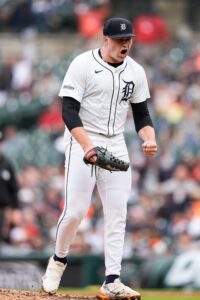
Photo courtesy of Kevin Sousa, Imagn Images

Source: https://www.mlbtraderumors.com/2026/01/tigers-to-sign-phil-bickford-to-minor-league-deal.html
 
Tigers, Corey Julks Agree To Minor League Deal

The Tigers have agreed to a minor league contract with free agent outfielder Corey Julks, per the team’s transaction log at MLB.com. He’ll presumably be in big league camp as a non-roster player.

Julks, 30 next month, has seen big league time in three consecutive seasons — albeit just 13 plate appearances with the White Sox this past season. He’s played roughly the equivalent of one full major league season, appearing in 165 games and tallying 565 plate appearances as a big leaguer. In that time, he’s slashed .234/.288/.337 with nine homers, 23 doubles, 20 steals (in 25 tries), a 7% walk rate and a 24.4% strikeout rate. Julks became a free agent after the White Sox passed him through outright waivers following the 2025 season.

It’s middling big league production, but Julks has a long history of producing at the Triple-A level, where he’s spent parts of four seasons and slashed .279/.365/.486. Julks belted 31 homers and swiped 22 bags with the Astros’ Triple-A affiliate back in 2022, and by measure of wRC+, he’s been at least 18% better than average at the plate in all four of his Triple-A campaigns.

Julks doesn’t have a significant platoon split in his fairly limited MLB time — he’s been below average against both lefties and righties — but he’s a right-handed bat who’s pummeled lefties in recent minor league seasons. He slashed .301/.377/.484 against southpaws this past season and hit them at a .297/.381/.424 clip the year prior.

Defensively, Julks has experience at all three outfield spots but has primarily played the corners. He was credited with above-average sprint speed and arm strength in 2023-24 but below-average range in the outfield. He’s also played 415 innings at third base and another 28 at second base in the minors, but he’s primarily a corner outfielder who at best can make an emergency cameo at another spot on the diamond.

Source: https://www.mlbtraderumors.com/2026/01/tigers-sign-corey-julks-outfielder.html
 
Tigers Have Shown Interest In Nick Martinez, Jose Quintana

The Tigers remain interested in adding a starting pitcher this offseason, writes Jon Heyman of The New York Post. Detroit was tied to Chris Bassitt and Lucas Giolito a few weeks back. While both pitchers remain available, the Tigers have also expressed interest in Nick Martinez and Jose Quintana, reports Evan Petzold of The Detroit Free-Press.

It seems they’re casting a wide net but clearly looking to add a mid-tier starter. They’ve made one rotation pickup this offseason, signing KBO returnee Drew Anderson to a $7MM deal. They also got Jack Flaherty back on a $20MM player option. They’re each penciled into the rotation behind Tarik Skubal, Reese Olson and Casey Mize. Anderson’s hold on a rotation spot seems less secure, as Troy Melton or Keider Montero could push him for that job in camp. Jackson Jobe could return from Tommy John surgery in the second half.

It’s a relatively thin group after MLB’s best pitcher. Olson missed most of the second half with a shoulder injury. Mize had an All-Star first half but was up-and-down later in the season. While Flaherty’s strikeout and walk profile remained strong, he’s coming off his second upper-4.00s ERA in three seasons. Anderson has started two MLB games and hasn’t pitched in the majors in five years. Melton has mid-rotation upside but worked mostly out of the bullpen as a rookie.

They’d be in better position if they add a low-variance veteran arm whom they can trust to provide league average innings. Bassitt and Giolito are at the higher end of that tier and would be locked into rotation spots. Martinez and Quintana could pitch at the back of the rotation or work out of the bullpen in a multi-inning role.

Martinez is especially familiar with the swing role, making him a natural fit for a Detroit team that highly values that kind of flexibility on the pitching staff. The 35-year-old righty has made a career out of seamlessly bouncing between the rotation and bullpen midseason. He worked more frequently in relief with the Padres from 2022-23 but was most often in the Cincinnati rotation over the past two years. Martinez posted a sub-4.00 ERA in each season between 2022-24. That climbed to a more pedestrian 4.45 mark last season, albeit across a career-high 165 2/3 innings.

The veteran righty doesn’t have huge stuff, and his strikeout rate has dropped in three straight seasons. Martinez’s game is built around excellent control and a multi-year track record of avoiding hard contact. He made $21.05MM last season after accepting a qualifying offer from the Reds. He’s certainly not going to match that salary this year but could command an eight-figure deal.

Quintana would be cheaper, as he played last season on a $4.25MM contract with Milwaukee. The 36-year-old southpaw (37 this weekend) took the ball 24 times and logged 131 2/3 innings. He struck out a below-average 16% of opponents but managed a 3.96 ERA — his third straight sub-4.00 showing. Quintana sits around 90 MPH and missed bats on a career-low 6.9% of his offerings last year.

Source: https://www.mlbtraderumors.com/2026...-interest-in-nick-martinez-jose-quintana.html
 
Ah yes, the offseason of minor league deals and "showing interest" in mid-rotation arms continues. Bickford and Julks are fine depth signings - zero risk, potential upside if things break right. That's smart roster management. But JJ hit the nail on the head earlier - if these are the headlines in January, something's off.

The Martinez/Quintana interest is... well, it's something. Martinez at least gives you that swing role flexibility the Tigers love, and he's been consistently solid even if the strikeout numbers are trending the wrong direction. Quintana feels like the definition of "fine I guess" - a 36-year-old soft-tosser who survives on guile and a prayer. Neither of these guys moves the needle much.

What strikes me about this whole situation is the disconnect between having the best pitcher in baseball and building a rotation around him that screams "we're trying to be competitive but not TOO competitive." Olson coming off a shoulder injury, Mize being inconsistent, Flaherty with that shaky ERA, Anderson as a complete unknown, and now potentially adding a 35-37 year old to round things out? That's not a championship rotation behind Skubal - that's a "hope everything goes right" rotation.

The Skubal arbitration gap is still the elephant in the room. $13 million is a statement from both sides. I get why the Tigers don't want to pay ace money for a guy who's walking next winter, but you also can't have it both ways - pinch pennies on your star AND fail to build around him adequately.

At least Jobe coming back in the second half gives them something to dream on.
 
Is Anyone Even Trying To Win The AL Central?

Yet another offseason of hyperaggressive spending and mind-boggling CBT payrolls from the Dodgers and Mets (and, this winter, the Blue Jays) has led to increased talk of competitive balance ahead of the impending conclusion of the 2022-26 collective bargaining agreement. Owners are again expected to push for a salary cap -- though that's a perpetual goal and would absolutely have been the case regardless of how the usual suspects spent in free agency this winter -- and they'll have plenty of fan support in that regard.

Fans, particularly those of small market teams, feel a clear sense of defeatism, knowing their clubs will rarely (or in some cases never) be players for the top names in free agency. The Dodgers were close enough to losing in the World Series that it's not fair to say they can freely buy themselves a championship -- the Mets spent more in 2025 and missed the postseason entirely -- but it's fair to say they're spending enough to give themselves something like a 95% chance of making the postseason and entering as the favorite.

The other side of the cap argument, of course, is that it would assuredly usher in the implementation of a salary floor -- a level at which teams must spend on payroll or else be subject to some degree of penalization. There's already a weak "floor" in place for revenue-sharing clubs, but it seems to lack any semblance of teeth. The A's felt compelled to spend enough to push their CBT payroll up to $105MM last year -- roughly 1.5 times the amount they receive annually from revenue-sharing -- but that was seemingly because they're the only club to have been actually stripped of revenue-sharing status in the past. The Marlins were supposedly in the same boat this winter, and they've thumbed their nose at the idea of spending, as evidenced by a CBT payroll in the $80MM range.

I can see the arguments for a cap/floor system. I'm skeptical that it would actually force the game's lowest-payroll clubs to spend in meaningful ways, but that's another topic -- and one that we'll surely debate ad nauseum in the year to come as CBA talks intensify.

But whether it's a salary floor, firm penalties for not spending revenue-sharing funds in tangible ways, or greater access to draft/international resources for non-playoff clubs who remain competitive, something has to give. Right now, there's at least one entire division content to sit on its hands as the five respective front offices seemingly embody that same level of defeatism felt by their small- and mid-market fan bases.

If the Dodgers are a budding dynasty, it's unequivocally fair to say that's in part because of their limitless spending capacity. But it's also because there are teams seemingly content to throw their hands up and ask, "why even bother?" At a certain point, it becomes a self-fulfilling prophecy -- and I'd argue that at least with regard to the AL Central, we've reached that point. Let's look at each AL Central club's offseason to date.

landing-logo.png

Unlock Subscriber-Exclusive Articles Like This One With a Trade Rumors Front Office Subscription​

BENEFITS
  • Access weekly subscriber-only articles by Tim Dierkes, Steve Adams, and Anthony Franco.
  • Join exclusive weekly live chats with Anthony.
  • Remove ads and support our writers.
  • Access GM-caliber tools like our MLB Contract Tracker

Source: https://www.mlbtraderumors.com/2026/01/is-anyone-even-trying-to-win-the-al-central.html
 
Managers & Top Front Office Executives On Expiring Contracts

In the same way that players feel extra pressure to produce entering their last season before free agency, managers and front office bosses similarly feel the heat when entering the final year of their contracts. The difference is that even if a player has a rough season, they’re usually still in position to land at least a one-year deal in some fashion for the next year — a manager or a GM could find themselves fired in the wake of a bad year, with no guarantee about when (or even if) they’ll get another shot at leading a dugout or a front office.

This list details the baseball operations bosses (whatever their specific title) and managers who are entering the final year of their contracts, as well as the personnel whose contractual situations aren’t publicly known. Some clubs don’t publicize the terms of employee contracts, so it is entirely possible that some of these names signed extensions months ago but the teams have chosen to keep these new deals quiet for the time being. And, of course, the length of a contract doesn’t always correlate to job security. One bad season or even a poor start could suddenly threaten the status of a manager or head of baseball ops that seemingly seems safe right now.

As always, thanks to Cot’s Baseball Contracts for reference information on some of these contracts.

Angels: It’s pretty unusual to see a newly-hired manager already on this list, yet that is the situation Kurt Suzuki finds himself in after signing just a one-year guarantee to become the Halos’ new skipper. The deal has multiple club option years attached, and while one would imagine Suzuki wouldn’t be let go so quickly, the Angels’ manager’s office has been enough of a revolving door in recent years that it is hard to guess what owner Arte Moreno might do next. GM Perry Minasian is also entering the final guaranteed year of his contract, with a club option for the 2027 season. Ten consecutive losing seasons has led to a lot of discord in Anaheim, and an eleventh sub-.500 year might get both Suzuki and Minasian sent packing by next offseason.

Astros: GM Dana Brown and manager Joe Espada are each entering their final season under contract, with Brown hired in January 2023 and Espada in November 2023. Earlier this month, Astros owner Jim Crane didn’t entirely close the door on the possibility of an extension for either Brown or Espada, but said “I think we’ll go through this year like we always do, evaluate it and then make the decision at the end of the year.” Reading between the lines, it certainly seems like the spotlight will be on Brown and Espada, especially since the Astros are coming off their first non-playoff season since 2016. While the team’s laundry list of injuries is a valid excuse for their 2025 letdown, some personnel changes might well be coming if Houston can’t get back into the postseason hunt this year.

Athletics: General manager David Forst’s contract has already expired, as his most recent deal with the team was up following the 2025 campaign. Owner John Fisher has stated that “conversations are ongoing” about another extension, and since it has apparently been business as usual for the A’s this offseason, it seems like it’s just a matter of time before Forst formally extends his long stint in the team’s front office. Forst only officially took over the baseball operations department in the 2022-23 offseason, but he has been with the Athletics since 2000, first working as a scout and then becoming one of Billy Beane’s top lieutenants.

Blue Jays: GM Ross Atkins and manager John Schneider are both entering the final year of their contracts, as the Jays exercised their 2026 club option on Schneider’s deal back in November. This duo was facing heavy pressure heading into the 2025 season, yet Toronto’s AL pennant and near-miss in the World Series has entirely changed the narrative for both Atkins and Schneider. The Blue Jays already extended team president/CEO Mark Shapiro a few weeks ago, and extensions for Atkins and Schneider should follow before Opening Day.

Brewers: Pat Murphy is entering the final season of his three-year contract, but it is hard to believe the Brew Crew won’t have the manager soon locked up on another deal. Murphy has been named NL Manager of the Year in each of the first two seasons, won consecutive NL Central titles, and this October led the Brewers to their first NLCS appearance since 2018. October also saw Matt Arnold receive a promotion from GM to president of baseball operations, even though Arnold has already been the Brewers’ top baseball exec for the last three seasons. Arnold’s specific contract situation hasn’t been made clear for a few years now, but it would surely seem like Milwaukee’s continued success and his new job title probably landed the PBO an extension at some point. Regardless, Arnold seems in no danger of being fired even if 2026 is his last year under contract.

Cardinals: Oli Marmol is headed into his final year, but the manger and the Cardinals have already started discussing an extension to retain Marmol beyond the 2026 campaign. It seems like something should be finalized in due course, with St. Louis continuing to entrust Marmol with the reins as the team now moves into a full-on rebuild phase.

Diamondbacks: Torey Lovullo has quietly become one of baseball’s longer-tenured managers, as Lovullo has been running Arizona’s dugout since the 2016-17 offseason. He has signed multiple extensions (none for more than two guaranteed years) since his initial three-year pact, yet while 2026 represents the final year of Lovullo’s current deal, the Diamondbacks are reportedly going to let Lovullo enter the season without an extension in place. Owner Ken Kendrick did praise Lovullo’s efforts in keeping the D’Backs competitive amidst a swath of pitching injuries and a partial trade deadline selloff in 2025, but it is intriguing that the vote of confidence wasn’t backed up by another contract. This will be a storyline to watch as the Diamondbacks’ season progresses, and a change in the dugout might well be coming if the D’Backs can’t get back into the postseason.

Dodgers: President of baseball operations Andrew Friedman first came to Los Angeles on a five-year, $35MM pact covering the 2015-19 seasons, and he signed an extension back in November 2019. Terms of that deal weren’t known, yet it is clear that if Friedman hasn’t already signed another new deal in the last six years, the Dodgers are almost surely keen in retaining the executive. The Dodgers have reached the playoffs in every single season of Friedman’s tenure, have won three World Series championships under his leadership, and have become baseball’s dominant franchise due to both their record-high payrolls and their ability to draft and develop minor league talent.

Guardians: Chris Antonetti gets an obligatory mention since the Guardians haven’t publicly addressed his contract status since he signed an extension with the team back in 2013. Following the 2015 season, Antonetti was promoted to the president of baseball operations title, and his decade in charge has seen Cleveland make seven postseason appearances. As the Guards are coming off their sixth AL Central crown of Antonetti’s tenure, there is no sense ownership is looking to make a change, nor is there any sense Antonetti (who has turned down overtures from other teams in the past) is looking to leave.

Mariners: Dan Wilson’s contract terms weren’t made public when he was hired as manager in August 2024, and president of baseball operations Jerry Dipoto’s status hasn’t been addressed since he signed a contract extension of an unknown length back in September 2021. It may very well be that Dipoto has quietly signed another deal in the last four-plus years, but regardless, the Mariners’ success in 2025 very likely means neither Dipoto or Wilson are going anywhere, even if the M’s don’t feel the need to publicize any extensions.

Marlins: Previous Miami GM Kim Ng was signed to a three-year contract with a club option for the 2024 season, and the Marlins chose to pass on that option in order to hire Peter Bendix as the new president of baseball operations. Terms of Bendix’s contract weren’t disclosed, so given the length of Ng’s contract, it is possible Bendix could also be entering his final guaranteed year if Miami pursued the same structure with another first-time front office boss. While Ng’s dismissal caught many in baseball by surprise, Bendix’s job appears to be a lot safer, as the Marlins’ surprising surge to 79 wins in 2025 is a promising step forward for the team’s (latest) rebuild.

Mets: Carlos Mendoza is entering the final guaranteed year of his three-year contract, and New York holds a club option on the manager’s services for the 2027 season. The Mets have overhauled both Mendoza’s coaching staff and a good chunk of the roster in the wake of the slow-motion collapse that left the team outside the playoff picture in 2025, so far more is expected than just an 83-79 record this year. The club option probably means that the Mets will wait until after the season (if at all) to discuss an extension, and given the Mets’ high payroll and expectations, even a slow start might put Mendoza’s status in jeopardy.

Orioles: Mike Elias’ contract terms were never publicized when he was hired to lead Baltimore’s front office in November 2018, though he did receive a title change from general manager to president of baseball operations last offseason. Elias’ specific contract status remains unspecified, and it is possible he could be facing more heat if the O’s have another subpar season. Consecutive playoff appearances were followed by the thud of a 75-87 record in 2025, though ownership appears to have given Elias some support in the form of bigger budget, as the Orioles’ busy offseason has been highlighted by the blockbuster Pete Alonso signing.

Padres: Reports in early November suggested that A.J. Preller was close to signing a new extension to remain as San Diego’s PBO, though close to three months later, there hasn’t been any word of a deal between the two sides. It could be that a contract was signed but simply not publicly announced, or perhaps Preller and the team agreed to table the negotiations until after most of the Padres’ offseason business was complete. Considering all the reports of discord within the Padres’ ownership situation and some possible tension between Preller and team CEO Erik Greupner, a contract extension probably shouldn’t be considered a sure thing until a deal is actually done, though things still seem to be leaning in the direction of Preller getting re-upped. For all of the off-the-field drama that has frequently defined Preller’s long tenure in San Diego, the Padres are coming off their fourth playoff appearance in the last six seasons.

Reds: As Cincinnati is coming off its first playoff berth since 2020, president of baseball operations Nick Krall looks to have a decent amount of job security, and might be in line for an extension depending on his current contract status. Krall has been in charge of the Reds’ front office for the last five seasons, and he received an extension of an unspecified length when he was promoted to the president of baseball operations title following the 2023 campaign.

Tigers: Scott Harris has now finished three full seasons as Detroit’s PBO, so if a four-year contract might be considered the usual minimum for a first-time president of baseball ops, 2026 might be Harris’ final year under contract. It’s all speculative, of course, since Harris’ terms weren’t made public, and it might also be a moot point since Harris could be an extension candidate, if anything. The Tigers have made the second round of the playoffs in each of the last two seasons, though the team’s late-season collapse in 2025 and the uncertainty over Tarik Skubal’s future remain areas of concern.

Twins: Derek Falvey’s shocking decision to step down as Minnesota’s president of baseball (and business) operations has unexpectedly made GM Jeremy Zoll the top voice in the team’s front office. Zoll was promoted to the GM role in November 2024 to become Falvey’s chief lieutenant, and the length of Zoll’s contract isn’t known. It is fair to guess that Zoll might’ve gotten an extension after becoming general manager, so he probably remains under team control through at least 2027 even after this sudden elevation to the head of the baseball ops department.

White Sox: Chris Getz has been the team’s GM since August 2023, and his tenure has included a record 121-loss season in 2024 and an improvement to “only” 102 losses in 2025. Getz’s contract term wasn’t publicized at the time of his hiring so this is just a speculative entry in case his first deal was only a three-year pact. There doesn’t appear to be any sense that ownership is displeased with the Pale Hose’s progress during the rebuild, so if Getz actually did sign a three-year deal, the Sox might look to extend him at some point this season.

Yankees: Brian Cashman is the longest-tenured front office boss in baseball, acting as the Yankees’ GM since February 1998. That remarkable 28-year run has included 28 winning records and four World Series titles, though the team hasn’t won the Series since 2009. Owner Hal Steinbrenner appears to trust Cashman as much as ever, so it seems very likely that Cashman’s tenure will stretch into a third decade barring an utter disaster of a 2026 season. Cashman’s last deal covered the 2023-26 seasons, but since the Yankees’ aversion to extensions also extends to personnel as well as players, he might not sign his next contract until after his current deal actually expires. It’s a sign of Cashman’s job security that he has waited until December to sign each of his last two contracts to remain with the club.

Source: https://www.mlbtraderumors.com/2026...ffice-executives-on-expiring-contracts-7.html
 
MLB To Take Over Broadcasts For Six Additional Teams

4:37pm: Tom Friend of Sports Business Journal reports that the Tigers, Angels and Braves are all moving on from Main Street Sports as well. Friend writes that it’s likely that the Detroit and Los Angeles clubs will also turn their broadcasts over to MLB, although they haven’t closed the door on working out some kind of independent streaming deal on a different platform than MLB.tv.

Friend’s reporting is most interesting regarding the Braves. He writes that the team could launch its own network rather than turning distribution to the league. The Rangers went that route when their deal with Diamond collapsed last offseason. The Texas franchise created its own network that negotiated directly with distributors to set up cable, satellite and streaming deals on different platforms.

The Braves haven’t made anything official, though they’ve more or less confirmed they won’t be returning to Main Street. “The Atlanta Braves are aware of the reports regarding Main Street Sports Group,” the team said in a statement. “While disappointed with this development, we have been actively preparing for this outcome and are well on our way towards launching a new era in Braves broadcasting. … We look forward to sharing our path forward in the coming weeks.”

1:10pm: Major League Baseball will take over the broadcasts of six new teams in 2026, reports John Ourand of Puck. The six clubs are the Brewers, Marlins, Rays, Royals, Cardinals and Reds. That represents six of the nine clubs who terminated deals with Main Street Sports last month. That leaves the Braves, Tigers and Angels as the three clubs from that group of nine who still need to formalize broadcast plans for this year.

The company has seemingly been hanging by a thread for a long time. Cord cutting and streaming have been eroding the regional sports network (RSN) model for years. Previously known as Diamond Sports Group and operating under the Bally Sports logo, the company was in bankruptcy for most of 2023 and 2024. When they emerged from bankruptcy late in 2024, they changed the company name and switched to the FanDuel Sports branding. More trouble emerged recently as they reportedly missed payments to several teams, which is what prompted the nine teams to walk away last month.

In recent years, MLB has handled the broadcasts of several other clubs who saw RSN deals collapse. The Padres, Diamondbacks, Rockies, Twins and Guardians were with the league in 2025. In those instances, the league largely kept TV broadcasts the same, retaining most of the personnel. For fans, this arrangement worked better as it did not involve local blackouts. Customers without cable packages could buy streaming packages directly from the league.

For teams, this expanded viewership but the financial situation wasn’t as good. Instead of a guaranteed fee from the RSN, they instead got a fungible amount of money based on streaming numbers. Clear numbers haven’t been made available but the industry consensus is that teams bring in less money via this model than they did via the previous RSN system. Travis Sawchik of MLB.com says the new model only brings in about 50% of the previous RSN set-up.

This often has on-field implications. Some of those teams, particularly the Padres and Twins, saw their player payrolls decrease in recent years. The lower spending capacity seemingly had an impact on Juan Soto being traded from the Padres to the Yankees a couple of years ago and Carlos Correa getting traded from the Twins to the Astros last summer, among other moves.

It was reported in September that ESPN would be acquiring the local rights for those five teams for the next three years. It’s unclear how that will impact local customers who have been paying the league directly to stream games. Also in September, it was reported that the Mariners would also be moving to the league. Last month, the Nationals announced that they would be moving to the MLB model.

Assuming the league will still be selling streaming packages for the five teams it was handling last year, then the league will have at least 13 teams in its portfolio in the coming season. With three clubs still outstanding, it’s possible MLB could get to more than half the league.

Commissioner Rob Manfred has previously spoken of his desire to market a streaming package like MLB.TV but without local blackouts. Controlling the rights for roughly half the league will make that more viable. Expanding the portfolio even further will be challenging. Most of the larger-market clubs still have pretty healthy RSN situations and would have less interest in jumping into a pooled system with these clubs.

That is part of a broader league strategy that will come into play in the next few years. A large number of the league’s broadcast deals expire after 2028. Manfred’s hope is to maintain as much flexibility as possible until then, at which point he could try to sell companies packages of combined rights. As an example of how this might play out, ESPN’s deal recently fell apart but then MLB pivoted to split it up and sell it to various companies. ESPN bought back some bits and acquired some new ones, while Netflix and NBC/Peacock acquired other components.

It will take a few years to see how that all plays out. In the shorter term, it could impact the upcoming collective bargaining agreement negotiations. The current CBA expires December 1st of this year. Presumably, MLB doesn’t want those talks to lead to canceled games in 2027. Ratings and attendance have been up lately, with the faster pace of the pitch clock a possible explanation. Missed games due to a lockout would hurt that momentum, which wouldn’t help the league in selling rights the following year.

For fans of the teams involved in today’s news, new information about broadcast options should be forthcoming. The Cardinals already announced their streaming prices, which are $19.99 monthly or $99.99 for the full season. Barry Jackson of the Miami Herald outlined the situation for Marlins fans today, with some more details still to be determined.

This could also impact player payroll for some clubs. Though the streaming model is a less certain source of revenue, these teams now at least have some clarity on what kind of money should be coming in this year. As of less than two weeks ago, the Reds were reportedly interested in players like Eugenio Suárez but reluctant to make more moves until they figured out the broadcast puzzle. They reportedly reached an agreement with Suárez yesterday.

Photo courtesy of Ron Chenoy, Imagn Images

Source: https://www.mlbtraderumors.com/2026/02/mlb-to-take-over-broadcasts-for-six-additional-teams.html
 
Back
Top