
Red Sox Have Shown Interest In Seranthony Domínguez

The Red Sox are known to be looking for bullpen upgrades. According to Sean McAdam and Chris Cotillo of MassLive, right-hander Seranthony Domínguez is one specific name they have checked in on, though the report suggests nothing is imminent.

Domínguez, 31, has been a leverage reliever in the big leagues for several years now. He has generally done a good job of missing bats and keeping the ball on the ground but has also shown some control problems.

Overall, Domínguez has 306 big league innings on his track record, having allowed 3.50 earned runs per nine. His 10.5% walk rate is a bit worse than par but his 45.1% ground ball rate is a few ticks better than average while his 27.9% strikeout rate is quite strong. He has racked up 40 saves and 78 holds along the way.

2025 was a fairly extreme season for him, a year in which he added a splitter and a curveball to his arsenal. It was split between the Orioles and Blue Jays, as he was amusingly traded in between games of a doubleheader between the two. He was on the Baltimore roster in the first game of the contest and then pitched against them as a Blue Jay in the second game. He finished the year having tossed 62 2/3 innings with a 3.16 ERA. His 13.8% walk rate was the highest of his career but his 30.3% strikeout rate was also better than normal for him.

Despite the lack of control, Domínguez held a key role in the Toronto bullpen through their playoff run, with mixed results. He did post a strong 3.18 ERA over 12 postseason appearances, but he walked 11 opponents and only struck out 10. He seemed to benefit from a .115 batting average on balls in play and 91.5% strand rate in that small sample of work under the bright lights.

For the Red Sox, their bullpen needs aren’t desperate. Their relief group had a collective 3.41 ERA in 2025, second only to the Padres. But even the best teams can find a way to make an addition and bump out their eighth-best arm.

At the beginning of the offseason, MLBTR predicted Domínguez could earn an $18MM deal over two years. The relief market has moved fast, with guys like Edwin Díaz, Devin Williams, Phil Maton, Kyle Finnegan, Emilio Pagán, Raisel Iglesias, Gregory Soto, Ryan Helsley and others off the board. That leaves Robert Suarez, Brad Keller, Pete Fairbanks, Tyler Rogers, Sean Newcomb and Domínguez as some of the better names still out there.

The Red Sox may not have huge payroll flexibility but they also have plenty of other balls in the air. They are looking for big lineup upgrades and may be able to trade controllable starting pitching. It’s also possible they could use their corner outfield surplus on the trade block. If they add a big bat at first base, then maybe Triston Casas is available as well. Amid all of that, adding to the bullpen probably isn’t the biggest priority but they also can’t wait forever with the way the market is moving.

Photo courtesy of Nick Turchiaro, Imagn Images

Source: https://www.mlbtraderumors.com/2025/12/red-sox-have-shown-interest-in-seranthony-dominguez.html
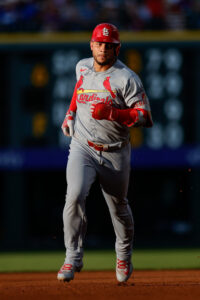
 
Yankees, Astros Among Various Clubs Interested In Freddy Peralta Trade

There hasn’t been much movement at the top of the free agent rotation market. Most of the focus on starting pitching has been on the trade front, though we didn’t see any major deals at the Winter Meetings.

Most of the top trade candidates are questionable to move at all. Brewers star Freddy Peralta is among that group. Milwaukee isn’t motivated to trade the All-Star righty on the heels of a 97-win season, but they’re not going to shut down conversations entirely. They’ve heard from no shortage of teams with interest. Ken Rosenthal and Will Sammon of The Athletic report that the Astros, Giants, Mets, Orioles, Red Sox and Yankees are among the clubs that have reached out about Peralta.

The wide range of suitors is to be expected. Houston, San Francisco, Baltimore and the Mets all have starting pitching at or near the top of the priority list. The Astros are focusing on the trade market as they try to stay below the luxury tax line. The Giants and Mets have ample payroll flexibility but have downplayed their desire to make long-term commitments to a starter. The Orioles are casting a wide net to find an impact arm who can slot in the upper half of the rotation. They’ve been tied to Framber Valdez and Ranger Suárez in free agency, as well as trade possibilities like Edward Cabrera and MacKenzie Gore.

The Yankees will begin the season without Gerrit Cole and Carlos Rodón due to injury. Clarke Schmidt may miss the entire season rehabbing Tommy John surgery. They’re set to open the season with Max Fried and Cam Schlittler in the top two spots. Will Warren and Luis Gil project as the third and fourth arms for now, and they don’t have a fifth starter lined up. Warren had a solid rookie season but struggled with the home run ball. Gil was the Rookie of the Year in 2024. This year, he was limited to 57 innings with mediocre strikeout and walk numbers after missing a few months with a lat strain.

Boston isn’t as clearly in need of starting pitching. They entered the offseason pursuing a #2 starter. They’ve acquired Sonny Gray to fill that role and brought in Johan Oviedo as a back-end option. The focus is on adding a big bat or two, but they’ve been tied to virtually every free agent or trade candidate of significance.

Peralta fits on every contender. He’ll make $8MM in the final season of what turned out to be a dramatically team-friendly extension. He’s coming off a career-low 2.70 ERA and finished fifth in NL Cy Young balloting. This was the third straight season in which he reached 200 strikeouts and started 30+ games. The Brewers fully expect to compete for another division title themselves. They’ve pulled the trigger on trades of stars with dwindling club control windows (e.g. Josh Hader, Corbin Burnes) to remain consistently competitive, though that’s not an absolute. They were happy to hold Willy Adames all the way to free agency.

Adames rejected a qualifying offer and netted a compensatory draft pick when he signed with the Giants. Barring injury, Peralta would be a near lock to do the same if Milwaukee holds him all year. That’d net them a compensatory pick after the first round of the 2027 draft — assuming he signs for at least $50MM. Milwaukee would be entitled to the highest level of compensation as a revenue sharing recipient.

Obviously, the Brewers could extract a far greater return for even one year of Peralta’s services on the trade market. They’re balancing that against the hit it’d deal to the 2026 team. Brandon Woodruff is back to join Quinn Priester, Jacob Misiorowski and Chad Patrick in what would still be a high-upside rotation. Every club would be better with Peralta on it, though.

President of baseball operations Matt Arnold addressed the Peralta rumors shortly before the Winter Meetings. “I’m not sure that there’s a scenario that’s been presented that would make any sense for us,” Arnold said last week (link via Adam McCalvy of MLB.com). “We obviously get hits on him all the time. He’s a very popular target, certainly. But he’s also a huge part of our team and we want to be competitive in 2026. A big part of this is bringing back the core that we had last year.”

Source: https://www.mlbtraderumors.com/2025...ious-clubs-pursuing-freddy-peralta-trade.html
 
2025 Rule 5 Draft Results

The 2025 Rule 5 draft is taking place this afternoon at the Winter Meetings in Orlando. This post will be updated with the results as they come in.

As a refresher, the Rule 5 draft is a way for players potentially talented enough for the big leagues but blocked by their current clubs to find opportunities elsewhere. Any players that were 18 and under at the time of their original signing and went professional in 2021, and any players who turned pro at 19 years of age or older in 2022, are eligible to be selected in the Rule 5 draft if they are not on a 40-man roster.

Though the amateur (Rule 4) draft now has a lottery to determine the selection order, the Rule 5 draft still goes the old-fashioned way of reverse order of standings from the season that just ended. Clubs need to have an open 40-man roster spot in order to make a pick but aren’t obligated to make a selection on their turn. If they do make a pick, they will have to pay $100K to the team they select from. The selected players must stay on the active roster (or injured list) for the entire 2026 season or else be placed on waivers. If they clear waivers, they must be offered back to their original team. They cannot be optioned to the minors.

Players like Anthony Santander and Ryan Pressly have been notable picks in other recent years while guys like George Bell and Roberto Clemente are found deeper in the history books. Last year, 15 players were selected. Only four of those remain with the club who selected them and only three of those have had their rights fully transferred to their new club. The White Sox took Shane Smith from the Brewers. The Marlins took Liam Hicks from the Tigers. Mike Vasil was taken by the Phillies from the Mets but was later traded to the Rays and then went to the White Sox via waivers.

The one other pick from last year’s draft which is still live is Angel Bastardo, who the Blue Jays took from the Red Sox. He was recovering from Tommy John surgery and spent the entire 2025 season on the injured list. He is still on Toronto’s 40-man but they don’t yet have his full rights, as a player needs at least 90 active days to remove the Rule 5 restrictions. If the Jays are willing to roster him for about three months during the 2026 season, they could then gain his full rights and option him to the minors. All other picks were eventually returned to their original organization and/or became free agents.

This year’s picks will be featured below as they come in…

  1. Rockies: RHP RJ Petit (from the Tigers) (Eric Longenhagen of FanGraphs was on this before the official announcement)
  2. White Sox: RHP Jedixson Paez (Red Sox)
  3. Nationals: RHP Griff McGarry (Phillies)
  4. Twins: C Daniel Susac (Athletics) (Susac was then traded to the Giants, per Longenhagen. The Twins will get minor league catcher Miguel Caraballo in return, per Bobby Nightengale of The Minnesota Star Tribune)
  5. Pirates: RHP Carter Baumler (Orioles) (The Pirates then traded Baumler to the Rangers for RHP Jaiker Garcia. Evan Grant of the Dallas Morning News previously suggested Texas would likely get Baumler)
  6. Angels: pass
  7. Orioles: pass
  8. Athletics: RHP Ryan Watson (Giants) (Will be traded to Red Sox, per Chris Cotillo of MassLive. The A’s will get Justin Riemer in return, per Cotillo.)
  9. Braves: pass
  10. Rays: pass
  11. Cardinals: RHP Matt Pushard (Marlins)
  12. Marlins: pass
  13. Diamondbacks: pass
  14. Rangers: pass
  15. Giants: pass
  16. Royals: pass
  17. Reds: pass
  18. Mets: pass
  19. Tigers: pass
  20. Astros: RHP Roddery Muñoz (Reds)
  21. Guardians: RHP Peyton Pallette (White Sox)
  22. Red Sox: pass
  23. Mariners: pass
  24. Padres: pass
  25. Cubs: pass
  26. Dodgers: pass
  27. Blue Jays: RHP Spencer Miles (Giants)
  28. Yankees: RHP Cade Winquest (Cardinals)
  29. Phillies: RHP Zach McCambley (Marlins)
  30. Brewers: pass

Second round (all others passed)


Photo courtesy of Mike Watters, Imagn Images

Source: https://www.mlbtraderumors.com/2025/12/2025-rule-5-draft-results.html
 
Red Sox Interested In Kyle Teel

Carlos Narvaez had a solid rookie season and emerged as Boston’s top option behind the plate in 2025. However, the Red Sox have been linked to J.T. Realmuto’s market, so there is some indication that the Sox aren’t entirely set at the catching position. Along those same lines, MassLive.com’s Sean McAdam reports that the club has shown some interest in reuniting with ex-Boston prospect Kyle Teel, though “nothing is close now” between the Red Sox and White Sox. McAdam adds that the BoSox had talks with the ChiSox about Teel both this offseason and last summer.

It was almost exactly a year ago to the day that Boston included Teel as part of a four-prospect package in the blockbuster trade that brought Garrett Crochet to Fenway Park. A consensus top-60 prospect heading into the 2025 season, Teel made his Major League debut this year and had a strong initial showing, hitting .273/.375/.411 with eight home runs over his first 297 plate appearances in the Show.

Normally there wouldn’t be even a slight chance that the White Sox would consider flipping such a potential building block, except Edgar Quero is also on the roster as another possible “catcher of the future.” This has led to teams inquiring on both Teel and Quero’s availability, just in case the South Siders were willing to deal from this on-paper surplus, or had already decided on which of Teel or Quero was their preferred choice going forward.

McAdam writes that “the White Sox are seen as more likely to deal Quero than Teel.” This could be due to Quero’s shaky defense, as many scouts feel Quero won’t be able to stick at catcher while Teel’s glovework is seen as at least average. Of course, there is no rush for Chicago to move either Quero or Teel any time soon, with both players so early in their development as big leaguers.

Re-acquiring Teel would be a somewhat unusual move on Boston’s part, and might indicate some trader’s remorse. Obviously the Red Sox weren’t going to land Crochet without including at least one blue-chip prospect, and Teel ended up being the odd man out of the group known as Boston’s “big four” prospects at the time (Teel, Roman Anthony, Kristian Campbell, and Marcelo Mayer). In a sign of how quickly things can change on the catching front, at this time last year the Red Sox thought they had Connor Wong lined up as a reliable everyday catcher, yet the 2025 season saw Wong struggle badly and Narvaez step up as a starter.

The Red Sox have enough young pitching depth that they could potentially drum up an offer intriguing enough to get the White Sox to move Teel, even if that scenario is certainly on the unlikely side. Many expect Realmuto to ultimately re-sign with the Phillies, which could leave Boston looking for more catching help. Narvaez’s health is a slight question mark since he underwent a minor knee surgery following the season, but he is expected to be set for the start of Spring Training.

Source: https://www.mlbtraderumors.com/2025/12/red-sox-interested-in-kyle-teel.html
 
Red Sox Showing Interest In Willson Contreras

After missing out on both Pete Alonso and Kyle Schwarber, the Red Sox continue to pursue upgrades for their lineup. One target they’re recently looked into, according to MassLive.com’s Chris Cotillo, is Cardinals first baseman Willson Contreras.

Of course, the Red Sox and Cardinals already completed one trade sending a notable veteran to Boston; right-hander Sonny Gray was traded to the Sox in exchange for righty Richard Fitts and minor league lefty Brandon Clarke earlier in the offseason. (The Cardinals included $20MM in cash to help facilitate the swap.) Like Gray, Contreras is a veteran on a pricey contract with a full no-trade clause who St. Louis would like to move in order to clear payroll and create opportunities for younger players.

However, while Gray was very clear about his willingness to waive his no-trade clause this winter, Contreras has been more on the fence. The catcher-turned-first-baseman said at season’s end that he would consider certain scenarios but preferred to remain in St. Louis. Contreras has reportedly warmed a bit to the idea of approving a trade as the offseason has progressed, but he’s still going to be particular about his potential destination. It’s not yet clear to which teams Contreras would be willing to approve a trade, but he’d presumably prefer a contender. Boston clearly checks that box.

The fit in Boston is a natural one. First base was a question mark throughout the 2025 season. Young slugger Triston Casas struggled through a cold spell for the first three weeks and then suffered a season-ending knee injury just as he was beginning to show signs of emerging from that slump. Boston turned to Romy Gonzalez, Abraham Toro and eventual free agent pickup Nathaniel Lowe for much of the season. Gonzalez thrived against left-handed pitching but was below-average against righties, as is typical for him. Toro struggled and was eventually outrighted off the roster. Lowe performed decently down the stretch but was non-tendered due to a hefty arbitration price and a poor four months to begin the season.

Acquiring Contreras, who’s batted .256/.356/.461 (130 wRC+) across the past four seasons, would add an everyday option to the lineup and allow Gonzalez to be deployed in more of a utility role. Though he’s new to first base, Contreras made a smooth transition to the position in 2025. The longtime catcher had a poor defensive reputation behind the dish but turned in solid marks for his glovework at his new defensive home. Statcast’s Outs Above Average metric pegged him as a positive defender (+6), and Defensive Runs Saved had him as a nearly average defender (-1). Those numbers could feasibly improve a bit as he takes even more reps at the position.

Contreras is earning $36.5MM over the next two seasons and has a $5MM buyout on a $17.5MM club option for the 2028 season. That remaining $41.5MM in guaranteed money is roughly in line with market value — at least in terms of average annual value — for a first baseman who’ll turn 34 next May. Christian Walker landed a three-year, $60MM contract covering his age-34 through age-36 seasons just last winter, for instance.

For the Red Sox, the $20.75MM in remaining AAV would put them over the luxury tax threshold, though given their pursuit of so many notable free agents and trade targets, that doesn’t seem like it’ll be a big impediment this time around. If the Sox don’t want to go too far beyond the tax line, the Cardinals’ inclusion of $20MM in the Gray trade shows a clear willingness to pay down salary in exchange for a better return. Those prior talks surely gave both parties an idea of which remaining players in Boston’s system would be of interest. And while it may not be a deciding factor in Contreras’ decision, the familiarity of having former teammates like Gray and Aroldis Chapman already on the roster could be somewhat of a perk.

Source: https://www.mlbtraderumors.com/2025/12/red-sox-trade-rumors-willson-contreras-cardinals.html
 
Rangers Have Not Had Substantial Trade Talks Regarding Corey Seager

The Rangers, as they look to address several areas of need on the roster while simultaneously scaling back payroll, have received numerous calls on star shortstop Corey Seager. However, while Evan Grant of the Dallas Morning News lists the Red Sox (as was reported last night), Yankees and Braves as teams that have inquired, he adds that the Rangers are not at all motivated to move Seager and haven’t had any meaningful trade talks regarding the five-time All-Star.

On the surface, it sounds like a fairly similar situation to that of Ketel Marte in Arizona. Seager, like Marte, is an MVP-caliber talent on a weighty long-term contract whose current club is hoping to walk the line of simultaneously addressing multiple roster needs and scaling back the payroll. The Rangers aren’t expressly turning teams away but also aren’t shopping Seager and would surely need multiple controllable young big leaguers who could help immediately if they were to even entertain the idea of a trade.

Seager, 32 in April, was limited to 102 games last season thanks to multiple hamstring strains but continued to produce at an elite level when on the field. He hit .271/.373/.487 last season and touts a huge .294/.372/.544 batting line in his past 1514 plate appearances as a Ranger. That’s 52% better than league-average production after weighting for his home park, by measure of wRC+. Seager also walked at a career-best 13% clip in 2025 and notched the second- or third-best marks of his career in average exit velocity (92.9 mph), barrel rate (15.3%) and hard-hit rate (53.6%). He also posted a career-high 16 Defensive Runs Saved, while Statcast’s Outs Above Average credited him as a positive defender (+4) for the third time in the past four seasons.

The Rangers signed Seager to a 10-year, $325MM contract prior to the 2022 season. He’s lived up to that massive payday thus far but is still owed $186MM over the next six seasons (paid out evenly at $31MM per year). Adding that type of commitment would send the Yankees careening into the top tier of luxury penalization for a third straight season. They’re currently just shy of the third-tier cutoff ($284MM), per RosterResource. As soon as they cross that line, they’ll be subject to a 95% tax on subsequent additions and will see their top pick in next year’s draft dropped by 10 places. Effectively, Seager could cost them double the remaining commitment on his contract.

It’s not quite so extreme in Boston, where the Red Sox are about $20MM shy of the first luxury tier. Seager would push them into the first tier for a second straight season. They’d owe a 30% tax on the roughly $11MM of Seager’s contract that clocks in beyond that first penalty line. Once they’re more than $20MM over the limit, that’d jump to 42%. Crossing the threshold by more than $40MM would push the Red Sox’ top draft pick back 10 spots and bump the tax on subsequent additions to 72.5%.

The Braves are currently the furthest of this group from the luxury tax threshold, sitting about $33MM shy on RosterResource’s projections. They could technically add Seager without hitting the tax line, though acquiring him would effectively signal a willingness to pay the tax, as they’d be about $2MM away from the first-tier cutoff and have several other acquisitions they’d like to make. However, Ken Rosenthal of The Athletic reported last month that Atlanta is one of eight teams on Seager’s limited no-trade list. That only further reduces the likelihood of a deal. Seager will gain full no-trade protection after the 2026 season, by virtue of 10-and-5 rights.

It’s still not entirely clear what type of payroll figure Rangers ownership has in mind. Texas currently projects for a payroll around $169MM, which is about $47MM shy of last year’s Opening Day mark. They’re looking for help behind the plate, at first base and on the pitching staff. That’s a lot of boxes to check, clearly, but there should be at least some room for modest spending. There are also various trade avenues to explore that don’t involve shipping out their best all-around position player (or one of their best but expensive arms like Jacob deGrom or Nathan Eovaldi, for that matter).

It’s of at least moderate note that Texas didn’t outright dismiss the possibility of trading Seager, but it’s more notable that they’re not digging deeply into the possibility. If one of the interested parties presents a compelling enough offer, perhaps the Rangers would ponder such a switch, but this appears to be a very different scenario than, say, the Cardinals — a rebuilding club with motivation to shed several veteran contracts and a willingness to pay down some of that salary. Seager’s name may well continue to surface in rumors, just as we’ve seen with Marte in Arizona or Tarik Skubal in Detroit, but that doesn’t mean he’s all that available or that the Rangers are eager to deal him.

Source: https://www.mlbtraderumors.com/2025/12/corey-seager-trade-rumors-yankees-red-sox-braves-rangers.html
 
Royals Exploring CJ Abrams, MacKenzie Gore, Jarren Duran In Trade Talks

The Royals have had discussions with the Nationals about shortstop CJ Abrams and left-hander MacKenzie Gore, ESPN’s Jeff Passan reports. Jarren Duran also continues to be a player of interest, as Passan writes that Kansas City is still considering the Red Sox outfielder after first being linked to Duran’s market prior to last summer’s trade deadline.

It is no secret that the Royals are looking to improve what has been arguably baseball’s least-productive outfield over the last couple of years. Between Boston’s crowded outfield and Kansas City’s numerous rotation options, the two teams seem like natural and logical trade partners, especially given how the Red Sox have continued to pursue starting pitching even after landing both Sonny Gray and Johan Oviedo. Likewise, the Royals have added Lane Thomas to their outfield mix, yet an everyday starter like Duran would be a much more clearcut upgrade.

Acquiring Gore would represent a fascinating pivot for K.C., and perhaps a step in a somewhat more convoluted path to obtaining outfielders. Gore would only add to the Royals’ rotation surplus, yet with Gore now in the mix as a front-of-the-rotation arm, Kansas City could be more open to sending a pitcher like Cole Ragans to the Red Sox in a hypothetical Duran deal. Ragans has been cited as perhaps the most logical fit for Duran, as Michael Wacha and Seth Lugo both recently signed extensions with the Royals, Kris Bubic is only a year removed from free agency, and the Royals’ array of younger arms might not quite move the needle enough to pry Duran (who is team-controlled through the 2028 season) out of Fenway Park.

Perhaps complicating this idea is the fact that the Red Sox almost surely have interest in Gore themselves. While the Sox haven’t been publicly linked to Gore’s market to date, their desire for frontline pitching and the fact that former Sox executive Paul Toboni is now Washington’s president of baseball operations makes it easy to connect the dots. The Nationals have gotten so much interest in Gore that Toboni undoubtedly has plenty of creative offers to consider, and there still isn’t any direct urgency to deal Gore since he is under arbitration control through 2027.

Toboni’s hiring represented a fresh start for a rebuild that seemed to have stalled out under former Nationals PBO Mike Rizzo. Washington hasn’t had a winning season since its 2019 World Series title year, yet even with impatience growing amongst District fans, the sense is that Toboni is more focused on adding more young talent than trying to contend. That could mean dealing away such top players (and trade chips) like Gore and Abrams, who were supposed to be cornerstones of the rebuild process when acquired in the 2022 Juan Soto trade.

Abrams is controlled through the 2028 season, so the Nationals have even less reason to trade the shortstop immediately than Gore. The Royals’ younger pitchers or more longer-term minor league prospects would likely have more appeal to the Nats than to a win-now team like the Red Sox, but Kansas City would have to pay a hefty price to extra Abrams given his team control and All-Star ceiling.

With that ceiling, however, comes a low floor. The last two seasons have seen Abrams excel in the first half only to tail off badly after the All-Star break. The lack of consistency also extends to Abrams’ splits, as the left-handed batter hasn’t been very productive against left-handed pitching. Defensively, Abrams is a mixed bag at best — the Outs Above Average metric has long hated his work at shortstop, while the Defensive Runs Saved metric has been more positive in general but graded Abrams as a -6 in 2025.

A move to second base might be in Abrams’ future anyway, and that would work for a Royals team that already has Bobby Witt Jr. entrenched at shortstop. Jonathan India is the incumbent at second base after K.C. agreed to a one-year, $8MM salary with India for 2026, which came as something of a surprise since India’s unimpressive 2025 season had made him a non-tender candidate. In the event that Abrams did land in Kansas City, the Royals could look to trade India or just relegate him to bench duty, as inefficient as that would be for a team with a limited payroll.

Source: https://www.mlbtraderumors.com/2025...ckenzie-gore-jarren-duran-in-trade-talks.html
 
Chris Martin Planning To Pitch In 2026

In September 2024, Chris Martin said that he was “95%” sure that 2025 would be his final season before retirement. It appears as that five percent chance of a return has now grown into a reality, as MassLive.com’s Chris Cotillo reports that Martin is planning to return in 2026 for his 11th MLB season. The Red Sox have interest in Martin for what would be a return engagement between the two sides, as Martin pitched for Boston during the 2023-24 seasons.

Martin spent the 2025 season with the Rangers on a one-year, $5.5MM deal, and the fact that the Arlington native turned down larger offers from the Red Sox and other teams to join the Rangers only added to the narrative of what seemed to be a farewell season. The right-hander delivered yet another strong season, posting a 2.98 ERA, 24.7% strikeout rate, and an elite 4.6% walk rate over 42 1/3 innings out of the Texas bullpen.

For the second straight season, Martin made multiple trips to the injured list. The righty missed time due to right shoulder fatigue, a left calf strain, and (most troublingly) thoracic outlet syndrome, with the TOS diagnosis emerging in September. Since the assumption was that Martin was retiring, there wasn’t any word on whether or not Martin underwent TOS surgery, but it would appear he is foregoing the procedure or his diagnosis wasn’t serious enough to require surgery.

Between the TOS situation, Martin’s other recent injuries, or the simple fact that he turns 40 in June, there is certainly some question about whether Martin can continue to defy Father Time. That said, Martin is still one of baseball’s best control pitchers and he is still getting strong results, so it makes sense that he would still want to keep playing as long as he still has gas in the tank.

Since he pitched for the Red Sox so recently, Boston has plenty of direct knowledge of Martin’s health, and the team is therefore ideally suited to perhaps manage Martin’s usage in order to keep him as healthy as possible in 2026. A one-year deal for Martin on a modest salary wouldn’t represent much of a risk for the Red Sox, and the upside is high if Martin can stay off the IL and keep posting his usual numbers. The Sox are known to be looking for experienced bullpen help, and Cotillo reported yesterday that other former Boston hurler Justin Wilson is another reunion candidate, plus left-hander Danny Coulombe drawing interest.

Source: https://www.mlbtraderumors.com/2025/12/chris-martin-planning-to-pitch-in-2026.html
 
Latest On Michael King’s Free Agency

1:35pm: The Boston Globe’s initial report has been clarified to note that, while the Red Sox, Yankees, and Orioles are among the teams King is considering, there are no finalists for his services at this point.

1:11pm: Right-hander Michael King has narrowed his search for a new team to three options, according to a report from Peter Abraham of the Boston Globe. Those teams are the Red Sox, Yankees, and Orioles. Additionally, Chris Cotillo of MassLive reports that the Rhode Island native and Boston College alum has “strong interest” in playing for Boston. Abraham notes that King would like to make a decision on his destination soon.

King, 30 has been among the league’s most widely sought-after starters this winter. He’s been connected to the Mets, Cubs, Tigers, Marlins, Angels, and Blue Jays in addition to the three apparent finalists for his services, and it’s not hard to see why the right-hander would garner such widespread interest. The 30-year-old flashed significant upside during his 2024 season with the Padres, when he pitched to a 2.95 ERA in 173 2/3 innings of work with a 3.33 FIP and a 27.7% strikeout rate. That was a strong enough performance to earn him a seventh-place finish in NL Cy Young award voting that year, which was his first as a full-time starter.

The right-hander seemingly appeared to be lined up for a massive payday heading into his platform season of 2025, but injuries complicated things this past year. King was limited to just 15 starts by a nerve issue in his shoulder (as well as a less significant knee injury late in the year), and while he dominated to the tune of a 2.59 ERA, 3.26 FIP, and a 28.4% strikeout rate in ten appearances prior to the shoulder injury, he didn’t look quite the same after returning with a 6.11 ERA and a 14.5% strikeout rate a 10.8% walk rate across his final five appearances in the regular season.

King moved to the bullpen for San Diego’s Wild Card series against the Cubs and looked more like himself as he struck out the side on 19 pitches in a scoreless inning of work, but headed into the offseason his second half struggles and significant injury woes left cause for concern as he entered free agency. He received a qualifying offer from the Padres, a positive sign that the club didn’t see King’s injuries as too concerning for the 2026 campaign, and declined it in order to pursue a multi-year pact in free agency.

Looking at the three teams still in the running for King’s services, the Orioles stand out as the team with the biggest need in their rotation. The club is coming off a deeply disappointing 2025 campaign where their decision to eschew high-end arms in free agency came back to bite them, as rolls of the dice on Charlie Morton and Tomoyuki Sugano failed to bear fruit while Zach Eflin took a big step back from his previous work with the Rays. While Kyle Bradish and Trevor Rogers could plausibly form an exciting front-of-the-rotation duo for the Orioles next year, adding at least one proven, playoff-caliber starter to the mix has been the team’s clear priority this winter.

King would certainly fit that mold if healthy, and likely could do so without breaking the bank and requiring Baltimore to commit to a second nine-figure contract this winter after they signed Pete Alonso last week. MLBTR predicted King to land a four-year, $80MM contract as the #14 ranked free agent in this offseason. Of course, with top-of-the-rotation upside and an expected contract price tag and length that falls below that of your typical front-end starter, there’s plenty of room for a more opportunistic team to get involved.

That’s likely where the Red Sox come in, given that Boston is incredibly deep in pitching talent as it is. Garrett Crochet leads a rotation that figures to also include Sonny Gray and Brayan Bello at the front end, with players like Johan Oviedo, Patrick Sandoval, and Connelly Early in the mix for the final spots as things stand. Kutter Crawford, Payton Tolle, Kyle Harrison, and Hunter Dobbins are among the pitchers who figure to serve as depth for the Red Sox this year, an embarrassment of riches that make adding a starter in free agency more of a luxury than a necessity.

Even so, landing King on a deal that the Red Sox perceive as good value would still make sense, as it could free them up to more fully explore trades involving some of their young pitching talent. Boston has already been connected to Ketel Marte, Willson Contreras, and Isaac Paredes on the free agent market as they search for help on offense this winter, and perhaps signing King and trading from their pitching depth to land one of those big names could be more attractive as an option than taking a swing on one of the big bats still available in free agency.

As for the Yankees, a reunion with the team King spent the first five years of his MLB career with splits the difference between the extremes Baltimore and Boston represent. New York isn’t in desperate need of a front-of-the-rotation ace with Max Fried already in place and Gerrit Cole expected back from Tommy John surgery at some point next year, but their rotation could certainly use additional depth. Cole and Carlos Rodon are both not expected to be ready for the start of the 2026 campaign, while Clarke Schmidt figures to miss most if not all of next year.

That leaves the Yankees with an Opening Day rotation of Fried, Cam Schlittler, Luis Gil, Will Warren, and Allan Winans. Given Winans’s lack of MLB experience and Gil’s significant injury history, there’s certainly room for another quality starter in the Yankees’ rotation mix even if they don’t necessarily need one with the same level of upside that King offers. Even so, King was a popular player during his time with the Bronx and well-liked within the organization. Between the potential value to be had on King’s contract and his past connection to the club, it’s hardly a surprise that New York would get involved in his market as they survey the offseason landscape for rotation help.

Source: https://www.mlbtraderumors.com/2025/12/red-sox-yankees-orioles-finalists-for-michael-king.html
 
Latest On Evan Phillips

The Dodgers non-tendered former closer Evan Phillips in November, as the right-hander is recovering from Tommy John surgery and was heading into his final season of club control. Phillips’ projected $6.1MM salary would’ve cost the Dodgers more than double due to taxes, and given that he underwent surgery in early June, there’s no guarantee he’ll be back on a mound this season at all.

On the surface, Phillips makes for an interesting free agent target for clubs looking at bullpen help both in 2026 and in 2027. It’s become increasingly common for pitchers rehabbing from UCL surgeries to sign two-year deals, with the first year ticketed largely for rehab and the second intended to be a full season on the mound. Phillips, however, prefers to sign a straight one-year deal and return to the market next offseason, reports Tim Healey of the Boston Globe. Phillips isn’t planning to sign until at least January, when he’s cleared to resume throwing, and may delay signing until July, when he’s effectively game-ready.

The Red Sox are among the teams that have expressed interest in Phillips, per Healey, though they’re surely just one of many. Phillips’ one-year target and pre-injury track record make him a plausible fit for nearly any team. He’s not going to be prohibitively expensive for most clubs, and the 31-year-old righty has been terrific in four-plus seasons with Los Angeles.

Originally landing with the Dodgers by way of a waiver claim from the Rays, Phillips pitched decently in the final few weeks of the 2021 season. However, it was the 2022 season that saw the right-hander truly break out. In 63 innings that season, he turned in a superhuman 1.14 ERA with a 33% strikeout rate and 6.4% walk rate.

Dating back to that 2022 breakout, Phillips has pitched 184 2/3 innings with a 2.14 earned run average, a 29.6% strikeout rate, a 6.6% walk rate, a 43.3% ground-ball rate, 45 saves and 36 holds. He’s allowed an average of just 0.68 homers per nine innings pitched while sitting better than 96 mph with his four-seamer, just under 95.8 mph with his sinker, 93.1 mph with his cutter and 85.1 mph with his slider.

There are advantages both to waiting into late in the offseason and waiting until midseason to sign. If Phillips waits until January or later, he’ll be able to more tangibly show the progress he’s made in his surgery rehab. Scouts won’t be getting a glimpse of him at 100%, of course, but it’ll show he’s well into the rehab process and give them some empirical data to compare to other pitchers when they were at the same point in their own rehab process. That could improve his earning power. Waiting until spring training could create some new suitors and/or new urgency among interested teams, too, as it’s inevitable that a handful of relievers around the game will go down with injuries this spring (as is the case every spring).

Waiting until midseason would mean going through the first several months of the year rehabbing on his own rather than with a team, but Phillips could more accurately see which clubs are postseason contenders. It’d also rule out any possibility of a qualifying offer — however slight it would be. (Had Phillips not been injured and continued on his prior trajectory, he’d have been a QO candidate; obviously, doing that over 20-30 innings post-surgery would make the chances of receiving one far smaller.) That wouldn’t be an option if he signs a one-year deal in late June or early July, as players need to spend the whole season on a major league roster/injured list in order to receive a QO.

It’s fairly rare for a reliever to receive a QO but it does happen. As shown on MLBTR’s Contract Tracker, in the past five years, three relievers have received and rejected QOs. They are Raisel Iglesias, Josh Hader and Edwin Díaz, who were all top closers when those deals were signed.

Phillips was arguably near that tier not too long ago but he would have to really dominate late in 2026 for a QO to become a real consideration after an extended surgery layoff. Still, from his perspective, he might prefer to wait to sign until the season has begun. Since he’s going to be missing the first half of the season regardless, he might as well close off the chance of a QO, even if it’s already a small one. A QO has a negative impact on a free agent’s earning power, so it’s always preferable to avoid it, if possible.

The midseason signing path would also give him more time to get fully healthy. As the season rolls along, it would also create a clearer picture of which teams need him the most due to injuries, competitiveness, and so on.

Last winter, David Robertson was a free agent but was reportedly looking for a deal with an average annual value of $10MM. When he didn’t find what he was looking for, he decided not to sign until the Phillies inked him in July, barely a week before the trade deadline. That was technically a prorated $16MM deal. Robertson only received about $6MM of that but that got him pretty close to his asking price for just a few months of work and he got to pick a club clearly in contention after the All-Star break.

That situation wasn’t exactly the same since Robertson was healthy whereas Phillips is not. However, it’s possible it plays out in a somewhat similar fashion. If Phillips doesn’t find offers to his liking in the coming months, he could just keep building strength. Presumably, interest from clubs would ramp up in kind. On the other hand, all this is contingent on Phillips avoiding setbacks. If he receives a somewhat fair offer in the coming months, he’ll have to weigh the pros and cons of turning it down to potentially try for more in the summer.

Photo courtesy of Jerome Miron, Imagn Images

Source: https://www.mlbtraderumors.com/2025/12/evan-phillips-rumors-sign-january-july-red-sox.html
 
Royals Continuing To Explore Outfield Market

The Royals entered the offseason in pursuit of two outfielders — ideally adding one apiece via free agency and trade. They accomplished that last week, signing Lane Thomas to a $5.25MM deal and bringing in Isaac Collins in a trade with Milwaukee.

Collins played mostly left field for the Brewers. He’s loosely penciled in there for now, while Thomas provides a right-handed hitting complement to Kyle Isbel and Jac Caglianone in center and right field, respectively. It’s better than it was at season’s end but still not a great group on paper. Thomas is coming off an injury-riddled season. Caglianone struggled mightily in his first 62 MLB games and could benefit from more time at Triple-A. Isbel is a glove-only center fielder, while Collins’ breakout season came as a 27-year-old rookie.

Unsurprisingly, the Royals haven’t closed the door on the possibility of adding another outfielder. Collins has plenty of minor league infield experience — mostly at second with a handful of starts at third base as well. President of baseball operations J.J. Picollo indicated that while the Royals expect him to play mostly outfield, he has enough defensive versatility for the front office to keep their options open (link via Anne Rogers of MLB.com).

The switch-hitting Collins has a very patient approach. Kansas City ranked 22nd in on-base percentage (.309), and only the Rockies had a lower walk rate than their 7.2% clip. Collins provides a different skillet and generally raises the lineup’s floor, but his limited power means he doesn’t have a huge ceiling as an everyday left fielder. The Royals aren’t going to be in the market for a star outfielder in free agency, yet they’re kicking the tires on a more impactful trade possibility.

Ken Rosenthal of The Athletic writes that the Royals could still be a factor for Jarren Duran. Rosenthal suggests that Kansas City has balked at putting star southpaw Cole Ragans in a Duran trade. Whether the Red Sox would insist on Ragans’ inclusion isn’t known, as The Athletic report indicates that Boston executives view the teams’ talks to date as preliminary.

That said, it’s clear the Red Sox are putting a lofty price on their top outfielders. Tim Healey of The Boston Globe writes that chief baseball officer Craig Breslow is telling interested teams that the Sox don’t feel any pressure to trade an outfielder. They’ve taken calls on Duran and Wilyer Abreu at least dating back to the summer. Between Abreu, Duran and Roman Anthony, they have three above-average to star caliber left-handed hitting outfielders. (Anthony signed an eight-year extension in August and certainly isn’t getting traded.) Ceddanne Rafaela hits from the right side and has the ability to play the infield, but much of his value comes from his elite center field defense.

Keeping all four players limits the Sox’s flexibility a bit. They can find at-bats for them all by rotating them through the designated hitter role and getting Rafaela occasional infield work. Boston has considered swapping one of Duran or Abreu for controllable starting pitching, though they’re less motivated to do so after acquiring Sonny Gray.

The Royals have been on the opposite end. Picollo said a few weeks ago that they were open to trading a starter for outfield help. He essentially took Ragans out of that mix, though. The 28-year-old lefty finished fourth in AL Cy Young voting two seasons ago. He missed a good chunk of ’25 battling a rotator cuff strain. He’s signed for a combined $12MM over the next two years and will be eligible for arbitration in 2028. He’s a potential ace whom the Royals control for three seasons at what’d likely be no more than $25MM in total.

“We’re in a really good spot (with rotation depth), so if the right trade comes along, and it costs us a starting pitcher, we have to look at it,” Picollo told Rogers at the Winter Meetings. “It’s just not going to be Cole. … We have to ask ourselves: Is this his max value right now? Probably not. If Cole pitches like he did in ‘24, who knows what his value is going to be? We just think right now, three years of control on a really good starting pitcher, it would have to be something crazy, something that’s like, ‘How can we pass this up?'”

Kansas City has gotten hits on controllable arms like Noah Cameron, Ryan Bergert and Stephen Kolek. Lefty Kris Bubic might be their likeliest rotation trade candidate, but he suffered a season-ending rotator cuff injury in July and is headed into his final arbitration year. No one from that group is valuable enough to headline a trade for Duran, who is coming off his third straight well above-average season. Duran is set for a $7.7MM salary and is under arbitration control through 2028.

Even if the sides can’t line up value on Duran, the Royals will evaluate other outfield possibilities. They’re also known to be searching for left-handed relief. That was more of a luxury buy around the Winter Meetings but takes on added importance after they traded Angel Zerpa to the Brewers for Collins and righty reliever Nick Mears.

Kansas City is down to Daniel Lynch IV and swingman Bailey Falter as lefty relievers on the 40-man roster. Lynch managed a 3.06 earned run average over 67 2/3 innings but did so with a well below-average 15.6% strikeout rate. There are a few one-year deal candidates available in free agency (e.g. Drew Pomeranz, Caleb Thielbar, Caleb Ferguson, Danny Coulombe). They could also explore the trade market, with St. Louis’ JoJo Romero known to be available as he enters his final year of arbitration.

Source: https://www.mlbtraderumors.com/2025/12/royals-continuing-to-explore-outfield-market.html
 
Red Sox Checked In On Corey Seager

The Red Sox have had talks with the Rangers about a Corey Seager deal, reports Tim Healey and Alex Speier of the Boston Globe. Seager joins a growing list of Boston trade targets that includes Ketel Marte, Isaac Paredes, and Brendan Donovan. The club has also been connected to free agentsBo Bichette, Pete Alonso, and Eugenio Suarez. WEEI’s Rob Bradford reports there isn’t any momentum regarding Boston’s pursuit of Seager.

While the club has been connected to several players in the trade market, chief baseball officer Craig Breslow admitted some discussions have been slow to progress. “In a lot of the conversations that we’ve had, a number of teams have conveyed that they’re very comfortable holding onto their players, as are we,” Breslow said. “So that does add a little bit of a layer of difficulty to try to make these things work.”

Seager delivered a typical season in 2025, providing stellar offensive production in between IL stints. The 31-year-old notched a 138 wRC+ across 102 games. Seager fell short of 30 home runs for the first time as a Ranger, largely due to missing time with a hamstring strain (twice) and an appendectomy. His 445 plate appearances were his fewest since his final year with the Dodgers in 2021.

Texas landed Seager on a massive 10-year, $325MM deal ahead of the 2022 season. He’s been an integral part of the lineup over the past four seasons and led the team to a World Series win in 2023. Seager finished second in AL MVP voting that year, but still went home with individual hardware after securing World Series MVP honors.

Seager will make $31MM in each of the next six seasons. There have been whispers that Texas would be trimming payroll this offseason. The team already chose to non-tender Adolis García and Jonah Heim instead of paying their arbitration price tags. The Rangers also traded Marcus Semien, who had three years and $72MM remaining on his contract, but the deal brought back Brandon Nimmo, who is slated to make $101.25MM through the 2030 season. The Mets did toss in $5MM as part of the trade.

Texas could use some help in the rotation and the bullpen. Linking up with Boston in a trade could help cheaply patch those holes. Breslow has said the team is willing to deal controllable starting pitching. Boston bolstered the rotation by adding Sonny Gray and Johan Oviedo via trade. Garrett Crochet and Brayan Bello are locked into rotation spots, which leaves little room for youngsters Payton Tolle, Connelly Early, and Hunter Dobbins. Veterans Patrick Sandoval and Kutter Crawford are also expected to be back healthy.

Trevor Story served as Boston’s primary shortstop last season. After multiple injury-riddled seasons, the former Rockie came through with a resurgent year. Story launched 25 home runs and stole a career-high 31 bases. He remains on the books for $25MM in each of the next two seasons. The contract also includes a $25MM club option for 2028. Story exclusively played second base in his first year in Boston, with Xander Bogaerts holding down shortstop. He could slide back to the keystone if the club acquires Seager, though that would require some reshuffling with Ceddanne Rafaela and potentially others. Center fielder Jarren Duran has been the subject of frequent trade talks, and his departure would clear a spot for Rafaela in the outfield.

Photo courtesy of Jerome Miron, Imagn Images

Source: https://www.mlbtraderumors.com/2025/12/red-sox-rangers-have-discussed-corey-seager.html
 
Giants Have Shown Interest In Brendan Donovan

Brendan Donovan has been one of the top trade targets for clubs seeking offensive help. The Royals, Mariners, Pirates, Guardians and Astros have all been tied to the lefty-hitting utilityman at points this offseason.

Derrick Goold of The St. Louis Post-Dispatch reports that the Giants have been in the mix for Donovan as well. Goold lists San Francisco alongside Seattle and Kansas City among the teams that have kept in touch with the Cardinals as they gauge the market. Tim Healey of The Boston Globe reports that the Red Sox have also talked with the Cards about Donovan, though he’s one of myriad star infielders whom Boston has considered.

The Giants are looking to add at second base. Casey Schmitt is the favorite to start there but probably fits better as a utility player. San Francisco had one of the least productive second base groups in MLB overall. Schmitt was a league average hitter, while Tyler Fitzgerald’s strikeout issues prevented him from building off an impressive 2024 rookie season. Donovan is coming off a .287/.353/.422 season and owns a very similar line in more than 2000 career plate appearances. He’d be a significant upgrade at second base and has the flexibility to help out in the corner outfield.

Kansas City surprisingly tendered a contract to Jonathan India. He’ll probably be back at second base, so Donovan might fit better for them in left field. They could also use India at designated hitter on days when Salvador Perez is behind the plate.

Seattle is hopeful of re-signing free agent second baseman Jorge Polanco. They’ve reportedly had a gap on the contract length, and president of baseball operations Jerry Dipoto spoke yesterday of preparing for the possibility that Polanco signs elsewhere. There’s been some thought that he could sign before the Winter Meetings are out tomorrow.

A Donovan trade, if it happens at all, doesn’t appear to be imminent. Goold writes that president of baseball operations Chaim Bloom and his staff are taking their time to evaluate offers. Ryan Divish and Adam Jude of The Seattle Times write similarly that Donovan is not expected to be moved before the end of the week.

Donovan is under club control for another two seasons. MLBTR contributor Matt Swartz projects him for a $5.4MM salary. That’ll likely climb into the $8-10MM range in 2027. The Cardinals haven’t firmly committed to trading Donovan, but there’s been no indication that an extension is on the table. They’re entering a rebuild, so it’d be a surprise if he’s not in another uniform by Opening Day. The Cardinals are pursuing controllable starting pitching in their trade conversations.

Source: https://www.mlbtraderumors.com/2025/12/giants-have-shown-interest-in-brendan-donovan.html
 
Nine Teams Exceeded Luxury Tax Threshold In 2025

Major League Baseball has finalized its calculations of teams’ competitive balance tax payrolls for the 2025 season. As first reported by The Associated Press, nine teams surpassed the $241MM base threshold. In a separate post, The AP lists the finalized CBT numbers for all 30 teams.

The payments are as follows:

  • Dodgers: $169.4MM
  • Mets: $91.6MM
  • Yankees: $61.8MM
  • Phillies: $56.1MM
  • Blue Jays: $13.6MM
  • Padres: $7MM
  • Astros: $1.5MM
  • Red Sox: $1.5MM
  • Rangers: $190K

Teams pay escalating penalties for exceeding the threshold in consecutive seasons. The Dodgers, Mets, Yankees, Phillies and Rangers have all paid the tax in at least three straight years — subjecting them to the highest escalator fees. The Astros went over the line for the second straight season. The Blue Jays, Padres and Red Sox had gotten below in 2024 and are categorized as first-time payors.

This is the second straight year in which nine teams paid the CBT. The Braves, Giants and Cubs had gone over the line in ’24 but dipped below this year, which resets their status going into 2026. Atlanta’s active offseason puts them in position to go back into tax territory next year, when the base threshold climbs to $244MM. San Francisco and Chicago each have projected CBT numbers more than $40MM below that right now.

While public estimates from RosterResource and Cot’s Baseball Contracts offer an excellent approximation of teams’ payroll commitments, the official numbers are not available during the season. It’s not uncommon for rounding errors in those calculations to vary by a few million dollars. That generally isn’t a big deal but can matter for teams that are hovering very close to the tax line. Each of the Red Sox ($249MM payroll), Astros ($246MM) and Rangers ($241.38MM) were believed to have gone narrowly beyond the $241MM cutoff, but that wasn’t 100% established until this evening — particularly in the case of Texas.

The Dodgers ($417MM), Mets ($347MM), Yankees ($320MM), Phillies ($314MM) and Blue Jays ($286MM) all had payrolls above $281MM. That was the third tier of penalization and marked the point at which a team’s top draft pick is dropped by 10 spots. The Mets were the only of those five that didn’t make the playoffs. Their top pick drops from 17th to 27th. The Yankees, Philadelphia, Toronto and L.A. all have their first-round pick dropped to between 35th and 40th.

Teams that paid the CBT are entitled to the lowest level of compensation for losing free agents who declined a qualifying offer. They receive a draft choice after the fourth round for each qualified free agent who walks. They’re charged the heaviest penalty — their second- and fifth-highest picks in 2026 and $1MM from their ’27 international bonus pool — for signing a qualified free agent from another team.

San Diego and the Mets receive a pick after the fourth round for losing Dylan Cease and Edwin Díaz, respectively. Toronto (Bo Bichette), Houston (Framber Valdez) and Philadelphia (Ranger Suárez) would receive the same if their free agents sign elsewhere. The Dodgers surrendered their second- and fifth-round selections for Díaz. Toronto is slated to do the same for Cease, but if Bichette walks, they’d give up that compensatory pick instead and get their fifth-rounder back.

The Dodgers’ combined payroll and tax bill for the 2025 season lands north of $586MM. The two-time defending champions’ tax hit alone is higher than the payrolls of the bottom 12 teams in the league. There were 14 clubs that had a CBT number above $200MM. The Braves, Cubs, Giants, Angels, Diamondbacks and Mariners were the other six teams above the median. All but Seattle spent more than $200MM.

On the other end, the Marlins ($87MM) and White Sox ($92MM) were the two teams with payrolls below $100MM. The Rays ($103MM), Pirates ($109MM) and Athletics ($118MM) rounded out the bottom five — followed by the Guardians, Nationals, Twins, Brewers and Reds.

Overall, the league will collect just under $403MM in taxes. Teams must make the payments by January 21. The first $3.5MM will be used to fund player benefits. Half the remaining money goes to players’ retirement accounts, while the other half is used for revenue sharing distribution from MLB to teams.

Source: https://www.mlbtraderumors.com/2025/12/nine-teams-exceeded-luxury-tax-threshold-in-2025.html
 
White Sox, Red Sox Among Teams With Interest In Munetaka Murakami

NPB slugger Munetaka Murakami’s posting window closes at 4pm CT time on December 22. With just over a day left for Murakami to sign with an MLB club, Mark Feinsand of MLB.com reports that the White Sox are among the teams that are presently engaged in talks with the slugger’s camp. Chris Cotillo of MassLive adds that the Red Sox have “kicked the tires” on Murakami, as well as fellow NPB infielder Kazuma Okamoto. Okamoto’s posting window closes on January 4.

Murakami’s time on the market has been unusually quiet for a player of his status. These reports of interest on the part of Chicago and Boston are the first significant reports tying Murakami to any of MLB’s 30 teams, as his representation has seemingly played things very close to the vest regarding his market. The 25-year-old has surely received interest from other clubs as well that has simply gone unreported, of course, but Murakami’s market doesn’t seem to be quite as strong as expected even when factoring in that reality.

Geoff Pontes of Baseball America suggested in an appearance on Foul Territory this past week that the slugger’s market has been “softer” than he and his representation were expecting entering the offseason. MLBTR ranked Murakami as the #4 free agent on the market this winter, predicting an eight-year, $180MM contract for the young slugger as part of our Top 50 MLB Free Agents list. That ranking accounts for Murakami’s top-of-the-scale power and extreme youth heading into free agency; Yoshinobu Yamamoto was just six months younger than Murakami when he landed a $325MM contract from the Dodgers, while the fact that Juan Soto was headed into his age-26 season was a key factor in him landing a record-shattering $765MM deal last winter.

With that said, Murakami’s low contact rates have raised some eyebrows around the baseball world since his posting, and it’s not hard to see why. The Athletic’s Eno Sarris illustrated the concerns with Murakami’s lack of contact in NPB by sharing a list of players with comparable contact rates and exit velocities in the majors in recent years. The resulting group includes some stars like Nick Kurtz (and Shohei Ohtani if the parameters adjusted to be somewhat more favorable to Murakami), but it includes a far larger group of middling players, ranging from decent regulars like Matt Wallner to early-career flame-outs like Aristides Aquino. There’s certainly reasons to believe Murakami will be a great deal better than those players, of course; his raw production in NPB is nothing short of otherworldly. Even so, the risk in the young slugger’s profile is real, and it’s not necessarily a shock that teams might shy away from giving him a massive contract until and unless he can prove his style of play works at the big league level.

Turning to the clubs with reported interest in Murakami, the White Sox are a very interesting fit. The slugger is certainly young enough to be part of the next competitive team on the south side; he’s just two years older than star rookies Colson Montgomery and Kyle Teel. That makes him an intriguing fit for the Sox, especially if he signs with the club on a long-term deal. Miguel Vargas and Lenyn Sosa are the club’s projected starters at the infield corners at the moment, but neither player is locked in strongly enough to prevent the addition of Murakami.

A short-term deal could also be possible, as well; the White Sox signed Erick Fedde to a two-year deal two winters ago and rode a strong first half to secure a three-way trade involving Fedde that brought back Vargas. A similar approach could be employed here as well, at least in theory. Chicago might be a particularly appealing destination for the young slugger given their lack of competitive expectations this year; it could allow him the opportunity to make necessary adjustments at the big league level without the pressure of a pennant race, and perhaps the White Sox would be more comfortable than most clubs trying Murakami at third base despite widespread concerns about his ability at the position.

As for the Red Sox, Murakami could provide the sort of elite slugger than the Red Sox lost when they traded away Rafael Devers over the summer. That makes the fit between the sides plausible, but there are certainly questions and obstacles as well. For one, the Red Sox are entering a clear win-now window after making the playoffs last year, and might not be willing to play Murakami through any struggles that could come with his adjustment to the majors. For another, the Red Sox are already extremely left-handed and have Triston Casas in-house as a first base/DH option with plenty of upside in his own right. Boston would need to be confident that Murakami would be a substantial upgrade over Casas in order to commit significant dollars to him for the same role.

While a pursuit of Murakami from Boston can’t be ruled out, the quote from Cotillo about Boston “kicking the tires” on the slugger suggests more of a reserved approach to his market. That’s an understandable path to take, particularly given that Okamoto could be a better fit. Okamoto is older than Murakami and lacks his countryman’s elite power, but he’s enjoyed a much more steady career in NPB without contact rate concerns, offers more playable defensive skills at third base, and is a right-handed hitter who more effectively complements the Red Sox lineup. That solid fit is part of why the Red Sox have been linked to Okamoto on occasion throughout the winter, even as they pursue a reunion with third baseman Alex Bregman.

Source: https://www.mlbtraderumors.com/2025...teams-with-interest-in-munetaka-murakami.html
 
Red Sox Acquire Willson Contreras

Less than a month after landing Sonny Gray, the Red Sox have acquired another prominent veteran talent from St. Louis. Boston has landed first baseman Willson Contreras and $8MM in cash considerations from the Cardinals in exchange for a package of three right-handed pitchers — Hunter Dobbins and prospects Yhoiker Fajardo and Blake Aita.

Contreras and his agents at Octagon negotiated an extra $1MM bonus for Contreras to approve the trade, as the veteran’s contract includes a full no-trade clause. The final two guaranteed seasons of Contreras’ contract and the club option on his services for 2028 have been slightly reworked, so he’ll now receive $18MM in 2026, $17MM in 2027, and the Red Sox hold a $20MM club option on his services in 2028, with a $7.5MM buyout. (The previous terms included an $18.5MM salary in 2027 and a $17.5MM club option with a $5MM buyout.)

The final accounting works out to $42.5MM in guaranteed money for Contreras over the remainder of his deal. Factoring in the Cardinals’ $8MM contribution, Boston’s commitment to Contreras is $34.5MM in salary, and his luxury tax number is $17.25MM.

When the Cards were first exploring a rebuild last winter, neither Contreras or Gray was open to waiving their no-trade protection. After a lackluster 78-84 season sent the Cards more firmly looking towards the future, Gray, Contreras, and Nolan Arenado (who blocked a deal to the Astros last winter) all indicated in recent months that they were more open to accepting a trade.

In Contreras’ case, he cracked the door open at the end of season by saying that “if something comes up…and it makes sense for me and my future, how about we talk about that?” Contreras said. The first baseman stressed that he was still eager to contribute as a veteran leader within the Cardinals’ rebuild, though reports emerged a few weeks ago that Contreras was showing an increased willingness to waive his no-trade clause and move on to a new challenge.

WillsonContreras-vertical-200x300.jpg
Contreras (who turns 34 in May) ends his St. Louis tenure with a .261/.358/.459 slash line and 55 home runs over 1416 plate appearances from 2023-25. Signed to a five-year, $87.5MM free agent deal back in December 2022, the idea was that Contreras would take over from Yadier Molina as the team’s regular catcher, yet in somewhat awkward fashion, the Cardinals reduced Contreras’ playing time behind the plate and used him regularly as a DH. Heading into the 2025 season, Contreras became a full-time first baseman, returning to a position he’d played only a handful of times earlier in his career with the Cubs. The Outs Above Average metric gave Contreras a positive +6 grade for his first base work in 2025, but he also received -1 Defensive Runs Saved.

Regardless, it would seem like Contreras is at least a passable defender at the cold corner, and the Red Sox can live with only so-so defense as long as the former All-Star continues to hit. Contreras batted .257/.344/.447 with 20 home runs over 563 PA in 2025, translating to a 124 wRC+. A career-low 7.8% walk rate was a concern and Contreras has always been prone to strikeouts, but he continued to make consistently hard and productive contact. Contreras is a right-handed batter, which helps balance out a Boston lineup that tilts to the left side.

Contreras’ final four seasons in Chicago overlapped with Craig Breslow’s time working in the Cubs’ front office, before Breslow was hired to take over Boston’s baseball operations department following the 2023 season. Breslow’s tenure has thus far been defined by significant trades, ranging from the deals that brought Gray, Garrett Crochet, and now Contreras to Fenway Park, and last June’s surprising move that sent Rafael Devers to the Giants.

One of the many factors involved in the Devers trade was Devers’ displeasure over being asked to move to first base in the wake of Triston Casas’ season-ending knee surgery in early May. While Romy Gonzalez and deadline pickup Nathaniel Lowe helped fill the first base void, there was little doubt the Sox were going to address the position in a larger fashion this winter. Pete Alonso, Isaac Paredes, Kazuma Okamoto, Munetaka Murakami, and Bryce Eldridge were among the first base candidates on Boston’s radar on the free agent and trade fronts this winter, and Cotillo reported last week that Contreras was another name under consideration.

With Contreras now in the fold, a Casas trade now looks increasingly likely. Casas has been floated in trade talks even dating back to last winter and prior to his knee surgery, and despite his injury-shortened season, rival clubs figure to have interest in the former top prospects. Conversely, if the Sox could figure out a way to dump Masataka Yoshida’s contract, Casas could share first base/DH duties with Contreras.

Adding a first baseman solves another piece of Boston’s infield puzzle, and turns a position from a weak link into a strength. The Red Sox remain linked to such other major infield names as Bo Bichette or old friend Alex Bregman, and Contreras’ $36MM price tag shouldn’t prevent the Sox from spending big on either of those names, even considering Boston’s recent wariness about major financial commitments. Trading an outfielder could further shake up the position-player mix, and there have been consistent rumors about the possibility of the Sox moving an outfielder for pitching.

The Red Sox entered the winter with a lot of pitching depth in terms of young arms, yet were lacking proven frontline hurlers that could join Crochet and Brayan Bello in the rotation. Gray was one answer, and fellow trade pickup Johan Oviedo could be another after Oviedo was acquired from the Pirates. This has made Breslow more comfortable in trading from further down his pitching depth chart, and after moving Richard Fitts and prospect Brandon Clarke to St. Louis for Gray, Breslow has now parted ways with Dobbins, Fajardo, and Aida.

The equation has been pretty simple for Breslow. The CBO has been willing to move some (i.e. Jhostynxon Garcia, Kyle Teel) of Boston’s more highly-touted prospects while hanging onto the likes of Marcelo Mayer, Roman Anthony, and Kristian Campbell, and also moving some pitchers that no longer seem to be in Boston’s plans. In Dobbins’ case, he isn’t even going to be available for the Cardinals’ Opening Day roster, as the righty tore his right ACL last July. This was the second right ACL tear Dobbins has endured, plus he has a Tommy John surgery on his checkered health history.

Dobbins made his MLB debut in 2025, and posted a 4.13 ERA, 6.6% walk rate, and 17.6% strikeout rate over his first 61 innings in the Show. An eighth round pick for the Sox in the 2021 draft, Dobbins is more of grounder-heavy pitcher than a big strikeout arm, but his slider and curveball have good whiff rates as complements to his 95.5mph fastball. Significant questions remain about Dobbins’ durability, but the 26-year-old right-hander has less than a year of MLB service time and now projects to be a longer-term add to the St. Louis rotation.

Cardinals president of baseball ops Chaim Bloom is plenty familiar with Dobbins, as Bloom was running Boston’s front office when Dobbins came into the organization. Interestingly, of the five pitchers obtained by the Cardinals in the Contreras and Gray trades, Dobbins is the only one who was part of Boston’s organization when Bloom was still there.

Fitts and (when healthy) Dobbins can factor in the Cardinals’ rotation picture as early as 2026. Dobbins doesn’t at all fit Bloom’s desire to add another veteran arm to the rotation, yet finding an innings-eater is a short-term goal, whereas Dobbins is part of the bigger picture. That has been the story of this offseason in St. Louis, as with Bloom now fully installed atop the decision-making pyramid, the Cardinals are embarking on the rebuild they considered but then backed away from last winter.

Trading Contreras removes another big chunk of salary from the Cards’ books. An Arenado deal could be the next step, though that trade will be trickier due to both Arenado’s salary and the fact that (unlike Contreras or Gray) Arenado is coming off a rough 2025 season. Other players like Brendan Donovan and JoJo Romero have also been regularly mentioned in trade rumors. One player St. Louis wasn’t very willing to move is Alec Burleson, who now looks to step right into the everyday first base role with Contreras gone.

Fajardo was an international signing for the White Sox in 2024, and he has now been traded twice before his 20th birthday. Fajardo changed his Sox when Chicago sent him Boston a year ago in the Cam Booser trade, and the righty had a 2.25 ERA, 28.8% strikeout rate, and a 9.4% walk rate over 72 innings in rookie ball and with A-level Salem in 2025. MLB Pipeline ranked Fajardo 23rd on their ranking of the top 30 Red Sox prospects, describing the teenager as “a potential mid-rotation starter” whose four-seam fastball can hit 97mph.

Aita was a sixth-round pick for the Red Sox in the 2024 draft. His first pro season saw the 22-year-old right-hander post a 3.98 ERA in 115 1/3 combined innings in Salem and at high-A Greenville, with a 21.4% strikeout rate and 6.5% walk rate. As per Geoff Pontes of Baseball America, Aita technically has a five-pitch arsenal but he rarely throws his slider. Aita’s fastball is in the 92-93mph range but with plenty of movement, and there’s also a lot of movement and spin on his sweeper and cutter.

ESPN’s Jeff Passan (multiple links) was the first to report that Contreras was going to Boston for Dobbins and multiple minor league pitchers, with The Athletic’s Ken Rosenthal later identifying Fajardo and Aita. ESPN’s Jesse Rogers reported the detail of Contreras’ $1MM bonus for waiving his no-trade clause. MassLive’s Chris Cotillo reported the $8MM heading from St. Louis to Boston, and Cotillo and The Athletic’s Katie Woo had the details on the reworked money in Contreras’ contract.

Inset picture courtesy of Isaiah J. Downing — Imagn Images

Source: https://www.mlbtraderumors.com/2025/12/red-sox-acquire-willson-contreras.html
 
MLBTR Podcast: Three-Way Trade, Murakami’s Short-Term Deal, And Willson Contreras To Boston

The latest episode of the MLB Trade Rumors Podcast is now live on Spotify, Apple Podcasts, and wherever you get your podcasts! Make sure you subscribe as well! You can also use the player at this link to listen, if you don’t use Spotify or Apple for podcasts.

This week, host Darragh McDonald is joined by Anthony Franco of MLB Trade Rumors to discuss…


Check out our past episodes!

  • The Mets Sign Jorge Polanco, And The Braves, Blue Jays And Royals Make Moves – listen here
  • Winter Meetings Recap – listen here
  • An Agent’s Perspective with B.B. Abbott – Also, Cease, Williams, Helsley, And Gray – listen here

The podcast intro and outro song “So Long” is provided courtesy of the band Showoff. Check out their Facebook page here!

Photo courtesy of Wendell Cruz, Imagn Images

Source: https://www.mlbtraderumors.com/2025...erm-deal-and-willson-contreras-to-boston.html
 
Red Sox Notes: Contreras, Casas, Rafaela

The Red Sox landed an impact bat in Willson Contreras on Sunday. The longtime catcher made the move to first base last season, and that’s expected to stick in Boston. “We see him primarily at first base, maybe some DH opportunities. But the more that we can get his bat in the lineup, the better off we’re going to be,” chief baseball officer Craig Breslow told reporters, including Sean McAdam of MassLive.com.

Contreras bounced around a bit when he first came up with the Cubs, even logging innings at third base and the corner outfield spots, but spent the majority of his time behind the plate. He served as Chicago’s primary catcher from 2017 through 2021. Conteras split his time fairly equally between catcher and DH in 2022. He went to St. Louis in 2023 and continued to play both catcher and DH somewhat evenly. The Cardinals changed course this past season, slotting Contreras in as their primary first baseman. He also made the occasional start at DH.

Heading into 2025, Contreras only had 11 career appearances at first base. He made 119 starts at the position this past season. Contreras delivered fine to solid defensive results, depending on the metric. Outs Above Average looked favorably on Contreras, with a +4 grade. Defensive Runs Saved wasn’t as kind at -1. Given Contreras’ significant contributions as a hitter, Boston will likely be fine with close to average defensive numbers. The 33-year-old has posted a wRC+ of at least 124 in four straight seasons.

Boston has Carlos Narvaez and Connor Wong penciled in as its two backstops. Narvaez had just six games of big-league experience when he was dealt from the Yankees to the Red Sox last offseason. He emerged as a reliable offensive contributor, hitting 15 home runs and slashing .241/.306/.419 across 118 appearances. Wong fell off significantly after a strong 2024. He failed to get on track at the plate after missing most of April with a broken finger. Wong has shown enough in the past to be relied on as a backup heading into next season, and it seems he’ll maintain that role if Boston isn’t interested in playing Contreras at the position.

The Contreras addition immediately puts Triston Casas’ role into question. For his part, Breslow expressed optimism about Casas’ outlook. “We still have a ton of confidence and belief in Triston. What he needs to do is commit to doing everything possible to get back on the field. He’s doing that right now,” Breslow said, relayed by Chris Cotillo of MassLive.com. Casas is currently recovering from a ruptured patellar tendon that cost him most of 2025. His status for the start of next season is uncertain.

Casas has frequently come up in trade rumors this offseason, even before Boston acquired Contreras. The fact that the team added a player at his position could increase the chances he’s on the move. The main inhibitor toward a potential deal is Casas’ recent performance, both in terms of production and health. He hit just .182 over 29 games before going down with the knee injury. Casas was better in 2024, but also spent three months on the injury list with a rib strain.

It’s not just Contreras pushing Casas, either. Boston has another DH option in Masataka Yoshida, who’s been squeezed out of the outfield mix by Jarren Duran, Roman Anthony, and Ceddanne Rafaela. Wilyer Abreu also performed well last year, mostly against right-handed pitching. Breslow didn’t sound overly concerned about the potential roster glut. “Those things tend to work out. (It’s an) opportunity to keep everybody fresh, to keep everybody involved and engaged at the same time.”

Sliding Rafaela to the infield could help alleviate some of the roadblocks for Casas and the young outfielders, but that isn’t the current intention of the club. “We’re a better team with Ceddanne in center field, and we’ll try to keep (him) there,” Breslow said, per Ari Alexander of 7News Boston WHDH. Rafaela earned a Gold Glove in center field this past season.

After splitting his time between shortstop and center field in 2024, Rafaela was primarily on the grass this past season. He made 19 starts at second base, but the rest of his appearances came in the outfield. Rafaela was one of the most impactful defenders at any position in 2025. He tied for second with Alejandro Kirk in Statcast’s Fielding Run Value metric. Patrick Bailey was the only player to be more productive as a defender.

Second base is an area of need for the Red Sox at the moment. If the season started today, Boston would likely be rolling with an uninspiring platoon of Romy Gonzalez and Nick Sogard at the position. Kristian Campbell could factor into that mix, though he’ll need to show more in the minors to earn another big-league opportunity.

Photo courtesy of Jeff Curry, Imagn Images

Source: https://www.mlbtraderumors.com/2025/12/red-sox-notes-contreras-casas-rafaela.html
 
Brayan Bello Receiving Trade Interest From Rival Teams

The Red Sox have gotten a lot of calls about right-hander Brayan Bello, according to The Athletic’s Ken Rosenthal and Will Sammon. The source who shared this information with Rosenthal/Sammon pushed back, however, on the idea that the Sox had “quietly shopped” Bello themselves, as one rival executive framed the situation.

On paper, it would seem odd that the Red Sox are trying to move Bello when they’ve spent most of the offseason trying to reinforce their rotation. Bello is coming off a season that saw him post a 3.35 ERA over a career-best 166 2/3 innings, and the righty has tossed 486 games over 87 games (86 of them starts) for the Sox over the last three years.

Back in March 2024, the Red Sox showed their commitment to Bello by locking him up to a six-year, $55MM extension covering the 2024-29 seasons, and Boston holds a $21MM club option Bello for the 2030 season that includes a $1MM buyout. Bello doesn’t even return 27 until May, so between his age and the long-term contract, it would seem like the Red Sox have a homegrown arm locked into the rotation for at least the remainder of the decade.

As Rosenthal and Sammon point out, however, it makes some sense that the Red Sox might at least be testing the waters about what they could get for Bello, given the value of controllable starting pitching. Even if “control” in this sense reflects Bello’s extension rather than a player’s arbitration or pre-arb years, Bello’s remaining price tag of $50.5MM over the next four seasons seems like a fair price, and potentially even still a bargain.

While Bello has been solid over his four MLB seasons, it can be argued that the Red Sox were hoping for a bit more from a pitcher who posted much bigger strikeout numbers in the minors. In the Show, Bello has only a 19.8% strikeout rate over 543 1/3 career innings, and his 17.7K% this season was the lowest of his career. He has an unspectacular 8.3% career walk rate to go along with that lack of missed bats.

Bello has gotten good bottom-line results by limiting hard contact, and inducing a lot of grounders, with a 52.7% groundball rate for his career. His 95.2 mph fastball has solid velocity but Bello’s sinker is his primary pitch, even if the sinker’s effectiveness hasn’t tended to vary in consistency. Over his career, Bello’s 4.09 ERA isn’t much below his 4.26 SIERA, but that gap stretched much wider (3.35 to 4.55) in 2025.

The Red Sox entered the offseason with plenty of big league-ready or experienced arms in their organization, but there was a clear goal of raising the rotation’s ceiling with more established hurlers. To date, Sonny Gray and Johan Oviedo have been brought in via trades with the Cardinals and Pirates, respectively, and now project to be part of Boston’s 2026 rotation. Richard Fitts and left-handed pitching prospect Brandon Clarke were dealt to St. Louis for Gray, lower-level righty Jesus Travieso was moved to Pittsburgh as part of the Oviedo trade, plus Boston sent right-hander Hunter Dobbins and two more lower-level arms to the Cardinals in a separate trade for first baseman Willson Contreras.

Whether the Red Sox are actually trying to actively trade Bello or are just listening to offers out of due diligence remains unclear, as the Rosenthal/Sammon item implies. The truth may lie somewhere in between all of the common offseason hot stove terminology. Still, Red Sox chief baseball officer Craig Breslow has said his team is open to moving controllable pitching “in order to address other areas of the roster.”

Trading Bello would be a much different animal than moving a pitcher like Fitts or Dobbins or someone else not even guaranteed of a big league job in 2026, yet in a sense, a Bello deal would be an elevated version of the raise-the-ceiling strategy. If the front office has some misgivings over Bello’s ability to sustain his production, or he is no longer viewed as a pitcher who can reliably be counted on for a playoff rotation, the Red Sox could potentially look to deal Bello. Speculatively, he could be dealt for a more clear-cut frontline pitcher with fewer years of control, or perhaps moved to address a need in the lineup.

Within that same notes post, Rosenthal and Sammon also write that the Red Sox remain engaged with the Cardinals about Brendan Donovan. Boston is one of many teams linked to Donovan’s market, however, and the most recent reports suggested that the Mariners and Giants were the favorites to pry Donovan away from St. Louis. That said, Cards president of baseball operations Chaim Bloom has shown plenty of willingness to swing trades with his former Boston team, and Bloom’s time running the Sox front office overlapped with a big chunk of Bello’s career. Speculatively, the length of Bello’s extension could make him a factor in a Cardinals rotation even after the team is through its rebuild period, even if the Cardinals are more likely to explore higher-end prospects in any Donovan trade package.

Source: https://www.mlbtraderumors.com/2025/12/brayan-bello-receiving-trade-interest-from-rival-teams.html
 
Back
Top