News Cubs Team Notes

Giants, Yankees, Mets, Cubs Interested In Edward Cabrera

9:55PM: The Giants are “also believed [to be] interested” in Cabrera, Jon Heyman of the New York Post writes. San Francisco has already signed Tyler Mahle and Adrian Houser to join Logan Webb, Robbie Ray and Landen Roupp in the rotation, but a more controllable pitcher like Cabrera would be useful since Ray and Mahle will be free agents next winter. Beyond that starting five, the Giants have several younger arms but not a lot of experience, and conceivably one or two of these pitchers could be moved to Miami in a hypothetical Cabrera trade package.

12:54PM: The Yankees are discussing the possibility of a trade for right-hander Edward Cabrera with the Marlins, according to a report from Chris Kirschner and Ken Rosenthal of The Athletic. The report also adds that the Yankees remain involved in the market for Brewers right-hander Freddy Peralta after their involvement was first reported at the Winter Meetings last month. Meanwhile, Barry Jackson of the Miami Herald reports that the Mets and Cubs have also shown interest in Cabrera.

Cabrera, 27, is an exciting young arm with considerable upside. The righty enjoyed a breakout season last year with Miami, pitching to a 3.53 ERA with a 3.83 FIP in 137 innings of work across 26 starts. That’s decent mid-rotation production already, but what makes Cabrera an especially enticing trade candidate is the possibility he’ll take a step forward in the future. The youngster averaged a career-best 97.0 mph on his fastball this past season despite throwing a career-high in terms of innings, and paired a strong 25.8% strikeout rate with a career-best 8.3% walk rate.

With a solid 47.9% ground ball rate for his career in addition to those strong strikeout and walk numbers, it’s not hard to imagine Cabrera building on his 2025 season to emerge as a dominant starter. The righty is also controlled through the end of the 2028 season, meaning that an acquiring club would have plenty of time to work with him before he reaches free agency.

Of course, that’s not to say there aren’t causes for concern. 2025 was the first year Cabrera crossed the 100 inning threshold at the big league level due to an assortment of injury woes. The most significant of were shoulder problems that limited him in both 2023 and ’24, but even last season saw Cabrera make two trips to the injured list. His second trip to the shelf, which occurred back in September, saw sidelined due to a right elbow sprain. Elbow injuries are always worrisome for pitchers given that UCL injuries wipe out at least a year of a pitcher’s career when they require surgery, though it’s worth noting that Cabrera still struck out 26.3% of his opponents over his final two starts of the season after he returned from the shelf.

The Yankees, for their part, are seeking at least one starter to add to their rotation with both Gerrit Cole and Carlos Rodon poised to start the season on the injured list, while Clarke Schmidt figures to miss most if not all of the 2026 campaign. Max Fried, Luis Gil, Cam Schlittler, and Will Warren all figure to be part of the Opening Day rotation at this point, but additional injuries could crop up and it makes plenty of sense for the Yankees to add another starter to the mix ahead of depth options like Paul Blackburn and Ryan Yarbrough.

Cabrera could be a particularly appealing addition for New York given that MLBTR contributor Matt Swartz projects him to earn just $3.7MM in arbitration this year. While the Yankees certainly have the budget to afford someone pricier, their primary focus seems to be retaining Cody Bellinger at this point and it’s unclear if the team has the stomach for a second nine-figure deal on top of the one Bellinger is reportedly seeking. That would leave bids of players like Ranger Suarez and Framber Valdez unrealistic, and Cabrera projects to be better than most other starters in free agency at this point.

That affordability also figures to be attractive to the Cubs, who have long been known to be searching for a player to add to the front of their rotation this winter. The club appeared to finish second in the Tatsuya Imai sweepstakes behind the Astros earlier this week, so it’s possible that missing out on Imai could spur the team to more aggressively pursue Cabrera or other starting pitcher.

Cabrera’s affordable salary would be particularly attractive for the Cubs given their reported interest in the infield market. They’ve been connected to each of Kazuma Okamoto, Alex Bregman, Eugenio Suarez, and Bo Bichette on one level or another throughout the offseason, and while Okamoto is off the market the other three remain available. Swinging a deal for Cabrera could allow the Cubs to sign one of those big bats without going over the luxury tax, something they’ve been loathe to do in recent years, and that signing of an infielder could lessen the blow to the team’s offense a trade for Cabrera might create.

As for the Mets, the team has made adding to the front-of-their-rotation a stated priority as well but so far have been focused on reworking their position player mix and bullpen. Pete Alonso and Edwin Diaz both walked in free agency, while Jorge Polanco, Devin Williams, and Luke Weaver have signed to help make up for those losses. Meanwhile, they’ve shipped out Brandon Nimmo and Jeff McNeil while bringing Marcus Semien into the fold via the trade market.

All that maneuvering has left the starting rotation virtually untouched, and the Mets have made clear that they’re willing to deal from their collection of young infield talent (including Ronny Mauricio, Mark Vientos, and Luisangel Acuna) this winter as they look to improve the rest of their roster. They also have plenty of young pitching of their own, which could be attractive to the Marlins as a way to keep their deep rotation well-stocked with talent even after dealing Cabrera.

Source: https://www.mlbtraderumors.com/2026/01/yankees-mets-cubs-interested-in-edward-cabrera.html
 
Interesting offseason for the Cubs so far. Lots of names floating around but not much concrete movement on the major pieces yet. The bullpen additions have been solid but you can tell they're still hunting for that rotation anchor and maybe a bat to help offset losing Tucker.

The Bregman situation is fascinating to watch unfold. Detroit being "lukewarm" after offering him that big deal last year suggests they might be playing the waiting game, hoping his market softens. If the Cubs really aren't willing to go long-term on him, I'm not sure how they land him unless Boras decides shorter term with higher AAV is the way to go again.

Cabrera trade talks are probably the most intriguing development. Young arm with upside, controllable through 2028, and that projected $3.7MM salary makes him way more realistic than going after Valdez or Suarez on the open market. Would let them potentially still make a move on an infielder without blowing past the tax threshold. The elbow sprain history is a concern but the stuff is legit when he's healthy.

The Bellinger possibility is kind of funny given how that whole situation played out. Trading him away for basically nothing, then potentially bringing him back at market rate. That said, if Tucker walks and they need a right fielder who can produce, there are worse options. Just seems like it would create a logjam with Ballesteros, Caissie, and Alcantara all needing at-bats.

Feels like Hoyer is being patient, maybe too patient. The Imai miss stings a bit given they were reportedly the top competition to Houston at the end.
 
Bregman Rumors: Red Sox, D-Backs, Tigers, Cubs

Alex Bregman’s market appears more muddled after the Blue Jays signed NPB third baseman Kazuma Okamoto. Toronto had been tied to the three-time All-Star but no longer seems to have room for an infielder (barring a reunion with Bo Bichette).

The Red Sox, Diamondbacks, Cubs and Tigers have been the remaining most frequently speculated landing spots. ESPN’s Buster Olney suggested last week that Boston has an offer on the table. In a column at ESPN this morning, Olney floated the possibility that the Red Sox might be willing to do something similar to the six-year, $171.5MM offer which the Tigers reportedly made to Bregman last winter. There’s no firm reporting about what the Red Sox have put on the table, to be clear, so the notion that the Red Sox could go long term seems mostly to be informed speculation on Olney’s part.

Boston landed Bregman on a three-year deal with opt-outs last winter. They juiced the average annual value to $40MM, albeit with significant deferrals that dropped the actual value closer to $30MM annually. Bregman is no longer attached to a qualifying offer and coming off a better season on a rate basis than he had in 2024. He’s also entering his age-32 season, so he may be more incentivized to secure the longest deal and maximum guarantee. The upside of taking short-term deals with opt-outs decreases as a player approaches his mid-30s.

ESPN’s Jesse Rogers and Mark Feinsand of MLB.com each wrote on Tuesday that many within the industry considered Arizona and Toronto the top threats to a Boston reunion before the Jays added Okamoto. That’d naturally point to the Diamondbacks as the strongest challengers now, yet most chatter on the Bregman/Arizona tie has been connected to a potential Ketel Marte trade. With D-Backs general manager Mike Hazen implying they could soon pull Marte from the market entirely, that could have a trickle-down impact on Bregman.

Arizona could certainly fit Marte and Bregman on the roster. The latter would step in as the everyday third baseman. The bigger question is whether ownership would sign off on another nine-figure infield investment after extending Marte for $102.5MM last spring. The long-term payroll would be a bigger stumbling block than this year’s outlook. Marte agreed to defer $6MM of his $15MM salary in 2026, so trading him would only free up a fraction of the first-year salary that Bregman would command.

Meanwhile, two of last year’s finalists appear to be less involved this time around. Detroit has reportedly thus far shied away from making another long-term offer. Top shortstop prospect Kevin McGonigle is on the doorstep of the majors. Bregman would be a significant upgrade over the current third base grouping of Colt Keith, Zach McKinstry and potentially Javier Báez once McGonigle arrives.

Manager A.J. Hinch gave a vote of confidence to McKinstry in response to speculation about a third base acquisition. “I get asked about third base all the time. I’m like, ’Our guy made the All-Star team,'” Detroit’s skipper told Audacy’s 97.1 The Ticket (h/t to Evan Petzold of The Detroit Free Press).

McKinstry was indeed an All-Star behind an excellent first half, but he has been a career utility player and hit .213/.278/.378 after the Break. It’s hard to believe he’s truly standing in the way of the Tigers signing Bregman — though it’s understandable that Hinch would publicly defend his player. Detroit’s $165MM payroll projection is already more than $20MM above where they opened the 2025 season, which seems a bigger obstacle to a significant free agent move.

The Cubs proposed a four-year, $115MM deal last winter. They’ve been positioned on the periphery of the market this time around. Matt Shaw had an encouraging second half of his rookie season. President of baseball operations Jed Hoyer and GM Carter Hawkins spoke at the Winter Meetings about their confidence in the 24-year-old infielder. It doesn’t appear that much has changed in the past month on that end. Feinsand reports that while the Cubs continue to have some level of interest in Bregman, they’re not expected to make the highest offer.

Source: https://www.mlbtraderumors.com/2026/01/bregman-rumors-red-sox-d-backs-tigers-cubs.html
 
Cubs Acquire Edward Cabrera

The Cubs and Marlins have completed one of the more notable trades of the offseason — a swap that’ll send righty Edward Cabrera from Miami to Chicago in exchange for top outfield prospect Owen Caissie and minor league infielders Cristian Hernandez and Edgardo De Leon.

edward-cabrera-marlins-miami-200x300.jpg


Cabrera, 28 in April, is a former top prospect who has shown flashes of excellence in the past but wasn’t healthy enough to deliver on that potential until a breakout 2025 campaign. Though he still logged some IL time this past season, he turned in a career-high 137 2/3 innings with a strong 3.53 ERA and encouraging underlying numbers. Cabrera punched out 25.8% of opponents, logged a career-low 8.3% walk rate — far better than the 13.3% clip he carried into the season — recorded a 46.6% ground-ball rate and sat 97 mph on his four-seamer (and 96.8 mph on his sinker) in 2025.

Early in the 2025 season, Cabrera missed two weeks with blisters on his pitching hand — his second career IL trip due to blister troubles. His second IL trip in 2025 was more alarming, as it was prompted by an elbow sprain late in the year. That’s a far more worrying injury, but Cabrera returned after only three weeks and fired nine generally solid innings across his final two appearances, sitting 97.7 mph on his four-seamer and 97.9 mph on his sinker during that time. Given the trade interest in him this offseason and a deal now nearing its completion, it doesn’t appear there’s any current concern about a major elbow injury looming on the horizon.

Beyond his premium velocity and quality rate stats, Cabrera’s contractual situation always figured to hold broad-reaching appeal. He’s entering the second of four arbitration seasons as a Super Two player and is projected by MLBTR contributor Matt Swartz to earn a highly affordable $3.7MM in 2026. He’s under club control all the way through 2028, and based on the fairly low starting point in his arbitration journey, those three seasons aren’t likely to cost much more than $20MM overall.

Cabrera will slot into a deep Cubs rotation mix, joining Rookie of the Year finalist Cade Horton and veterans Matthew Boyd, Jameson Taillon and Shota Imanaga (who accepted a $22.05MM qualifying offer in November). Acquiring Cabrera likely pushes veteran swingman Colin Rea back into a long relief role to begin the season, though he’d be among the first men up in the event of an injury elsewhere on the staff.

Right-hander Javier Assad is also in the mix, though he missed nearly all of the 2025 season due to a severe oblique strain and posted a career-low 15% strikeout rate in the 37 innings he managed to tally late in the season. Assad still has minor league options remaining, so he could be sent to Triple-A to begin the year or else considered for a multi-inning relief role similar to the one Rea might occupy. Other options down in Triple-A include hard-throwing 26-year-old righty Ben Brown and former top prospect Jordan Wicks (also 26). Top prospect Jaxon Wiggins is not yet on the 40-man roster and has barely pitched in Triple-A, but he could be in line for a big league debut this coming season as well.

Of course, the Cubs will be eagerly awaiting the return of ace Justin Steele, ideally at some point in the season’s first half. The 30-year-old Steele was the team’s top starter from 2022-24, pitching a combined 427 innings of 3.10 ERA ball with plus strikeout, walk and ground-ball rates, but he made just four starts in 2025 before requiring UCL surgery in late April. Every rehab process is different, but it’s reasonable to expect that he could be back in June or July.

By the season’s second half, the Cubs could be looking at a rotation led by Steele, Horton and Cabrera, with veterans Taillon, Boyd, Imanaga and Rea among the options for the final couple spots. Injuries will almost always disrupt any team’s best laid plans, but that’s a quality group of arms that doesn’t even factor in Wiggins, who posted a 2.19 ERA and 31% strikeout rate in 18 starts (and one relief appearance) between Double-A and Triple-A last year.

On the Marlins side of things, Cabrera stood as an obvious trade candidate — but one who’d come at a fairly hefty price, given that salary and remaining club control. He landed on the back end of MLBTR’s Top 40 Offseason Trade Candidate list back in November.

It’s obviously not a financially driven move, but the Fish are deep in rotation options — with multiple top prospects nearing readiness — and have various holes in the lineup to fill. Swapping out Cabrera for a package headlined by Caissie works toward that end.

Even with Cabrera departing, Miami can roll out a rotation including Sandy Alcantara, Eury Perez, Ryan Weathers and Braxton Garrett in the top four spots. Journeyman Janson Junk had a surprisingly nice showing with the Fish in 2025 and is an option either in the fifth spot or long relief. The same can be said for righty Ryan Gusto, whom the Marlins acquired in the deadline trade sending Jesus Sanchez to Houston. Former top prospects Max Meyer, Dax Fulton and Adam Mazur are all on the 40-man roster, too. Current top prospects Thomas White and Robby Snelling could both debut this coming season. White, in particular, is regarded as one of the top prospects in the entire sport.

owen-caissie-cubs-top-prospect-300x200.jpg


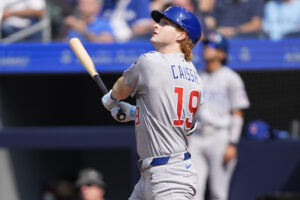
Caissie should step right into the Marlins’ outfield next season. The 23-year-old slugger made his big league debut this past season, struggling in a tiny sample of 27 plate appearances, but is a former second-round pick and longtime top prospect who has shredded minor league pitching. That includes a 2025 campaign in which he slashed .286/.386/.551 (139 wRC+) with 22 homers, 28 doubles and a pair of triples in 99 games/433 plate appearances of Triple-A work.

Caissie is a lefty-swinging corner outfielder with big power and big swing-and-miss tendencies. He fanned in nearly 28% of his Triple-A plate appearances last year. He’s regularly been able to offset the damage of those strikeouts by walking at high clips, however. He drew a free pass in 13.2% of his Triple-A plate appearances last year and has an overall 13.6% walk rate in five minor league seasons.

Scouting reports on Caissie praise his plus throwing arm but predict he’ll be limited to corner work (despite some early-career experience in center field). He has the makings of a prototypical three-true-outcomes right fielder. The Marlins could go with 2025 breakout slugger Kyle Stowers in left field and Caissie in right, thus giving them a pair of high-powered bats to plug into the heart of their order for the foreseeable future.

Because Caissie only made a brief MLB debut this past season, he still has six full seasons of club control remaining. He’s still rookie-eligible, so the Marlins could potentially pick up a draft pick for him via MLB’s prospect promotion incentive program, depending on when he’s brought up for his Marlins debut and (of course) on how he fares in awards voting early in his big league tenure. Caissie was only selected to the major league roster last offseason, meaning he’s only exhausted one minor league option year and still has two remaining.

Caissie joins Stowers and breakout center fielder Jakob Marsee in comprising a talented and intriguing outfield core. The Marlins’ lineup, in general, has gotten more interesting over the past couple years, thanks largely to the emergence of Xavier Edwards alongside those young outfielders. Former top catching prospect Agustin Ramirez hit for power in his rookie campaign this past season but struggled to get on base and played extremely poor defense behind the plate. Marlins president Peter Bendix has emphasized that the club hopes to continue developing Ramirez behind the plate, but he could see time at first base and DH in 2026, especially once top catching prospect Joe Mack debuts.

Hernandez, 22, is a speed-and-defense shortstop who spent the 2025 season with the Cubs’ High-A affiliate. Baseball America recently ranked him 16th among Cubs farmhands heading into the 2026 season, noting that he has plus raw power but hits the ball on the ground far too frequently to ever tap into that pop. (This past season’s seven home runs were a career-high.) BA’s report notes that Hernandez has the tools to be an above-average defender but is often inaccurate with his throwing despite good arm strength.

Improving the accuracy on Hernandez’s throws seems like a more attainable goal than overhauling his offensive approach to get more loft without compromising his lower-than-average strikeout rate, but if the Marlins can fix both those traits, it’s possible they’ll have a starting-caliber shortstop on their hands. Those are big “ifs,” of course, particularly considering that Hernandez just hit .252/.329/.365 as a 21-year-old in his second stint with the Cubs’ High-A affiliate. He’s a project, but a capable shortstop coming off a 52-steal season (61 attempts) is a nice secondary piece to add to the system.

De Leon is the furthest from MLB-ready. He’s an 18-year-old who signed as part of Chicago’s 2024 international class. The 6′, 170-pound De Leon played with the Cubs’ Dominican Summer League club in 2024, hitting .277/.431/.433 in 181 plate appearances. He moved up to their Rookie-level Arizona Complex League affiliate in 2025 and slashed .276/.353/.500 in 153 turns at the plate. BA’s Geoff Pontes listed him as a sleeper prospect to watch heading into the 2026 season, citing his encouraging exit velocities and plus raw power.

With just 334 professional plate appearances under his belt and his 19th birthday still six weeks away, De Leon is a pure development project for Miami. He’s been a productive hitter in each of his two pro seasons, though, even with some moderately worrying swing-and-miss tendencies (28.8% strikeout rate in 2025). He’ll probably head to the Marlins’ Low-A affiliate to begin the 2026 season and doesn’t seem likely to be a potential major league factor until 2028 or 2029 at the earliest.

The Marlins remain a work in progress and will most likely enter 2026 as something of a playoff long shot, but there are a number of upward-pointing arrows on the roster, making it an encouraging time for Miami fans.

Bleacher Nation’s Michael Cerami first reported that a Cabrera trade between the two teams was near completion. Kevin Barral of Fish On First reported Caissie as the likely headliner. Christina De Nicola of MLB.com and Craig Mish of SportsGrid broke the news of the other two prospects in the deal. Jeff Passan of ESPN first reported that the medical review process had been complete and the trade was official.

Source: https://www.mlbtraderumors.com/2026/01/marlins-trade-edward-cabrera-cubs.html
 
Cubs Claim Ryan Rolison

The Cubs have claimed left-hander Ryan Rolison off waivers from the White Sox, per ESPN’s Jesse Rogers. The Sox designated Rolison for assignment when they needed to open a 40-man roster spot for free agent signee Sean Newcomb. The Cubs currently have four vacancies on their 40-man, so a corresponding move isn’t needed.

A first-round pick by the Rockies back in 2018, Rolison didn’t make his major league debut until the 2025 season, as injuries significantly derailed his trajectory to the majors. He wound up tossing 42 1/3 frames for Colorado — 31 relief appearances, one start — and being tagged for a grim 7.02 earned run average in that time. He pitched well out of the bullpen in Triple-A, however, notching a 3.34 ERA with a 25.2% strikeout rate, 7.1% walk rate and 48.8% ground-ball rate.

Rolison previously sat in the upper 80s and low 90s with his four-seamer while working as a starter, but his average fastball jumped to 93 mph this season while working in short relief. Home runs were a major issue for him in his debut campaign (2.34 HR/9), but despite that penchant for serving up the long ball, he actually induced a large amount of weak contact. When opponents did manage to barrel Rolison, those balls left the yard too often, but hitters still averaged a measly 87.5 mph off the bat against him.

It’s been some time since the former Ole Miss standout was a prospect of real note, but big league clubs clearly still see something in Rolison now that he’s healthy. He’s bounced from the Rockies, to the Braves, to the White Sox, to the Cubs now since his original DFA in Colorado. Following his DFAs with the Rockies and Braves, he didn’t even make it to waivers. The Braves and Cubs acquired him via small trades. And even in spite of those rough-looking numbers in his debut, he still wasn’t able to be passed through waivers by the South Siders.

Rolison has a minor league option remaining, so the Cubs don’t necessarily need to carry him on the Opening Day roster. He’s been used more in relief than as a starter in recent seasons, which isn’t a huge surprise for a former starter who lost about two years of his still-young career to a torn labrum in his left shoulder, which required surgery. The Cubs are quite deep in rotation options — particularly with a trade for Marlins righty Edward Cabrera reportedly in its final stages — and have deepened their bullpen this winter with signings of Phil Maton, Hunter Harvey, Jacob Webb, Hoby Milner and Caleb Thielbar. Rolison joins lefties Luke Little and Riley Martin as southpaw bullpen options who seem likely to begin the year in Triple-A Iowa.

Source: https://www.mlbtraderumors.com/2026/01/cubs-claim-ryan-rolison-waivers-white-sox.html
 
Cubs Sign Jeff Brigham To Minors Contract

The Cubs signed right-hander Jeff Brigham to a minor league contract, MLB.com’s Jordan Bastian reports. Brigham’s deal includes an invitation to Chicago’s big league Spring Training camp.

Brigham (who turns 34 in February) is a veteran of six Major League seasons, with 120 2/3 innings pitched over 94 total games with the Marlins, Mets, and Diamondbacks. Three of Brigham’s six seasons included four or fewer appearances, including his work with Arizona in 2025 — the righty posted an 8.10 ERA over four games and 3 1/3 innings.

The D’Backs signed Brigham to a minors deal last winter, and he hasn’t pitched since being released by the team last August while on the minor league injured list. Injuries plagued Brigham for a good deal of the 2025 season, as he only pitched in 18 games (21 2/3 IP) in Arizona’s farm system in addition to his brief time in the majors. This Cubs contract presumably indicates that Brigham is healthy and ready to vie for a bullpen job in Spring Training.

The bullpen has been a heavy focus for the Cubs this winter, with Phil Maton, Hunter Harvey, Hoby Milner, and Jacob Webb all signed to free agent deals. Between this group and swingmen/backup starting options like Colin Rea and Javier Assad also in the mix, Brigham or any other non-roster invites face a tough competition to break camp with the team. Brigham is also out of minor league options, which adds another layer of difficulty in his quest to both make the cut and remain on the 26-man roster.

Brigham has a career 4.85 ERA, with a 10.7% walk rate and an inflated home run rate contributing to his uninspiring ERA. The right-hander has had trouble keeping the ball on the ground in the big leagues, though his 23.8% strikeout rate is respectable. Over 191 2/3 career innings at Triple-A, Brigham has a 4.09 ERA, 30.27% strikeout rate, and 10.7% walk rate, with much better grounder rates but still some issues at limiting the long ball.

Source: https://www.mlbtraderumors.com/2026/01/cubs-sign-jeff-brigham-to-minors-contract.html
 
Cubs To Sign Alex Bregman

The Cubs and third baseman Alex Bregman are in agreement on a five-year, $175MM contract, per Jon Heyman of the New York Post and Jeff Passan of ESPN. The deal does not have opt-outs, and Bregman receives a no-trade clause, according to Bob Nightengale of USA Today. Bregman is a client of the Boras Corporation.

After opting out of his deal with the Red Sox, Bregman now gets the long-term contract he has been seeking. We at MLBTR ranked him at No. 5 on our Top 50 Free Agents list and projected him for a six-year, $160MM contract. Meeting that projection would have taken him through his age-37 season in 2031 at a $26.7MM average annual value. This deal gives him one less year but shatters expectations with a much higher $35MM AAV.

For the Cubs, the addition of Bregman is the latest move in an active offseason. The club acquired young starter Edward Cabrera from the Marlins three days ago. They have also signed reliever Phil Maton to a two-year deal, as well as relievers Jacob Webb, Caleb Thielbar, Hoby Milner, starter Colin Rea, and first baseman Tyler Austin on one-year deals. Shota Imanaga also accepted his qualifying offer to remain with the team.

Now, Bregman gives the Cubs a major offensive upgrade without the loss of a draft pick, as he rejected a qualifying offer from the Astros in 2024. His salary brings the team’s projected 2026 payroll to $231MM, a full $25MM over last year’s $206MM figure, according to RosterResource. Meanwhile, their CBT payroll stands at $247.6MM for 2026, putting the Cubs $3.6MM above the first luxury tax threshold.

Bregman, 31, played in 114 games with Boston this year, making 495 plate appearances. Although he missed a month and a half with a right quad strain, he continued to excel on offense, batting .273/.360/.462 and grading out 25% better than average by wRC+. After posting a career-low 6.9% walk rate in his last year with the Astros, Bregman bumped that up to 10.3% in 2025. He maintained his reputation as a high-contact hitter, with his 14.1% strikeout rate grading out in the 88th percentile. His 90.1 mph average exit velocity and 44.4% hard-hit rate were both career bests. He also continued to do well defensively, earning 1 Defensive Run Saved and 3 Outs Above Average for his work at third base. Overall, Bregman’s 2025 contributions were good for 3.5 fWAR and his third career All-Star nomination.

A lot of that came from his red-hot first two months. At the time of his injury, Bregman had a 156 wRC+ through 226 PA. His production following his return was more uneven. He posted a 128 wRC+ in July, followed by a 108 wRC+ in August and just a 76 wRC+ in September. In the first half, Bregman was 52% better than average by wRC+. In the second half, he was right around average.

Though he wasn’t his usual self in the last two months of the year, Bregman’s lengthy track record still made him one of the top free agents in this year’s class. Since debuting with the Astros in 2016, he has batted .272/.365/.481 with 209 home runs and a 133 wRC+. His first two All-Star appearances came in 2018-19. Bregman averaged 8.1 fWAR and finished in the Top 5 in AL MVP voting in both years, finishing as the runner-up in 2019. While he hasn’t reached those heights in the years since, he has still been a well-above-average hitter. He has posted a wRC+ between 117 and 137 in every year from 2020-25. Bregman’s defense has also held firm. Since the start of 2020, he has been worth 10 DRS and 17 OAA. He ranks eighth among qualified third basemen in that span by OAA.

That track record and Bregman’s still-excellent 2025 drew ample interest in free agency. The Red Sox were clearly keen on a reunion, with recent reports indicating they had made him an “aggressive” offer. Outside of them and the Cubs, his known suitors included the Tigers, the Diamondbacks, and the Blue Jays (before they signed Kazuma Okamoto). The Tigers and Cubs were interested in Bregman last offseason as well. Detroit reportedly offered him six years and $171.5MM, albeit with significant deferrals. Chicago’s offer was in the four-year, $115MM range. Now, one year later, the team is paying a whopping $60MM more to sign him.

More to come.

Source: https://www.mlbtraderumors.com/2026/01/cubs-to-sign-alex-bregman.html
 
Details Of Red Sox’ Pursuit Of Alex Bregman

2:19pm: Cotillo reports that Boston’s offer to Bregman was for five years and $165MM with significant deferrals.

2:09pm: Alex Bregman is headed to Chicago after landing with the Cubs on a five-year, $175MM contract that was first reported last night. That’s a crushing blow for the Red Sox, who were long reported to be prioritizing a reunion with Bregman after he opted out of the final two years and $80MM on his contract with the club back in November. In the aftermath of Bregman’s departure, reports out of Boston are shedding some light on the efforts the Red Sox made to retain their All-Star, and where that offer ultimately fell short.

According to a report from The Boston Globe’s Peter Abraham last night, the Red Sox “did not come close financially and were not willing to give Bregman a full no-trade clause, which the Cubs did.” Today, reporting from Chris Cotillo and Sean McAdam of MassLive confirmed that the Red Sox were unwilling to offer Bregman a no-trade clause and added that the team cited “organizational policy” regarding no-trade protection in doing so. That, McAdam writes, “proved to be a sticking point” for Bregman, who has young children and values stability for them as he heads into his third consecutive year in a new city.

As for the financials, McAdam writes that the five-year offer from Boston was “reasonably competitive,” but added that it fell short of Chicago’s offer financially. Like the Cubs’ offer, which includes $70MM in deferred money, the Red Sox offer also included significant deferrals. Those deferred payments were scheduled out differently, however, as McAdam notes that the Red Sox proposed a payment plan “stretching out decades.” The exact payment details of Chicago’s offer aren’t yet known, McAdam notes that the decades-long payment structure Boston offered widened the gap between the two offers and reduced the value of the Red Sox’ offer further than the already-lower sticker price, relative to the Cubs’ offer.

Exactly how the two offers stack up will be easier to judge once more details come out about Bregman’s contract details in Chicago, but in any case it seems the offer that the Red Sox reportedly considered “aggressive” came up well short of what Cubs president of baseball operations Jed Hoyer and his front office managed to put together. As a result, the Red Sox will have to turn elsewhere in their search for another middle-of-the-order bat for their infield. USA Today’s Bob Nightengale was among the reports to suggest in the aftermath of Bregman’s signing that the other top infielder on the market, shortstop Bo Bichette, could be the player they pivot to. Bichette figures to sign for even more than Bregman, did, however; MLBTR predicted an eight-year, $208MM contract for the infielder at the outset of the offseason.

Some of that, of course, has to do with the contract length. Perhaps an eight-year deal for Bichette, which would run through his age-35 season, would be just as or even more appealing to the Red Sox than signing Bregman through his age-36 season on a five year deal. On the other hand, it’s worth noting that this Red Sox front office has not yet given out a contract longer than three years via free agency. If the team has an aversion to long-term deals more generally, it would be difficult for the Red Sox to outbid rival suitors for Bichette like the Phillies and Yankees that have no qualms about signing free agents to lengthy contracts.

If the Red Sox aren’t willing to splurge on Bichette, the pickings for replacement Bregman become a lot slimmer. Eugenio Suarez offers big power and could be a fit on a shorter-term deal in free agency, but he struggled in the second half last year, will play this year at 34 years old, and is a lackluster defender at the hot corner. Turning to the trade market, Alex Speier of the Boston Globe reportedly shortly before the new year that the Red Sox had narrowed their focus to five infield options: Bregman, Bichette, Ketel Marte, Isaac Paredes, and Brendan Donovan. With Bregman now in Chicago and Marte having been officially taken off the market by Arizona, that leaves Paredes and Donovan as the two primary alternatives to Bichette in that report.

Of the two, Paredes seems to be the better fit. Both are controlled for two seasons after this one, but Paredes is a right-handed hitter who seems likely to cost less in trade than Donovan. While Paredes has been pushed out of the Astros’ nominal starting lineup by the addition of Carlos Correa over the summer, Donovan’s market is known to have many suitors including the Giants, Mariners, and Royals. What’s more, Paredes is a right-handed hitter who primarily plays third base, making him a much cleaner replacement for Bregman than Donovan, a lefty hitter who has played all over the field but primarily plays second base. Paredes is also a marginally better hitter over the last four seasons (124 wRC+ vs 119) coming off a stronger platform season (128 wRC+ vs 119). Paredes (hamstring injury) and Donovan (sports hernia surgery) both ended their seasons with injury complications but are expected to be full-go for Spring Training next month.

Of course, it’s possible the club could look at other options now that their preferred targets have begun to dwindle. The Cubs, themselves, now have a surplus of infield talent after bringing in Bregman displaced Matt Shaw at third base. Adding another unproven youngster to a very young Red Sox roster likely wouldn’t be especially appealing, but Cubs second baseman Nico Hoerner has garnered trade interest this winter and could be more available now that Bregman has freed up Shaw to take over the keystone following a hypothetical Hoerner trade. An elite defender at second base who has also posted strong grades at shortstop in the past, Hoerner is a well-regarded clubhouse presence who could help fill the leadership void created by the loss of Bregman.

With that said, his 109 wRC+ last year was a career-high, and his lack of power is unlikely to be especially attractive to a team like the Red Sox that finished middle-of-the-pack in homers last year and expressed an interest in bringing in a big-time slugger like Kyle Schwarber or Pete Alonso earlier this winter in hopes of improving that area of the offense. It’s also an open question as to whether the Cubs would even be especially inclined to deal Hoerner, as an infield of Bregman, Hoerner, Dansby Swanson and Michael Busch would be among the strongest in baseball headed into 2026. What’s more, Hoerner is slated to hit free agency following the 2026 campaign and the Red Sox may prefer to add a player under longer-term control for fear of finding themselves in this same predicament again next year.

Source: https://www.mlbtraderumors.com/2026/01/details-of-red-sox-pursuit-of-alex-bregman.html
 
Back
Top