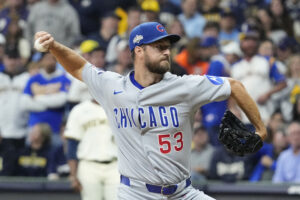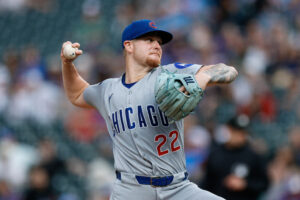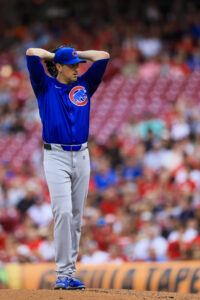
Cubs Notes: Tucker, Imanaga, Horton, Coaching Staff

The Cubs had a solid season in 2025 but it came to an end on Saturday when they dropped Gave Five of the Division Series to the Brewers. That turns the focus to the offseason and some upcoming decisions. President of baseball operations Jed Hoyer held an end-of-season press conference yesterday but largely avoided tipping his hand about anything. Reporters such as Patrick Mooney of The Athletic, Sahadev Sharma of The Athletic and Jordan Bastian of MLB.com provided dispatches from the presser.

Kyle Tucker’s impending free agency will be a big storyline this winter and Hoyer provided some boilerplate comments about trying to retain the player. “Everyone can use a guy like Kyle Tucker. Everyone gets better by having a player like that,” Hoyer said. “We’ll certainly be having those conversations.”

The Cubs obviously think highly of Tucker. Back in December, they gave up Isaac Paredes, Hayden Wesneski and Cam Smith in order to acquire Tucker’s final year before free agency. They saw Tucker near his best for a while. He slashed .291/.395/.537 through the end of June for a 157 wRC+ while stealing 20 bases.

But his results tapered off as the season went along. A finger fracture suffered in early June didn’t immediately slow him down but seemed to catch up with him eventually. A calf strain also popped up later in the season. From July through the end of the season, Tucker slashed just .225/.348/.342 for a 103 wRC+. He had a .259/.375/.370 line and 118 wRC+ in the postseason.

Despite the tepid finish, Tucker has shown remarkably well-rounded production when healthy and should still be in high demand this winter. From 2021 to the present, he has a combined .277/.365/.514 line and 143 wRC+. He stole 105 bases in there with strong defensive grades, though the glovework seems to be trending down. FanGraphs credited him with 23.4 wins above replacement, making him one of the ten most valuable position players in that stretch.

Though he is limping towards free agency, it’s still possible Tucker’s market will be strong enough that he could secure something like a ten-year, $400MM deal. The Cubs could do that, in a sense. They are a big-market club and their future payroll is quite clean, with Dansby Swanson the only guy really locked in beyond 2026. However, they would need to shatter precedent, as the largest contract in franchise history is Jason Heyward’s $184MM deal from a decade ago.

One other guy who is technically on the books beyond 2026 is left-hander Shota Imanaga, thanks to his convoluted contract. In the next few weeks, it will be determined if he stays on the books or not. The Cubs will soon have to decide whether or not to trigger a three-year, $57.5MM club option for the 2026-28 season. If they turn that down, Imanaga has a $15.25MM player option for 2026. If he triggers that, after 2026, the Cubs have to decide on a two-year, $42.5MM club option. If that is turned down, Imanaga would get another $15.25MM player option.

Hoyer technically responded to a question about Imanaga yesterday but without really answering anything. “When we signed Shota, if you’d shown us his production over the last two years, we would have taken that in a heartbeat,” Hoyer said. “So not only has he produced for us, but he’s just a great teammate and terrific asset to the organization. Obviously we have decisions to make and discussions to (have). Over the next two or three weeks we’ll do that, but I’ve got nothing but positive things to say about Shota.”

After Imanaga’s MLB debut in 2024, the club option seemed like a no-brainer. He posted a 2.91 earned run average over 29 starts. Despite his fastball averaging just 91.7 miles per hour, he was able to strike out 25.1% of batters faced and only gave out walks 4% of the time. But his results backed up here in 2025. As he averaged just 90.8 mph on his fastball, he posted a 3.73 ERA with a 20.6% strikeout rate and 4.6% walk rate. That includes a rough second half with a 4.70 ERA.

Since Imanaga is now 32 years old and his trends aren’t great, it’s possible the Cubs may look to quit while they’re ahead. Matthew Boyd, Jameson Taillon and Cade Horton will have spots in next year’s rotation. Horton finished the season on the injured list due to a rib fracture but is healthy now. He actually would have been on the NLCS roster if the Cubs had advanced, per Bastian. Justin Steele will be back from his UCL surgery at some point. Colin Rea can be retained via a $6MM club option, which has a $750K buyout. Guys like Ben Brown, Javier Assad and Jordan Wicks will be in the mix.

Subtracting Imanaga from the group would further thin out a group that already looks lacking. On the other hand, adding Imanaga back in there would leave the rotation feeling decent but lacking in upside. There’s an argument that they should turn down their option and use the money saved to pursue more of a front-of-rotation arm. This winter’s free agent market will feature guys like Framber Valdez, Dylan Cease, Tatsuya Imai, Ranger Suárez and others. The trade market could feature MacKenzie Gore, Joe Ryan, Sonny Gray and others.

As for the coaching staff, Hoyer noted they would all be invited back. That makes it possible the Cubs face minimal turnover this winter but it’s also possible some staffers get poached by other clubs. There are eight managerial vacancies and bench coach Ryan Flaherty has already been connected to a few of them. Once those new managers are hired, they will likely have some ability to make coaching decisions. That should lead to a lot of coaching musical chairs this winter, so time will tell if that impacts anyone with the Cubs.

Photo courtesy of Christopher Hanewinckel, Imagn Images

Source: https://www.mlbtraderumors.com/2025/10/cubs-notes-tucker-imanaga-horton-coaching-staff.html

 
Kevin Alcántara Undergoes Sports Hernia Surgery

Cubs outfielder Kevin Alcántara has undergone surgery to repair a sports hernia, the team announced. Maddie Lee of the Chicago Sun-Times was the first to report the news.

The Cubs have not offered a clear timeline for Alcántara’s recovery, but the surgery was successful, according to Lee, so there’s no reason to believe this will affect his 2026 campaign. Corey Seager is a prominent recent example of a player who returned from sports hernia surgery. He had a hernia on his left side repaired in late January 2024 and recovered quickly enough to start at shortstop on Opening Day just two months later. The following September, he needed another hernia repair, this time on the right side, and he returned in plenty of time to post a .950 OPS in 18 games in spring training. Barring a setback, Alcántara should still have a relatively normal offseason.

Acquired from the Yankees in the 2021 Anthony Rizzo trade, the 23-year-old Alcántara is one of Chicago’s top prospects. The latest lists from Baseball America and MLB Pipeline have him ranked fifth in the system, while FanGraphs and Keith Law of The Athletic are even higher on his skills, ranking him as the Cubs’ No. 1 and a top-50 prospect in the game. His calling card is huge slugging potential. He hit 26 doubles and 17 home runs across 102 games at Triple-A in 2025, and evaluators who are bullish on his bat think he has even more power to unlock. It’s easy to see why that’s so tantalizing, especially coming from a center fielder with plus speed.

Alcántara has taken a couple of sips of coffee at the big league level in each of the past two Septembers but has yet to establish himself in the major leagues. In truth, he could probably benefit from some more minor league seasoning in 2026; his .273/.356/.470 slash line and 111 wRC+ in 137 career games at Triple-A aren’t quite as impressive as his numbers from the lower levels of the minors. In particular, his 29.6% strikeout rate is concerning. Unfortunately for the Cubs, however, they’ll soon have to make a difficult decision. Alcántara will be out of minor league options next season. Presuming he’s healthy, he’ll need a spot on Chicago’s Opening Day roster next year – unless they trade him first.

Source: https://www.mlbtraderumors.com/2025/10/kevin-alcantara-undergoes-sports-hernia-surgery.html
 
Offseason Outlook: Chicago Cubs

The Cubs won a playoff series for the first time in eight years. With clean books beyond 2026, will they make a major rotation addition this winter?

Guaranteed Contracts


Option Decisions

  • Shota Imanaga, SP: three-year, $57.75MM club option. If declined, Imanaga has a $15.25MM player option for 2026. If Imanaga exercises that, he'd have another $15.25MM player option for 2027 if the Cubs don't exercise a $42.5MM club option for 2027-28.
  • Andrew Kittredge, RP: $9MM club option with a $1MM buyout
  • Colin Rea, SP/RP: $6MM club option with a $750K buyout
  • Justin Turner, 1B/DH: $10MM mutual option with a $2MM buyout

Arbitration-Eligible Players (service time in parentheses; salary projections via Matt Swartz)


Free Agents


The Cubs broke through this year with a 92-win season, their highest total since 2018. They reached the playoffs for the first time since 2020 and won a playoff game and series for the first time since 2017. After the Cubs lost Game 5 of the division series to the Brewers with a "bullpen game" pitching approach, fans couldn't help but wonder if the team could have gone further with a healthy Cade Horton and/or Justin Steele.

Let's start this offseason outlook by assessing the complicated option of the pitcher the Cubs chose to avoid in Game 5, Shota Imanaga. Imanaga, 32, was a rousing success last year as an MLB rookie. He made the All-Star team and garnered Cy Young and Rookie of the Year votes, posting a 2.91 ERA in 173 1/3 innings.

After eight starts this year, Imanaga suffered a strained left hamstring that knocked him out for 53 days. On the season, Imanaga's control remained excellent, but his average fastball velocity slipped below 91 miles per hour and his strikeout rate dropped below league average. Among starters with at least 100 innings, Imanaga's 29.2% groundball rate was the lowest in baseball, leading to a 1.93 HR/9 rate that ranked second-worst.

Imanaga still managed a 3.73 ERA, but it's fair to say he demonstrated the skills of perhaps a 4.20 pitcher. Even if 150 innings of a 4ish ERA is what the Cubs can expect from Imanaga moving forward, that's rotation-worthy. The question is whether the Cubs would sign such a pitcher to a three-year, $57.75MM contract heading into his age-32 season, and commit to that in early November.

A good comp for that might be Dallas Keuchel's three-year, $55.5MM deal with the White Sox six years ago. Though a groundball heavy pitcher, Keuchel was also a soft-tossing lefty heading into his age-32 season. That contract did not go well.

There are soft factors to consider here, such as the Cubs' recruiting efforts toward other Japanese players and Imanaga's popularity with fans last year. MLBTR writers debated Imanaga's complicated option situation, and here's our best guess:

landing-logo.png

Unlock Subscriber-Exclusive Articles Like This One With a Trade Rumors Front Office Subscription​

BENEFITS
  • Access weekly subscriber-only articles by Tim Dierkes, Steve Adams, and Anthony Franco.
  • Join exclusive weekly live chats with Anthony.
  • Remove ads and support our writers.
  • Access GM-caliber tools like our MLB Contract Tracker

Source: https://www.mlbtraderumors.com/2025/10/offseason-outlook-chicago-cubs-15.html
 
Cubs Expected To Pursue Dylan Cease This Offseason

Free agency won’t officially begin until five days after the conclusion of the World Series, but teams are already well into the process of making their plans for the coming offseason. For many teams, that will include pursuits of some of the winter’s top free agent talent. While Cubs outfielder Kyle Tucker is widely viewed as the top hitter headed into free agency this November, Bruce Levine of 670 The Score reported a connection between Chicago and one of the winter’s top pitchers: right-hander Dylan Cease. Levine reports that the Cubs are viewed as a potential top suitor for Cease and that he will be pursued by the North Siders this winter.

Cease has significant ties both to the city of Chicago and the Cubs organization as a whole. Drafted by the Cubs in the sixth-round of the 2014 draft, Cease developed into a top-100 prospect in the Cubs organization before being traded alongside Eloy Jimenez in the crosstown deal that brought Jose Quintana to Chicago prior to the 2017 trade deadine. While neither Jimenez nor Quintana quite lived up to expectations during their stints with their new clubs, Cease turned into the sort of top-of-the-rotation arm the White Sox were surely dreaming of when they made the trade. He was the runner-up for the AL Cy Young award with the South Siders in 2022 in his age-26 season and was traded to the Padres just before the start of the 2024 campaign for a package headlined by top pitching prospect Drew Thorpe.

2024 saw Cease put together another ace-level campaign as he pitched to a 3.47 ERA in 33 starts while striking out 29.4% of his opponents. He finished fourth in NL Cy Young award voting and even garnered some down-ballot MVP consideration. That seemed to set up Cease up for a major payday in free agency as long as he could keep it up in 2025, but he stumbled this year with a rather pedestrian 4.55 ERA in 168 innings of work. Cease’s peripherals were a good deal better than his results suggested, but a tough 2025 season creates a pattern of inconsistency that might worry some suitors after a similarly pedestrian 2023.

Cease might lack the sort of year-to-year consistency many clubs look for when searching for an ace to carry their pitching staff, but it’s still easy to see why he would be attractive to teams. The right-hander has been one of the game’s most durable arms in recent years, and his peripherals have remained far more consistent than his actual results. He’s struck out at least 200 batters in five consecutive seasons with at least 32 starts and a 165 innings in each of those seasons. While his ERA has fluctuated between 2.20 and 4.58 across those five seasons, his FIP (between 3.10 and 3.72) and SIERA (between 3.46 and 4.10) have been far more stable. While Cease’s 3.72 ERA ranks 29th among starters with at least 500 innings of work since 2021, his FIP (12th), SIERA (22nd), and xERA (11th) all rank more favorably.

Perhaps most importantly for the Cubs specifically, Cease throws hard and racks up strikeouts. His strikeout rate ranks 3rd in that aforementioned group, behind only Blake Snell and Gerrit Cole. His fastball velocity, likewise, ranks third behind Cole and Sandy Alcantara in that same group. Cease actually threw harder than his career average this year with a 97.1 mph fastball velocity. That was good for sixth among qualified starters this season, and his strikeout rate trailed on Tarik Skubal and Garrett Crochet. For a Cubs rotation that had the third-lowest fastball velocity in the majors at just 93.1 and put together a pedestrian 20.5% strikeout rate, Cease would be the sort of power pitcher a generally soft-tossing Cubs rotation could really benefit from.

As good of a fit for the Cubs as Cease might seem to be on paper, that shouldn’t be taken to mean a deal is necessarily likely to get done. Cease will have plenty of suitors as one of the top starters on the market, and big spenders like the Mets are known to be in the market for rotation help this winter. Cease’s familiarity with the Cubs organization and the city of Chicago is unlikely to give the Cubs a significant leg up considering that Cease is a client of the Boras Corporation, and agent Scott Boras’s clients aren’t known for affording much of a hometown discount in free agency.

The Cubs haven’t spent at the top of the free agent market very often in recent years. Since signing Jon Lester and Jason Heyward in back-to-back offseasons in 2014 and ’15, the Cubs have signed just two players to deals worth $100MM or more: Yu Darvish, who was famously traded to the Padres halfway through his six-year, $126MM pact with Chicago, and Dansby Swanson. Cease will surely be seeking a contract worth at least that much, and it’s unclear if the Cubs would be willing to go out of their comfort zone to land him.

Another factor could be the Qualifying Offer, as the Cubs have generally been reluctant to sign qualified free agents. Swanson is the only free agent Chicago has signed with a QO attached outside of re-signing their own players since they signed John Lackey to a two-year deal in December of 2015. Even if the Cubs aren’t interested in playing at the top of the market, it’s at least possible that they would circle back to Cease later this offseason if his market doesn’t materialize, as they did with Cody Bellinger during the 2023-24 offseason and attempted to do with Alex Bregman last winter.

It’s also worth wondering whether adding a starting pitcher will be the team’s top priority this winter to begin with. Whether they pursue a reunion with Tucker or not, targeting a bat in free agency could make some sense given that the club’s internal options to replace him in the lineup would be unproven prospects Moises Ballesteros, Owen Caissie, and Kevin Alcantara. The bullpen might also be a priority given that every high leverage reliever from this year’s relief corps except Daniel Palencia is scheduled to hit free agency this winter.

Of course, starting pitching could become a larger priority for the club in a hurry depending on how the option decisions between the club and southpaw Shota Imanaga play out in the coming days. Imanaga departing for free agency would create some urgency to replace him in the rotation, while him remaining in the fold alongside Jameson Taillon, Matthew Boyd, and Cade Horton with Justin Steele expected back from surgery in the first half of next season could be enough rotation talent to convince the Cubs to prioritize improving other areas of the roster. Colin Rea’s bargain $6MM club option for 2025 is likely to be picked up, and he’ll join Javier Assad as quality depth for the Cubs rotation headed into next year beyond their on-paper starting five.

Source: https://www.mlbtraderumors.com/2025/10/cubs-expected-to-pursue-dylan-cease-this-offseason.html
 
Extension Candidate: Pete Crow-Armstrong

Few players captured more attention throughout the 2025 season than Pete Crow-Armstrong. The young center fielder seemed to launch himself into superstardom in the first half this year, with 20 doubles, 21 homers, and 25 steals through the end of June. That worked out to a .263/.299/.537 slash line, good for a 128 wRC+ with elite defense in center field that made him an early rival for Shohei Ohtani in this year’s MVP race. He followed up that brilliant performance with a far less exciting second half, as he slashed just .228/.274/.412 (86 wRC+) with 17 doubles, ten home runs, and ten steals from July 1 onward.

Crow-Armstrong’s second-half slump was enough to knock him far out of the MVP conversation, but his season-long numbers remain impressive. In 157 games, the 23-year-old hit .247/.287/.481 (109 wRC+) with 35 steals in 43 attempts and an MLB-best +24 Outs Above Average for his work in center field. All of that combined to be worth 6.0 bWAR and 5.4 fWAR, good for 11th and 15th respectively among qualified hitters this year. A five- or six-win season from a 23-year-old who entered the year with less than 150 games of big league experience is hard to view as anything other than an exciting success, and that’s how Jed Hoyer characterized it in his end-of-season press conference shortly after the Cubs’ season came to a close in Game 5 of the NLDS.

“In totality, he had a great year,” Hoyer said of Crow-Armstrong, as relayed by Patrick Mooney of The Athletic. Hoyer went on to describe Crow-Armstrong as “the best defensive player in baseball” and noted that “when he’s hitting, he’s a superstar.”

All of that rings true based on his performance this season, and as the Cubs head into an offseason where Hoyer acknowledged they hope to have extension conversations with several players, Mooney writes that locking up the team’s star center fielder “figures to be the top priority.”

It won’t be the first time the Cubs and Crow-Armstrong talk about extending his stay in Chicago beyond his years of team control. The sides discussed an extension towards the beginning of the year, before his standout first half, and Crow-Armstrong passed on a deal that reportedly would’ve maxed out around $75MM with a guarantee in the $60MM-$70MM range. Crow-Armstrong, of course, rejected that offer, and while Hoyer expressed an openness to discussing an extension with the youngster’s camp during the season no further progress on the topic was reported throughout the year. Perhaps that’s not surprising, given the unusual year Crow-Armstrong just had.

If the Cubs do intend to reopen extension talks with their budding star, what could a sensible contract look like? After entering 2025 just barely short of a full year of MLB service time, Crow-Armstrong currently remains under control through the end of the 2030 season. At that point, he figures to be ticketed for free agency ahead of his age-29 campaign. A look at MLBTR’s Contract Tracker offers a wide range of comparable players in recent years. Players like Ke’Bryan Hayes, Lawrence Butler, and Ezequiel Tovar had less than two years of MLB service when they signed their deals, like Crow-Armstrong. They all landed extensions in the $60MM to $70MM range that the Cubs reportedly offered prior to this season, but those deals were blown out of the water by the $134.2MM guarantee Jackson Merrill landed in his eight-year extension with the Padres back in April.

Merrill is a year younger than Crow-Armstrong, meaning he signed his deal at the start of his age-22 season while Crow-Armstrong would be signing ahead of his age-24 season this offseason. Both players had five seasons left under club control before free agency, however, and were coming off similarly elite platform seasons; Merril’s 130 wRC+ outshone Crow-Armstrong, but his lesser defense and baserunning left him with a roughly comparable 5.3 fWAR. They also play the same position, making Merrill’s recent deal a logical point of reference for Crow-Armstrong overall.

It’s the second-highest guarantee an outfielder with less than two seasons of MLB service time has received in MLB history, behind the $210MM guarantee the Mariners offered Julio Rodriguez that can max out at $470MM over 17 years if all incentives are reached and options are exercised. Given that Rodriguez was in the midst of posting a 148 wRC+ with 5.7 fWAR and 6.2 bWAR in just 132 games as a 21-year-old rookie when he signed his extension, it’s safe to expect that a deal for Crow-Armstrong would come in closer to Merrill’s contract.

A contract similar to the one signed by Merrill could make some sense, and an eight-year, $140MM contract would beat Merrill’s contract in terms of both guarantee and average annual value. However, the Cubs may not be interested in such a large guarantee for only three additional seasons of team control, while Crow-Armstrong may not want to head into free agency at the tail end of his physical prime as a player who derives as much value from speed and defense.

Then, perhaps, the sides could get together on a longer contract that would buy out more free agent years. An 11-year deal that runs through the 2036 season would keep Crow-Armstrong in town for the rest of his prime and buy out six free agent years. An 11-year, $187MM guarantee would narrowly eclipse Merrill by both guarantee and AAV, while also narrowly beating out the eight-year, $184MM contract the Cubs gave Jason Heyward during the 2015-16 offseason for the largest deal in franchise history.

It would be a risky investment given Crow-Armstrong’s lackluster plate discipline, which left him with the third-highest swinging-strike rate in the majors this year. Given that risk and the fact that Crow-Armstrong is not set to even reach arbitration until next winter, it would be understandable if the Cubs decided to wait and see how the 2026 season played out before committing that sort of money to their center fielder.

On the other hand, the upside in Crow-Armstrong’s profile is obvious and Chicago’s reluctance to spend at the top of the market on free agents in recent years could mean that waiting another year could put Crow-Armstrong out of Chicago’s price range entirely. Rolling the dice on an extension for Crow-Armstrong could be the team’s best bet of securing a long-term, star-caliber talent. Meanwhile, it would be understandable if Crow-Armstrong was motivated to lock in long-term financial security ahead of a 2026-27 offseason where a contentious round of collective bargaining over the sport’s economic future is widely expected.

Source: https://www.mlbtraderumors.com/2025/10/extension-candidate-pete-crow-armstrong.html
 
AL East Notes: Story, Flaherty, Lowe, Fairbanks

MassLive.com’s Chris Cotillo and Sean McAdam touched on an assortment of Red Sox topics in the latest edition of their Fenway Rundown podcast, including a brief mention of Trevor Story’s status as the shortstop considers an opt-out clause in his contract. Cotillo believes “the Red Sox are pretty cautiously very optimistic that” Story will be staying with the team, and while’s plenty of grey area within that statement, it does offer some indication that Story is leaning towards declining his opt-out.

Story is owed $25MM in each of the next two seasons, plus there’s a $5MM buyout on his $25MM club option for the 2028 campaign. The Red Sox can override Story’s opt-out by guaranteeing that 2028 club option right now, but that doesn’t appear to be on the team’s radar, so the ball looks to be entirely in Story’s court. While Story’s .263/.308/.433 slash line and 25 homers over 654 plate appearances only translates to a 101 wRC+, his numbers were weighed down by a cold start to the season, as Story posted an .825 OPS over his final 429 PA.

Between this strong finish and a thin free agent shortstop market, there’s a case for Story to leave his $55MM guaranteed on the table and look for a bigger contract this winter. On the flip side, Story turns 33 next month, his defensive metrics were subpar, and the injury problems that plagued him in 2022-24 will be on the minds of front offices even though Story stayed pretty healthy in 2025. If Story wants to avoid the risks of another prolonged stint in free agency, staying in Boston with a contending Red Sox team certainly seems like a viable choice.

More from around the AL East…

  • Earlier this month, Jon Heyman of the New York Post floated Cubs bench coach Ryan Flaherty as a logical candidate to be part of the Orioles’ managerial search. MASNsports.com’s Roch Kubatko reports that Flaherty did indeed interview with the O’s about the position before the club opted to hire Guardians associate manager Craig Albernaz. Any number of other names might’ve been considered by the Orioles, but Flaherty joins Albert Pujols, Luis Rojas, and Scott Servais as the candidates directly linked to Baltimore’s search whether in formal interviews or (in Servais’ case) just some interest on the club’s part. Flaherty’s six seasons as an Orioles player likely held some extra appeal for Baltimore’s front office, but his well-regarded work as a bench coach in Chicago and San Diego has put him in the running for multiple managerial vacancies. Flaherty is reportedly one of the finalists for the Twins’ job, and he is a candidate for both the Padres and Braves in their ongoing searches.
  • The Rays hold a pair of club options on Brandon Lowe ($11.5MM) and Pete Fairbanks ($11MM) for the 2026 season, and both players have expressed a desire to remain in Tampa. Marc Topkin of the Tampa Bay Times explores the option decisions, noting that between the team’s offensive needs and how “the Rays typically view the bullpen as more changeable and volatile on a year-to-year basis,” Lowe seems more likely than Fairbanks to be part of the 2026 roster. This doesn’t necessarily mean that Fairbanks’ option will be declined, however, as the Rays would then lose the closer for nothing in free agency. Perhaps the most probable scenario is that Tampa Bay will pick up both options and then explore trade possibilities for either player — in Fairbanks’ case, his $11MM salary might not seem that onerous to some rival clubs in need of high-leverage bullpen help.

Source: https://www.mlbtraderumors.com/2025/10/al-east-notes-story-flaherty-lowe-fairbanks.html
 
MLBTR Podcast: Bo Bichette’s Health, Kazuma Okamoto, And Dylan Cease’s Market

The latest episode of the MLB Trade Rumors Podcast is now live on Spotify, Apple Podcasts, and wherever you get your podcasts! Make sure you subscribe as well! You can also use the player at this link to listen, if you don’t use Spotify or Apple for podcasts.

This week, host Darragh McDonald is joined by Steve Adams of MLB Trade Rumors to discuss…


Plus, we answer your questions, including…

  • If the Blue Jays were to extend Addison Barger, would the Lawrence Butler deal be a good comp? (40:35)
  • If a veteran signs a minor league deal, are they eligible to be taken in the Rule 5 draft? (44:50)
  • Will the Red Sox trade Jarren Duran? (46:25)

Check out our past episodes!

  • The Phillies’ Outfield, Tarik Skubal, And Hiring College Coaches – listen here
  • Murakami To Be Posted This Offseason, Managerial Vacancies, And More! – listen here
  • Rockies’ Front Office Changes, Skip Schumaker, And ABS Talk – listen here

The podcast intro and outro song “So Long” is provided courtesy of the band Showoff. Check out their Facebook page here!

Photo courtesy of Dan Hamilton, Imagn Images

Source: https://www.mlbtraderumors.com/2025...h-kazuma-okamoto-and-dylan-ceases-market.html
 
Yoervis Medina Passes Away

Former major league pitcher Yoervis Medina has passed away. Reports out of his native Venezuela indicate that authorities believe Medina suffered a heart attack while he was driving, leading to a fatal car accident. He was 37 years old.

Medina pitched for the Mariners and Cubs from 2013-15, working 146 innings across an identical number of games. He posted a 3.08 career ERA with a 23.1% strikeout rate along with a 12.4% walk rate. Most of his success came in his first two seasons, as Medina pitched to a 2.81 ERA with a 24.3% strikeout rate and 12.6% walk rate in 125 innings for the Mariners from 2013-14. In that span, he ranked 34th out of 109 qualified relievers in ERA and ranked 21st with a 53.5% ground ball rate.

He was traded to the Cubs in May 2015 for Welington Castillo and pitched in five games for them with a 7.00 ERA, but he wound up spending most of the season in the minors. That was followed by brief stints in the Pirates and Phillies organizations in 2016, neither of which resulted in a big league call. Medina then pitched in the Venezuelan winter league from 2016-20 before moving to the Italian Baseball League in 2023 and the Czech Baseball Extraliga in 2024.

Medina was teammates in Seattle with Jesús Montero, who was tragically killed in a motorcycle crash earlier this month. We at MLB Trade Rumors send our condolences to Medina’s family, friends, loved ones and former teammates.

Source: https://www.mlbtraderumors.com/2025/10/yoervis-medina-passes-away.html
 
Shota Imanaga Becomes Free Agent

Left-hander Shota Imanaga has become a free agent, according to a report from Jesse Rogers of ESPN. The Cubs declined their three-year, $57MM club option on Imanaga’s services for 2026-28, and Imanaga subsequently declined his $15MM player option for 2026.

It’s an outcome that would’ve seemed unthinkable just a few months ago. Signed out of Japan to a deal that was on paper a four-year, $53MM contract during the 2023-24 offseason that had the aforementioned complex option structure set to kick in after the 2025 campaign, Imanaga was nothing short of sensational for Chicago in his first year as an MLB pitcher last year. In 29 starts, he pitched to a 2.91 ERA with a 25.1% strikeout rate across 173 1/3 innings of work that earned him an All-Star appearance and a fifth-place finish in NL Cy Young award voting last year.

While that strong rookie campaign seemed to portend a long stay near the front of Chicago’s rotation for Imanaga, things started to unravel this year. Early in the season, he managed to get strong results despite shoddy peripherals, with a 2.82 ERA through eight starts despite a 4.59 FIP and a strikeout rate that had plummeted to just 18.8%. His season was abruptly put on hold by a hamstring injury that cost him nearly two months, and when he returned his strikeout rate continued to dip. He did manage to fire off seven scoreless innings with five strikeouts during his first start after the All-Star break, but from there he began a downward spiral where his results started to match his lackluster peripherals.

From July 25 through the end of the season, Imanaga made 12 starts where he surrendered a 5.17 ERA with a 5.42 FIP across 69 2/3 innings of work. His strikeout rate actually recovered a bit during this stretch, creeping back up to 23.2%, but he allowed an eye-popping 20 home runs in that stretch. Imanaga has always had trouble with the long ball, and even in his excellent 2024 campaign he allowed the tenth-most homers among qualified starters. This year, his 31 homers allowed were the fourth-most in all of baseball despite him pitching just 144 2/3 frames. That’s fewer innings than anyone else in the top 20 besides Tyler Anderson, who allowed 28 homers in 136 1/3 innings of work.

In spite of his lackluster season, a poll of MLBTR readers on September 10 suggested that more than 91% believed the Cubs should exercise his club option. From that point onward, what seemed at the time like a borderline call became more clear as he posted an 8.04 ERA in his final three regular season starts before posting an 8.10 ERA in the postseason and ultimately being passed over for a winner-take-all Game 5 start against the Brewers in the ALDS despite him being on regular rest. By that time, this outcome seemed far more likely. MLBTR’s Tim Dierkes took a guess at Imanaga’s future in our Offseason Outlook coverage of the Cubs on October 22, and settled on the sides both declining their options and Imanaga heading into free agency.

From the Cubs’ perspective, moving on from Imanaga is understandable for a handful of reasons. By picking up his option, the Cubs would be counting on Imanaga to rebound into at least mid-rotation form for his age-32, -33, and -34 seasons. That might not seem like a bad bet to make, but it’s worth noting that Wrigley Field is notoriously fickle in terms of park factors thanks to the wind. In 2024, when Imanaga was at his best with the Cubs, Wrigley suppressed home runs at the fifth-highest rate in all of baseball according to Statcast. This year, that inverted to make the Friendly Confines the 11th-friendliest ballpark in baseball to home run hitters.

Perhaps Imanaga will be able to return to form elsewhere, particularly if he signs in a park with more consistent homer-suppressing tendencies, but it’s not hard to see why the Cubs wouldn’t want to commit to him long-term given that reality. That doesn’t necessarily rule out the possibility that he’ll return to the Cubs at all; Rogers reports that it’s not yet clear if Chicago intends to extend Imanaga the Qualifying Offer. Recouping draft pick compensation for Imanaga if he departs would surely be attractive to the Cubs, and him accepting the QO may be preferable to having kept him on a three-year deal at a lower annual cost due to the short-term nature of the arrangement. With that said, the market has plenty of mid-rotation or better starters available this winter, and the Cubs might prefer to not risk Imanaga accepting the offer so they can reallocate those dollars to a starter they feel better fits their roster.

Source: https://www.mlbtraderumors.com/2025/11/shota-imanaga-becomes-free-agent.html
 
Orioles Acquire Andrew Kittredge From Cubs

The Orioles have reunited with Andrew Kittredge, as the team announced that the right-hander has been acquired from the Cubs in exchange for cash considerations. While not mentioned in the Orioles’ press release, it can be assumed that the O’s will be exercising Kittredge’s $9MM club option for the 2026 season rather than swinging a trade for the reliever just to buy him out for $1MM.

Last January, Kittredge came to Baltimore for the first time when he signed a one-year deal worth $10MM in guaranteed money — a $9MM salary for 2025, and the $1MM in buyout money. A debridement procedure in his left knee delayed Kittredge’s 2025 debut until late May, but he was in fine form afterwards, and he became an obvious trade candidate when the O’s fell out of contention. The result was a deal to the Cubs at the trade deadline, with Baltimore netting infield prospect Wilfri De La Cruz in return.

Kittredge’s overall numbers were even better in Chicago after the trade, and he made five appearances for the Cubs in the postseason. For 2025 as a whole, Kittredge posted a 3.40 ERA and a superb set of advanced metrics. His 30.8% strikeout rate and 5.3% walk rate each sat in the 92nd percentile of all pitchers, his 49.2% grounder rate was far above average, and his 41.6% chase rate was the best of any pitcher in baseball.

Today’s trade means that the Orioles have now gotten Kittredge and De La Cruz in their organization, plus they saved roughly $2.8MM in salary when the Cubs took on the remainder of Kittredge’s 2025 salary. Had everything gone to plan for Baltimore this season, the team surely had an eye towards exercising Kittredge’s club option anyway, so they’ll now get to make that decision after all and address a bullpen need.

Felix Bautista will miss most or all of the 2026 season recovering from shoulder surgery, plus Kittredge was one of several relievers dealt away by the Orioles at the deadline. Even with Kittredge’s contributions, Baltimore’s bullpen was one of the weakest in the league in 2025, and rebuilding the relief core seems to be one of the club’s top priorities this offseason.

From the Cubs’ perspective, passing the buck (literally and figuratively) on Kittredge’s club option seems like an unusual move. While Kittredge is entering his age-36 season and Chicago has traditionally been wary about overspending on relief pitching, $9MM seems like a fairly safe investment given how well Kittredge performed in 2025. The Wrigleyville bullpen was quite solid this year, yet since many names from that group are free agents, exercising Kittredge’s club option would’ve been a way for the Cubs to partially solidify things early in the winter.

Since Shota Imanaga’s three-year club option was also declined by the Cubs earlier today, quite a bit of projected money has now been cleared off the team’s books between Imanaga and Kittredge. As per RosterResource, Chicago has an estimated 2026 payroll of roughly $148.3MM and a luxury tax number of $164MM — well below their $206.4MM payroll and $227.3MM tax figure from 2025. While Wrigleyville fans have a right to be concerned over how much ownership is willing to spend, this situation could mean that the Cubs are making room for a bigger-ticket acquisition or two this offseason.

Source: https://www.mlbtraderumors.com/2025/11/orioles-acquire-andrew-kittredge-from-cubs.html
 
Cubs Not Expected To Pursue Top Free Agent Relievers

The Cubs are going to need to overhaul their bullpen this winter after trading Andrew Kittredge to the Orioles yesterday while Brad Keller, Drew Pomeranz, and Caleb Thielbar are all ticketed for free agency. Despite those four departures draining their entire high-leverage relief mix outside of Daniel Palenica, however, Sahadev Sharma of The Athletic reports that Chicago’s front office is not expected to be involved in the market’s of this winter’s top free agent relief arms.

That’s not especially surprising, as the Cubs have generally eschewed high-dollar multi-year deals for relievers over the years. There have been some rare exceptions to that rule, such as the three-year deal the Cubs signed Craig Kimbrel to in 2019 while Theo Epstein was in charge and the team’s pursuit of southpaw Tanner Scott in free agency under Jed Hoyer last offseason, but the Cubs have long preferred to build their bullpen on a budget. That includes last year’s group. Keller was a non-roster invitee to Spring Training, Pomeranz was acquired from the Mariners in a minor trade back in April, and Thielbar’s big league deal guaranteed him just $2.75MM total. Those three pitchers posted ERAs of 2.07, 2.17, and 2.64 respectively while combining for 177 1/3 innings across 192 appearances.

Sharma suggests that trying to find value on the margins of the market with minor league deals and reclamation projects figures to be the club’s goal once again this winter, though he does leave the door open for the possibility that the Cubs could jump into the market on a bigger name relief arm if their expected market doesn’t materialize and they linger into January and February. Otherwise, it seems as though the Cubs won’t be adding a top tier closer this winter. Sharma specifically names Edwin Diaz, Robert Suarez, and Devin Williams as players who aren’t likely to be in the cards for Chicago at this point.

That doesn’t mean they won’t add any veterans who can offer some more certainty towards the back of the bullpen, of course. Sharma notes that the club brought in Ryan Pressly via trade this past offseason in an effort to provide that sort of certainty. Pressly was on the last year of is deal, and it seems likely that if the Cubs do add a bullpen veteran on a notable deal, it would be a similar one-to-two year arrangement. That could come via either free agency or trade; perhaps the Rays would make Pete Fairbanks available on the trade market ahead of his final year under club control, or the team could try and pursue a one-year deal with a veteran closer like Kenley Jansen.

Its possible the club could be banking on some internal improvements to their relief corps, as well. Any number of young arms might be able to take a step forward similar to the one Palencia made this past season, and with the Cubs seemingly like to pursue starting pitching additions this winter, that could make converting a young rotation arm like Ben Brown into relief full-time a viable option. Brown is held back as a starter by a lack of a quality third pitch, but he did strike out 28.6% of his opponents with a 2.97 FIP after moving into a bullpen role to open the month of August. Porter Hodge and Luke Little are among the other arms in the club’s relief corps who have shown flashes of dominance at the big league level but have yet to put it all together consistently.

Source: https://www.mlbtraderumors.com/2025/11/cubs-not-expected-to-pursue-top-free-agent-relievers.html
 
Justin Turner Becomes Free Agent

Infielder Justin Turner is headed into free agency after his mutual option with the Cubs was declined, according to an announcement by the Major League Baseball Players Association this morning. It’s not clear who between Turner and the Cubs declined their end of the option, but either way Turner will be paid a $2MM buyout rather than a $10MM salary for 2026.

Turner, 41 later this month, had his first below-average season in over a decade in 2025. The veteran hit just .219/.288/.314 with a wRC+ of 71 in across 80 games and 191 plate appearances. He was largely a bench player for the Cubs this past season, with his primary role in Chicago being to serve as a platoon partner for the lefty-swinging Michael Busch at first base.

In that specific role, Turner actually did reasonably well for himself. He slashed .276/.330/.429 (112 wRC+) in 109 plate appearances against left-handed pitching. That’s a perfectly solid number, but it’s belied by atrocious numbers against same-handed pitching. Righties limited Turner to a slash line of just .141/.232/.155 with a wRC+ of just 16 in 82 trips to the plate. That’s the worst production against right-handed pitching among hitters with at least 70 trips to the plate against righties this year, and it left Turner is negative WAR according to both Fangraphs and Baseball Reference this year.

As Turner nears his 41st birthday, he hasn’t indicated one way or another what his plans are for the future. If he looks to continue his playing career, it’s not hard to imagine a team valuing his experience and leadership in the clubhouse enough to give him an invitation to Spring Training and allow him to compete for a bench role despite his rough 2025 campaign. With that being said, a big league guarantee on the level he received last offseason is hard to imagine, and he’d mostly only fit on a roster that struggles badly at the plate against southpaws.

As for the Cubs, they’ll be looking to largely overhaul their bench mix this winter. Turner and Willi Castro are both headed into free agency, while Reese McGuire is a potential non-tender candidate. A platoon partner for Busch may not be quite as necessary as it seemed this time last year after his breakout 2025 season where he posted a 140 wRC+ and even managed to post a 143 wRC+ against southpaws from July 1 onward. That’s a sample of just 52 plate appearances, however, and if the Cubs do want some insurance they could turn to someone like Wilmer Flores, Ty France, or Connor Joe.

Source: https://www.mlbtraderumors.com/2025/11/justin-turner-becomes-free-agent.html
 
13 Players Receive Qualifying Offers

Thirteen players have received a qualifying offer this year, reports Jeff Passan of ESPN. The list is as follows:


This year’s QO is valued at $22.025MM. All 13 players will have until Nov. 18 to decide whether to accept that one-year offer or decline and become a free agent. They can spend that time gauging the open market to determine interest in their services. If a player accepts the QO, he’ll be treated as a free agent signing and thus will be ineligible to be traded without his consent until June 15 of next year. If he declines, any team that signs him will be subject to draft and/or international bonus forfeitures, depending on its revenue-sharing and luxury tax status.

The bulk of the list was generally expected. Every recipient other than Torres and Imanaga was pegged as likely or a no-doubter to receive the QO on MLBTR’s annual lists of qualifying offer previews for position players and for pitchers. Torres was viewed as something of a long shot, at least on the MLBTR staff. He’s coming off a nice season in Detroit but struggled through a poor finish — perhaps in part due to injury — and wasn’t hit with a QO last offseason when coming off a comparable year at the plate in the Bronx.

Imanaga was listed as a borderline call on our preview as well. The Cubs declined a three-year, $57MM option on Imanaga last week. He subsequently declined a $15MM player option (which came with an additional player option at $15MM) — effectively opting out of a remaining two years and $30MM. The Cubs are banking on Imanaga also turning away one year at just over $22MM after turning down that remaining $30MM in guaranteed money.

The qualifying offer is determined each year by taking the average of the game’s 125 highest-paid players. We’ve already covered the penalties that each team would face for signing a qualified free agent, as well as the compensation each club would get for losing a qualified free agent to another team.

Among the notable free agents to not receive a qualifying offer are Lucas Giolito, Robert Suarez, Devin Williams and Jorge Polanco. Giolito might have received one had it not been for a late elbow issue that ended his season. Suarez has been excellent and just opted out of the remaining two years and $16MM on his contract, but he’ll be 35 next year. The Padres have been reducing payroll in recent seasons and likely didn’t want to risk Suarez locking in that weighty one-year sum. Williams would have received a QO with a typical season, but he struggled throughout much of the season’s first four months before a dominant finish. Polanco enjoyed a terrific rebound campaign but is 32 years old and was limited to DH work for much of the season due to ongoing injury issues.

The qualifying offer grants each of these free agents the chance at a notable one-year payday, though the majority of them will reject without much thought. Players like Tucker, Bichette, Schwarber, Valdez, Cease, Suarez and Diaz are likely to see comparable or larger (much larger, in Tucker’s case) salaries on multi-year deals in free agency. Even players like Grisham, who probably won’t land a $22MM annual value over multiple years, are still likely to reject. Major league free agents typically — though not always — prioritize long-term earning over short-term, higher-AAV pacts. A three- or four-year deal worth $14-16MM per year, for instance, is typically viewed as preferable to accepting one year at a higher rate.

There’s risk in declining the offer, of course. Teams are more reluctant to sign players who’ll cost them valuable draft picks and/or notable portions of their hard-capped bonus pool for international amateurs. Every offseason, there are a handful of free agents whose markets are weighed down by the burden of draft pick compensation. That typically applies to the “lower end” of the QO recipients. For top stars like Tucker, Bichette, etc. — draft/international forfeitures are simply considered the cost of doing business and don’t tend to have much (if any) impact on the player’s earning power.

Source: https://www.mlbtraderumors.com/2025/11/13-players-receive-qualifying-offers-2.html
 
Cubs Sign Colin Rea To One-Year Extension

11:05am: The Cubs have officially announced Rea’s contract. MLB.com’s Jordan Bastian broke down the contract structure, noting that Rea will earn $5.5MM in 2026 with a $1MM buyout on a $7.5MM club option.

7:24am: The Cubs have hammered out a restructured deal with right-hander Colin Rea, reports MLBTR’s Steve Adams. It’s a $6.5MM guarantee that includes a club option for the 2027 season and maxes out at $13MM over two years if that option is exercised. Rea is represented by Joe Speed.

Chicago had previously held a $6MM option or a $750K buyout for the upcoming season. The new deal supersedes the buyout, so Rea technically picks up $5.75MM in new money. That’s more than the $5.25MM difference between the option price and the buyout. Rea gets an extra $500K overall, while the Cubs secure an extra year of team control.

The 35-year-old Rea is coming off a solid season. He signed as a swingman and was pressed into the rotation by the middle of April because of the season-ending injury to Justin Steele. Rea was generally good for 5-6 competitive innings each time out. He turned in a 3.95 earned run average while ranking second on the team with 159 1/3 innings. Rea had a pedestrian 19.2% strikeout rate but he rarely issues free passes and did a decent job keeping the ball in the yard.

USATSI_27303715-300x200.jpg


It’s the third straight season in which Rea has been a capable fifth/sixth starter. He spent the 2023-24 campaigns with the Brewers, combining for a 4.40 ERA with a near-20% strikeout percentage in a little less than 300 innings. Only Freddy Peralta threw more innings for Milwaukee over that two-year stretch. Rea’s flexibility has clearly endeared him to Craig Counsell, who managed him with the Brewers in 2023 and this year with Chicago.

Second-year righty Cade Horton projects as the team’s top starter at the moment. They could get Steele back at some point in the first half. Matthew Boyd, Jameson Taillon and Rea are in the mix at the middle to back end. Javier Assad, Jordan Wicks and Ben Brown could compete for back-end spots (though the Cubs might commit to Brown as a full-time reliever sooner than later).

It’s clearly a light group for a playoff team. The Cubs figure to take a swing for at least a #2 or high-end #3 arm via trade or free agency. That’s all the more true after they declined their three-year option on Shota Imanaga. While there’s a slim chance Imanaga returns if the Cubs make him a qualifying offer, that decision seems to signal that the Cubs are aiming higher in their rotation targets.

The Cubs opened the ’25 season with a player payroll just under $193MM. RosterResource projects them around $154MM, including arbitration estimates, going into next season. They’re more than $70MM shy of the luxury tax threshold. The Rea extension nearly closes the book on the team’s option decisions. Their only remaining one is a $10MM mutual option for Justin Turner. The Cubs will easily decline their end in favor of a $2MM buyout.

Image courtesy of Michael McLoone, Imagn Images.

Source: https://www.mlbtraderumors.com/2025/11/cubs-colin-rea-agree-to-one-year-extension.html
 
MLBTR Podcast: Offseason Preview Megapod: Top Trade Candidates

The latest episode of the MLB Trade Rumors Podcast is now live on Spotify, Apple Podcasts, and wherever you get your podcasts! Make sure you subscribe as well! You can also use the player at this link to listen, if you don’t use Spotify or Apple for podcasts.

This week, host Darragh McDonald is joined by Steve Adams and Anthony Franco of MLB Trade Rumors to discuss…


Check out our past episodes!


The podcast intro and outro song “So Long” is provided courtesy of the band Showoff. Check out their Facebook page here!

Photo courtesy of Jeff Curry, Imagn Images

Source: https://www.mlbtraderumors.com/2025...son-preview-megapod-top-trade-candidates.html
 
Justin Turner Plans To Play In 2026

The 2025 season was a tough one for two-time All-Star Justin Turner, who batted just .219/.288/.314 in 191 plate appearances with the Cubs. Between that rough showing and Turner’s looming 41st birthday later this month, some have wondered whether he’ll continue playing. Agent Greg Genske of Vayner Sports tells Jon Morosi of MLB Network that Turner indeed is intent on playing in what would be his 18th major league season in 2026.

The 2025 season was the first below-average season Turner has had at the plate since establishing himself as a big league regular. He hit .259/.354/.384 between Boston and Seattle in 2024 and was 16% better than average at the plate in both ’23 and ’24, by measure of wRC+. This year’s downturn in production was steep, but it came in a relatively minimal sample and wasn’t accompanied by a glaring uptick in punchouts Turner’s strikeout rate did climb from 17.6% to 19.4%, but his contact rate — specifically his contact rate on balls within the strike zone — was largely unchanged.

Virtually all of Turner’s struggles in 2025 came against right-handed pitching. He tallied 109 plate appearances versus lefties and delivered a solid .276/.330/.429 batting line (112 wRC+). Against right-handed opponents, he was one of the worst hitters in MLB: .141/.232/.155 in 82 plate appearances (a gruesome 16 wRC+). At least some of that is attributable to a .179 BABIP against righties, though his struggles can’t be blamed solely on poor fortune. Turner’s 39.7% ground-ball rate was his highest since 2014, and he posted career-worst marks in pop-up rate, line-drive rate and hard-hit rate.

Based on Turner’s age and last year’s lack of production, anything more than a modest one-year deal seems unreasonable. Turner’s one-year deal with the Cubs paid him a guaranteed $6MM, and he’ll almost certainly need to take a pay cut on that sum. Last year’s struggles will make a club reluctant to offer him regular at-bats, but a team with payroll concerns and a left-handed option at first base/DH could view him as an affordable veteran roll of the dice who brings plenty of clubhouse benefits to the fold. Clubs like the Padres (Gavin Sheets), Rangers (Joc Pederson), Guardians (Kyle Manzardo, C.J. Kayfus) and Royals (Vinnie Pasquantino) all have lefty-hitting first base and/or designated hitter options that struggled against southpaws in 2025.

Source: https://www.mlbtraderumors.com/2025/11/justin-turner-plans-to-play-in-2026.html
 
Drake Baldwin Wins National League Rookie Of The Year, Earns Braves PPI Pick

Braves catcher Drake Baldwin is the 2025 National League Rookie of the Year, the Baseball Writers Association of America announced. Cade Horton of the Cubs and Caleb Durbin of the Brewers finished second and third in the voting, respectively. Baldwin’s win will net Atlanta a bonus draft pick after the first round in 2026, via the Prospect Promotion Incentive. Horton earns a full year of service time from his top two finish. The full voting results can be found here.

Drake_Baldwin_Braves_vertical-200x300.jpg


Baldwin came into the year as one of the top prospects in baseball. Since he finished the 2024 season at Triple-A, he had a shot at a big league job to start 2025. However, Atlanta was set to open the season with Sean Murphy as the primary backstop. Rather than be a backup at the major league level, there was an argument for Baldwin to stick at Triple-A and get regular reps.

In early March, Murphy suffered a rib fracture, an injury with a timeline of four to six weeks. That opened the door for Baldwin to get an Opening Day job. He hit well in the spring and Atlanta added him to the roster prior to Opening Day. Though Murphy got healthy by early April, Baldwin had already started producing and he never really stopped. The two shared the catching duties fairly evenly for a few months, though Murphy returned to the injured list in September due to a right hip labral tear.

Baldwin finished the year with 446 plate appearances over 124 games. He hit 19 home runs and slashed .274/.341/.469 for a wRC+ of 125. That means he was 25% better than the league average hitter, though that’s even further above par for a catcher. Most outlets considered his defense to be a bit below average, but not by much. FanGraphs credited him with 3.1 wins above replacement on the year.

While Baldwin’s win is surely gratifying for him personally, it also benefits the team. The current collective bargaining agreement introduced measures to combat service time manipulation. If a team promotes a top prospect early enough for him to earn a full service year, then that player meets certain awards criteria, the team is awarded with an extra pick just after the first round in the next draft. Since Baldwin was a consensus top prospect who was up all year, his Rookie of the Year win gives Atlanta a PPI bonus pick in 2026.

CadeHorton-2025-300x200.jpg


Horton also came into the season as one of the top prospects. He had finished 2024 at Triple-A but with just five appearances at that level. He was sent back to Triple-A to start 2025 but the Cubs needed rotation help fairly early on, as Justin Steele and Shota Imanaga were both on the injured list by early May.

Horton was called up on May 10th. He stayed up with the club the rest of the way, though a rib fracture put him on the injured list late in September. He finished the season with 118 innings pitched, having allowed 2.67 earned runs per nine.

There was probably some luck in there. Horton’s 20.4% strikeout rate was subpar, though his 6.9% walk rate was good and his 42.3% ground ball rate right around average. His .258 batting average on balls in play and 78.3% strand rate were both to the fortunate side. ERA estimators like his 3.58 FIP and 4.26 SIERA feel his ERA should have been around a run higher, though the performance was still good enough for a second-place finish in the voting.

That is significant for Horton, as there’s a flipside to the aforementioned PPI bonuses for teams. If a top prospect is not promoted early enough in the season to get a full service year, he can earn one retroactively with a top-two finish in the Rookie of the Year voting. Horton only earned 142 service days this year, 30 shy of the 172 needed for a full season, but this vote result will get him bumped up to the one-year mark. That means he will be on pace to become a free agent after 2030 instead of 2031.

USATSI_25963649-300x200.jpg


Durbin was not a top prospect to open the year, meaning PPI wasn’t a factor for him, but he had a good season regardless. Acquired from the Yankees last offseason, he was called up in April and took over the third base job in Milwaukee. He appeared in 136 games and stepped to the plate 506 times. He hit just 11 home runs and didn’t walk much but rarely struck out, leading to a .256/.334/.387 line and 105 wRC+. He also stole 18 bases and was credited with five Defensive Runs Saved and two Outs Above Average at the hot corner.

Several other players also received some recognition from the voters. Isaac Collins of the Brewers finished fourth, followed by Daylen Lile of the Nationals, Agustín Ramírez of the Marlins, Chad Patrick of the Brewers, Jakob Marsee of the Marlins, Jack Dreyer of the Dodgers, Matt Shaw of the Cubs, Jacob Misiorowski of the Brewers, Nolan McLean of the Mets and Heriberto Hernández of the Marlins.

Photo courtesy of Geoff Burke, Jordan Godfree, Isaiah J. Downing, Jeff Hanisch, Imagn Images

Source: https://www.mlbtraderumors.com/2025...rookie-of-the-year-earns-braves-ppi-pick.html
 
Kyle Hendricks To Retire

Veteran right-hander Kyle Hendricks is calling it a career. The longtime Cubs hurler, who spent the 2025 season with the Angels, is retiring, per Maddie Lee of the Chicago Sun-Times.

Kyle_Hendricks_Cubs_vertical-200x300.jpg


Hendricks, now 35, will be forever associated with the curse-breaking Cubs but was originally drafted by the Rangers. Texas grabbed him with an eighth-round pick back in 2011. A year later, while in High-A, he was flipped to the Cubs as part of the July 2012 trade which sent Ryan Dempster to Texas.

He continued to climb the minor league ladder and debuted with the Cubs in 2014. He made 13 starts that year, logging 80 1/3 innings, allowing 2.46 earned runs per nine. His velocity was barely above 90 miles per hour but he showed strong command of a five-pitch mix, relying more on disrupting hitters’ timing than missing bats. He would eventually earn the nickname “The Professor” on account of both his cerebral approach to pitching and the fact that he went to Dartmouth College, an Ivy League school.

At that time of his debut, the Cubs were still looking for their first World Series since 1908 and were also rebuilding. Despite a strong debut from Hendricks in 2014, the Cubs finished fifth in the National League Central for a fifth straight year.

But the light at the end of the tunnel was getting brighter. Guys like Hendricks, Anthony Rizzo, Jake Arrieta and Javier Báez were already on the roster. Kris Bryant hadn’t yet debuted but was the top prospect in baseball going into 2015. The Cubs made a big splash to signal a new era by signing Jon Lester to a six-year, $155MM deal.

In 2015, Hendricks got to pitch his first full big league season. He logged 180 innings over 32 starts with a 3.95 ERA, 22.6% strikeout rate, 5.8% walk rate and 51.3% ground ball rate. The Cubs emerged from their rebuild, winning 97 games and nabbing a playoff spot. At that time, the Wild Card round was just a one-game playoff between two clubs. The Cubs got by the Pirates and then beat the Cardinals in the NLDS, felling two division rivals, but were swept out of the NLCS by the Mets.

The Cubs and Hendricks found another gear the following year. Hendricks led the majors in ERA with a 2.13 figure over 190 innings. He finished third in Cy Young voting behind Max Scherzer and Lester. The Cubs won 103 games and finished atop the Central. They beat the Giants in the NLDS and the Dodgers in the NLCS. The latter series was clinched by Hendricks throwing 7 1/3 shutout innings in Game Six. That set up a matchup against Cleveland in the World Series, which would eventually go to seven games. Hendricks got the ball in the final game and went 4 2/3 innings, allowing one earned run. The Cubs would eventually win the game 8-7 in ten innings. Hendricks had a 1.42 ERA over five starts in that postseason.

That ultimately proved to be a peak for the franchise and for Hendricks himself, though the team had a few more winning seasons and Hendricks continued to be a solid piece of the rotation. In March of 2019, he and the Cubs agreed to a four-year, $55.5MM extension. That deal was set to keep him at Wrigley through 2023, though the Cubs would eventually pick up a club option for 2024 as well.

By that time, Hendricks had seen his results slip. As mentioned, he was never a huge velocity or strikeout guy but those attributes had fallen further from par as he aged. That led to him posting a 5.92 ERA in 2024. After that season, he and the Cubs finally parted ways. Early in the 2024-25 offseason, he signed a one-year, $2.5MM deal with the Angels. He grew up in Southern California, so this allowed him to pitch for a team close to his roots for the first time. He made 31 starts for the Halos with a 4.76 ERA.

Overall, Hendricks pitched in 307 games and logged 1,745 innings with a 3.79 ERA, 105 wins and 91 losses. He made 146 quality starts, including six complete games and four shutouts. He struck out 1,373 opponents. Baseball Reference estimates he earned just over $86MM in his career. We at MLB Trade Rumors congratulate The Professor on a fine career and wish him the best on whatever comes next.

Photo courtesy of Jeff Curry, Katie Stratman, Imagn Images

Source: https://www.mlbtraderumors.com/2025/11/kyle-hendricks-to-retire.html
 
Latest On Cubs, Shota Imanaga

The Cubs are headed into this offseason prioritizing pitching additions, as president of baseball operations Jed Hoyer told reporters (including Robert Murray of FanSided) yesterday. Hoyer noted that the club already has “a lot of position players,” which will lead them to prioritize giving a boost to both the rotation and bullpen.

It’s not necessarily a shocking update. While star outfielder Kyle Tucker’s free agency leaves a hole in the middle of Chicago’s lineup, it’s long seemed as though he was likely to end up elsewhere upon reaching free agency given the Cubs’ hesitance when it comes to giving out top-of-the-market contracts. Jason Heyward’s $184MM contract signed back during the 2015-2016 offseason remains the largest deal in Cubs history, and Tucker is expected to at least double that figure. While Hoyer told Murray that he’ll “be talking to” Tucker’s representation and was effusive in his praise of the four-time All-Star, a focus on pitching makes more sense given that hesitance to spend at the top of the market and Chicago’s roster outlook.

The Cubs already have everyday players locked into the majority of the spots on their roster. Nico Hoerner and Dansby Swanson are one of the league’s top middle infield duos, Ian Happ is the franchise’s longest-tenured player who just earned his fourth consecutive Gold Glove in left field, while Michael Busch and Pete Crow-Armstrong have cemented themselves as core pieces at first base and in center field. Seiya Suzuki is also sure to be in the lineup on an everyday basis, whether that’s in right field or as the team’s DH. Things seem more or less settled behind the plate as well after a career year for Carson Kelly, with Miguel Amaya and Reese McGuire both in the fold to help back up the veteran as well.

If the Cubs were going to make an addition to the lineup, adding a corner outfielder or DH (wherever Suzuki isn’t playing) or a third baseman would make the most sense. Even then, however, the Cubs have a group of up-and-coming young position players who could get full-season looks next year like Matt Shaw, Owen Caissie, Moises Ballesteros, and Kevin Alcantara. Shaw’s 93 wRC+ in 126 games last year, including a 130 wRC+ after the All-Star break, makes it easy to justify giving him runway at the hot corner next year. While none of Caissie, Ballesteros, or Alcantara has received substantial playing time in the majors yet, between the three of them it’s not unreasonable for Chicago to think they could mostly handle one spot in the lineup.

By contrast, the pitching staff clearly needs work. Shota Imanaga is now a free agent, and with Justin Steele’s return date uncertain coming off Tommy John surgery the only pitchers locked into rotation spots for Opening Day next year are mid-rotation veterans Matthew Boyd and Jameson Taillon as well as Rookie of the Year runner-up Cade Horton. Even among that group, there’s some red flags. Boyd has a lengthy injury history and only just enjoyed his first healthy season since 2019. Horton ended the season on the injured list and missed nearly all of 2024 due to a shoulder strain. Taillon missed around two months due to calf and groin issues. While players like Colin Rea and Javier Assad are viable starters in their own right, they’re best served as swing options.

That leaves room for a rotation addition or two, and there’s plenty of interesting arms who could make an impact for the Cubs this winter. Dylan Cease and Framber Valdez might price themselves out of the Cubs’ comfort zone, but either would still be far less expensive than Tucker. Chicago has done well courting NPB talent in the past, so perhaps right-hander Tatsuya Imai could be a fit. Ranger Suarez, Michael King, Brandon Woodruff, and Zac Gallen are among the many names who the Cubs could look to bring into the fold.

That doesn’t mean a reunion with Imanaga can be ruled out, however. The Cubs extended the southpaw a qualifying offer at the outset of the offseason last week, and he’ll need to decide in the coming days whether or not to accept that one-year, $22.05MM offer. Jon Heyman of the New York Post writes that Imanaga is expected to decline that offer, but that wouldn’t necessarily rule out a return even if he does so. Bruce Levine of 670 The Score suggests that the sides could look to reunite on a two-year deal this winter, which could come either before or after the QO deadline next week.

Reuniting with Imanaga would be a gamble, given the uncertain nature of Wrigley Field’s park factors and Imanaga’s struggles with keeping the ball in the park. Even so, however, it’s at least plausible that being attached to draft pick compensation dampens Imanaga’s market enough that a return to the Cubs makes sense for him. Chicago seems unlikely to participate in a bidding war for his services after declining a three-year, $54MM option on his services at the outset of the offseason, but if Imanaga were considering accepting the QO a two-year deal could theoretically allow the Cubs to lower the hit they’ll face for luxury tax purposes while also creating some additional security for Imanaga.

As for the bullpen, the Cubs are in need of reinforcements there most of all. Brad Keller, Drew Pomeranz, Caleb Thielbar, and Andrew Kittredge were all key high leverage arms for the team this season but are no longer with the club; the former three are free agents, while the latter was traded to Baltimore to avoid the buyout on his club option. That leaves Chicago with little certainty in the bullpen outside of Daniel Palencia, but reporting has suggested they won’t be very involved on top free agent relief arms like Edwin Diaz and Devin Williams. That still leaves a number of interesting veterans who could be had a one- or two-year deals, however, like Kenley Jansen and Pete Fairbanks.

Source: https://www.mlbtraderumors.com/2025/11/latest-on-cubs-shota-imanaga.html
 
MLBTR Podcast: Surprising Option Decisions, Qualifying Offers, And Paul DePodesta

The latest episode of the MLB Trade Rumors Podcast is now live on Spotify, Apple Podcasts, and wherever you get your podcasts! Make sure you subscribe as well! You can also use the player at this link to listen, if you don’t use Spotify or Apple for podcasts.

This week, host Darragh McDonald is joined by Steve Adams of MLB Trade Rumors to discuss…


Check out our past episodes!


The podcast intro and outro song “So Long” is provided courtesy of the band Showoff. Check out their Facebook page here!

Photo courtesy of Kiyoshi Mio, Imagn Images

Source: https://www.mlbtraderumors.com/2025...ons-qualifying-offers-and-paul-depodesta.html
 
Back
Top