News Cardinals Team Notes

Carlos Beltran, Andruw Jones Elected To Hall Of Fame

The Baseball Writers Association of America announced that Carlos Beltrán and Andruw Jones have been elected to the Hall of Fame. They’ll be inducted into Cooperstown alongside Jeff Kent, who was elected by the Era Committee, on July 26. Beltrán appeared on 84.2% of ballots, while Jones got to a 78.4% vote share.

Beltrán gets the honor in his fourth year. The switch-hitting outfielder was the only player who fell between 70% and 75% on last year’s ballot. His positive trend lines made it a near lock that he’d surpass the 75% threshold this winter.

The Royals drafted Beltrán, a native of Puerto Rico, in the second round in 1995. He reached the big leagues as a September call-up three years later and ranked as one of the sport’s top prospects going into his first full season in 1999. Scouting reports projected him as a potential five-tool center fielder, and Beltrán lived up to that billing immediately.

He hit .293/.337/.454 with 22 homers and 27 stolen bases during his debut campaign. Beltrán was the runaway choice for American League Rookie of the Year, the first of many accolades he’d accrue over the next two decades. Injuries and a sophomore slump limited his playing time in 2000, but Beltrán reestablished himself as one of the sport’s best outfielders the following year. He’d hit above .300 in two of the next three seasons, earning his first top 10 MVP finish behind a .307/.389/.522 showing in 2003.

The roster around Beltrán was not nearly as strong. A small-market Kansas City franchise was unlikely to re-sign him, making him a top trade chip as he entered his final season of club control. The Royals dealt Beltrán, a first-time All-Star, to the Astros midway through the ’04 season. He appeared on the National League roster — Houston was then an NL team — and finished 12th in MVP balloting despite spending the first three months in the American League. Beltrán hit .258/.368/.559 with 23 homers in 90 regular season games for Houston.
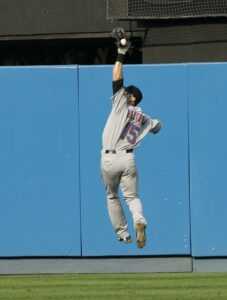
USATSI_23624114-227x300.jpg


His introduction to the postseason couldn’t have gone any better. Beltrán batted .435 with eight homers in 12 playoff games, helping Houston to within one game of a trip to the World Series. The Astros would go on to win the pennant one year later, but Beltrán had moved on in free agency by that point. He signed what was then a franchise-record deal with the Mets: seven years and $119MM.

Beltrán’s first season in Queens was a bit of a disappointment, but he rebounded with arguably the best season of his career in 2006. He hit a career-best 41 home runs and drove in a personal-high 116 runs with a .275/.388/.594 slash line. Beltrán won his first Gold Glove and Silver Slugger awards while finishing fourth in MVP voting. Baseball Reference credited him with eight wins above replacement, the best mark of his career. He remained a force into the playoffs, batting .278 with a .422 on-base percentage over 10 games.

For the second time in three years, Beltrán’s team lost the seventh game of an NLCS battle with the Cardinals. The ’07 Mets famously melted down in September to squander the NL East title to the Phillies. They wouldn’t return to the playoffs during Beltrán’s tenure, yet there’s no doubt they got their money’s worth from the free agent investment. Beltrán played in 839 games while hitting .280/.369/.500 with 149 homers over six and a half seasons in a Mets uniform.

The club also netted a top pitching prospect named Zack Wheeler when they traded the impending free agent to the Giants in 2011. He raked down the stretch with San Francisco, but they narrowly missed the postseason between their World Series wins in 2010 and ’12. Beltrán signed a two-year deal with the Cardinals the following year. He hit .282/.343/.493 over his time in St. Louis, but his impact again was brightest in the postseason. Beltrán was a stellar playoff performer in both years.

Beltrán signed a three-year contract with the Yankees over the 2013-14 offseason. He remained an above-average hitter over his time in the Bronx, albeit without the defensive value he’d had for the majority of his career. He made it back to the playoffs in 2016 after being dealt to the Rangers at the deadline. Beltrán finished his career on a one-year contract to return to the Astros.

The final season in Houston wound up leaving Beltrán with a complicated legacy. He was an integral part of the team’s sign-stealing operation that wasn’t publicly revealed until a few seasons thereafter. Beltrán wasn’t much of an on-field contributor at age 40, but he collected his first World Series ring when the Astros won their first title in franchise history.

Beltrán’s role in the sign-stealing scandal became public over the 2019-20 offseason. He had just been hired by the Mets as manager a few months earlier. He stepped down and forfeited his salary once the operation became public. Beltrán has remained involved in the game in less prominent roles, working as a television analyst with the YES Network and spending the past few seasons as a special assistant in the Mets’ front office. He’s also in charge of building the roster for the Puerto Rican national team at the upcoming World Baseball Classic.

The sign-stealing scandal probably delayed Beltrán’s entry to Cooperstown. His statistical résumé made him a very strong candidate to get in on the first ballot. He finished his playing days with a .279/.350/.486 batting line. He hit 435 home runs, stole 312 bases, and drove in nearly 1600. Baseball Reference valued his career at 70 WAR, which doesn’t even account for his playoff excellence. Jay Jaffe’s JAWS metric has him as a top 10 center fielder of all time. Whatever trepidation some voters may have had about honoring him within the first couple years on the ballot, the end result is that he’s headed to Cooperstown to cement his legacy as one of the best center fielders to play the game.

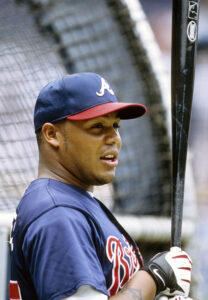
That’s also the case for Jones, who ranks 11th among center fielders by the same JAWS calculation. He gets in on his ninth year on the ballot, one season after receiving 66% of the vote. A native of Curacao, Jones signed with the Braves as an international amateur and flew through the minor leagues. He was the #1 prospect in the game when he reached the majors in the second half of the 1996 season. Jones stepped seamlessly onto a loaded Atlanta roster that was midway through their run of dominance in the National League. They were coming off a championship and would head back to the Fall Classic in ’96.

A 19-year-old Jones embraced the big stage, hitting .345 with a trio of home runs in October. That included a two-homer showing in Game 1 against the Yankees, and he remains the youngest player ever to hit a World Series home run. The Braves won the first game but wound up dropping the series in six.

Jones played mostly right field during his first full season. He hit .231 with 18 homers in 153 games and finished fifth in NL Rookie of the Year balloting. He really took off the following year, kicking off a decade-long run as the sport’s best defensive outfielder and a premier power threat. Jones hit 31 homers while batting .271/.321/.515 and earning his first Gold Glove in 1998. That was his first of seven 30-homer campaigns and, more remarkably, the start of a streak of 10 consecutive Gold Glove awards.
USATSI_8484016-208x300.jpg


He’d start all 162 games for the Braves in 1999, playing elite defense while batting .275/.365/.483 with 26 homers and 35 doubles. The Braves made it back to the World Series after losing the NLCS in the prior two seasons. They were again knocked off by the Yankees, this time in a sweep. Jones didn’t have great playoff numbers over that stretch but remained one of the league’s best players in the regular season. He hit 36 homers in a 2000 season which Baseball Reference valued at eight wins above replacement, a career high that ranked fourth in MLB among position players.

Jones earned an eighth-place MVP finish in 2000 and very likely would have finished higher had today’s defensive metrics been around at the time. He reeled off another three 30-plus homer seasons after that, narrowly dropping below that cutoff with a 29-homer showing in 2004. He rebounded with his most impressive offensive performance in ’05, as he slugged an MLB-best 51 longballs and led the National League with 128 runs batted in. Jones won a Silver Slugger for the first and only time and finished as the MVP runner-up behind Albert Pujols. It was a narrow split, as Pujols received 18 first-place votes against Jones’ 13. (Third-place finisher Derrek Lee received the other one.)

The righty hitter remained an impact run producer the following season, as he slugged 41 more home runs with a career-high 129 RBI. That was his last impact season, as his rate stats dropped in 2007. The Braves let him depart in free agency at season’s end, and he was essentially finished as an everyday player at age 31. Jones played parts of five more seasons between the Dodgers, Rangers, White Sox and Yankees. He didn’t record more than 64 hits in any of his final five campaigns.

While it was a precipitous decline, Jones had one of the more impressive peaks in baseball history. He hit 368 home runs with a .263/.342/.497 batting line between his debut and the end of his age-30 season. Retroactive defensive metrics come with significant error bars, but FanGraphs estimates he was roughly 134 runs better than an average defender during that stretch. That’s 25 runs clear of the second-place finisher at any position (Adrian Beltré) and certainly aligns with both his impressive accolades and scouting evaluations that consider him among the best outfield defenders in MLB history. Jones is one of six outfielders to win 10 Gold Gloves. He’s alongside Roberto Clemente, Willie Mays, Ken Griffey Jr., Al Kaline and Ichiro in that company and now, in Cooperstown.

Jones finished his career as a .254/.337/.486 hitter. His 434 homers place him one behind Beltrán for sixth among center fielders and tied with Juan González for 49th regardless of position. He nevertheless had a lengthy stay on the ballot as some voters struggled with his lack of production after he left Atlanta. Others may have withheld a vote on moral grounds, as Jones pleaded guilty to domestic battery charges and paid a fine after his wife alleged that he put his hands around her neck in December 2012. That came after the end of Jones’ MLB career, though he subsequently played two seasons in Japan to finish his professional playing days.

While Jones will certainly go into the Hall as a Brave, Beltrán had a nomadic enough career to consider a few options for his plaque. The Hall of Fame has final say but works with the player to choose which cap they’ll don. Beltrán tells Bob Nightengale of USA Today that while no decision has been finalized, he’s likely to go into Cooperstown as a Met.

Looking further down the ballot, Chase Utley’s 59% vote share was the highest among the candidates who were not elected. That’s up 20 points relative to last winter. It puts Utley, who has been on the ballot for three years, on track for eventual enshrinement — with an outside chance that he gets in as soon as next year. No other candidate appeared on more than half the ballots.

Of this year’s first-time candidates, only Cole Hamels (23.8%) received more than the 5% necessary to remain under consideration. All but one player who fell off the ballot was up for consideration for the first time. The lone exception is Manny Ramírez, who drops off after coming up short in his 10th year. Ramírez’s history of performance-enhancing drug use (including a failed test) made him a non-starter for many voters, and he appeared on fewer than 40% of ballots in his final year. His only path to enshrinement is via the Era Committees, and their decision last month on Barry Bonds and Roger Clemens makes it difficult to see a scenario where Ramírez ever gets in.

Next year will be the final consideration for Omar Vizquel, who has no chance of jumping from 18% to induction. Buster Posey and Jon Lester headline a class of first-time candidates that’ll also include Ryan Zimmerman, Kyle Seager, Brett Gardner and Jake Arrieta. Posey seems likely to get serious consideration for first-ballot induction, while Lester should easily have enough support to get more than 5% and remain on the ballot for future seasons.

Full voter breakdown courtesy of BBWAA. Respective images via USA Today Sports.

Source: https://www.mlbtraderumors.com/2026/01/carlos-beltran-andruw-jones-elected-to-hall-of-fame.html
 
Cardinals Showing Interest In Austin Hays

The Cardinals are among the teams that have expressed interest in free agent outfielder Austin Hays, reports Jon Heyman of The New York Post. Heyman has previously linked Hays to the Yankees, Mets and Royals this offseason.

St. Louis president of baseball operations Chaim Bloom said over the weekend that the team was open to adding a righty-hitting outfielder. Bloom’s comments came in response to a fan question about Harrison Bader, yet Hays seems more in line with the kind of player the Cardinals would target. Bader should be able to command a multi-year deal on a team that’d play him every day in center field, where St. Louis probably wants to continue giving Victor Scott II a chance to develop offensively.

Hays is likely to sign for much more cheaply on a one-year deal. He’d be more of a rotational corner outfield piece, ideally used most often as a short side platoon bat. He’s a career .282/.340/.479 hitter in a little over 800 plate appearances versus lefty pitching. The 30-year-old owns a slightly below-average .253/.301/.416 line in 1816 trips to the plate against right-handers. Last year’s splits were even more extreme, as Hays had a .949 OPS against southpaws and a .708 mark without the platoon advantage.

The Cardinals have the lefty-hitting Scott in center field and another left-handed bat, Lars Nootbaar, lined up to play left field. Nootbaar could be traded this offseason and seems more likely than not to move by the deadline. Alec Burleson is another left-handed hitter with ample corner outfield experience, but he’s expected to be the primary first baseman after the Willson Contreras trade.

Righty-swinging Jordan Walker will probably get another chance in right field, but he has a minor league option remaining and hasn’t found any kind of sustained MLB success. Prospect Joshua Baez, another righty bat, and lefty-hitting depth options Nathan Church and Bryan Torres are also on the 40-man roster. Hays has played exclusively left field over the past couple seasons. The Cardinals are also among the teams looking at Miguel Andujar, who offers a similar skillset but will probably be a little more expensive coming off an excellent finish to the 2025 season with Cincinnati.

Source: https://www.mlbtraderumors.com/2026/01/cardinals-showing-interest-in-austin-hays.html
 
Cardinals Hire Yadier Molina As Special Assistant

The Cardinals announced today that franchise legend Yadier Molina has been hired as special assistant to president of baseball operations Chaim Bloom. His duties will be focused on catching and game planning strategy.

“We are happy to welcome Yadi back to the Cardinals organization,” said Bloom in a statement, as relayed by John Denton of MLB.com. “He is an elite competitor, a consistent winner, and one of the greatest ever at his position, and we look forward to many contributions during his visits with us in this new role, both in and out of uniform. Yadi will provide input on our catching program, will advise our staff on catching and game planning strategy, and will give me and our front office valuable perspective from his unique vantage point. Perhaps most important, he will help us nurture in our players the high standards, attention to detail, and championship mindset that are so critical to winning.”

Fans in the St. Louis area are well familiar with Molina and his many accolades. He played for the Cardinals for nearly 20 years, beginning in 2004 and sticking around through 2022. His offense was up-and-down over his career but great at his peak. Even when his bat was on the lighter side, he provided value with his defense and intangible abilities as a team leader. Along the way, he made ten All-Star teams, won nine Gold Gloves and helped the Cards win titles in 2006 and 2011.

Due to those leadership qualities, he has long been seen as a future coach or manager, and he has expressed a desire to pursue those jobs. He has gained some managerial experience in a few Latin American leagues. He also managed the Puerto Rican team in the 2023 World Baseball Classic and is slated to do the same for this year’s version.

He and the Cards have previously broached the subject of him returning to the organization for a dugout role with them. Per Derrick Goold of the St. Louis Post-Dispatch, family commitments have been an obstacle to him taking on a full-time gig so far. Perhaps that will come to fruition in the future. For now, Molina will help the club in this role.

The Cards are in a rebuilding phase where they will be focusing on developing young players. That includes a cluster of catchers including Iván Herrera, Pedro Pagés, Yohel Pozo, Leonardo Bernal, Jimmy Crooks, Rainiel Rodriguez and others. Molina will presumably be working closely with those guys as they try to absorb some of what made him such a great backstop during his career. If he does eventually commit to a coaching job in the future, the building of relationships with those catchers will have a head-start.

Photo courtesy of Jake Roth, Imagn Images

Source: https://www.mlbtraderumors.com/2026/01/cardinals-hire-yadier-molina-as-special-assistant.html
 
MLBTR Podcast: What The Tucker And Bichette Contracts Mean For Baseball – Also, Nolan Arenado And Ranger Suarez

The latest episode of the MLB Trade Rumors Podcast is now live on Spotify, Apple Podcasts, and wherever you get your podcasts! Make sure you subscribe as well! You can also use the player at this link to listen, if you don’t use Spotify or Apple for podcasts.

This week, host Darragh McDonald is joined by Steve Adams and Anthony Franco of MLB Trade Rumors to discuss…

  • The overlapping stories at the top of the market and what they might mean: The Dodgers agreed to a deal with Kyle Tucker. The Mets gave Tucker a similar offer but then pivoted to signing Bo Bichette. Tucker had a long-term offer from the Blue Jays and Bichette from the Phillies but both went for the short-term deals. Is this some kind of paradigm shift or just unique circumstances? (1:50)
  • Could we ever predict this type of pivot in our Top 50 post in future years? (17:25)
  • How these deals impact parity, the upcoming expected lockout, collective bargaining agreement, etc. (34:35)
  • Bichette’s fit in the Mets’ position player mix (recorded prior to the Luis Robert Jr. trade) (1:04:25)
  • The Cardinals trading Nolan Arenado to the Diamondbacks (1:15:25)
  • The Red Sox signing Ranger Suárez (1:26:55)

Check out our past episodes!

  • The Cubs Land Cabrera And Bregman, Remaining Free Agents, And Skubal’s Arbitration Filing – listen here
  • Contracts For Imai And Okamoto, And Thoughts On The Pirates And Giants – listen here
  • Three-Way Trade, Murakami’s Short-Term Deal, And Willson Contreras To Boston – listen here

The podcast intro and outro song “So Long” is provided courtesy of the band Showoff. Check out their Facebook page here!

Photo courtesy of David Banks, Imagn Images

Source: https://www.mlbtraderumors.com/2026...all-also-nolan-arenado-and-ranger-suarez.html
 
A’s Had Deal In Place For Nolan Arenado Prior To D-Backs Trade

The Nolan Arenado trade saga in St. Louis came to a close last week, when he was dealt to Arizona in exchange for salary relief and minor league righty Jack Martinez. According to a report from Ken Rosenthal of The Athletic, however, the Diamondbacks weren’t the only team to reach a deal with the Cardinals. Rosenthal reports that the Athletics not only pursued Arenado in trade with St. Louis, but that the sides actually had a deal in place that would’ve sent Arenado to the west coast. The deal would’ve seen the A’s take on more money than Arizona was willing to, Rosenthal notes, but was scuttled by the fact that Arenado indicated he preferred to go to the Diamondbacks or Padres and may not have approved a deal with the A’s.

The news represents the latest indication of the Athletics’ desire to return to contention in advance of their move to Las Vegas, which is expected to be in time for the 2028 season. Arenado, 35 in April, is under contract for just two more seasons and would likely not have been on the club by the time the team arrived in Nevada. Even so, his addition would’ve been a way for the team to address third base in the short term. The A’s brought in Jeff McNeil to take over second base earlier this winter, and already have impressive players at first base (Nick Kurtz), shortstop (Jacob Wilson), DH (Brent Rooker), catcher (Shea Langeliers) and the outfield corners (Lawrence Butler and Tyler Soderstrom). That leaves third base as one of the most obvious places the team could upgrade, and even an aging Arenado would likely provide a higher floor than 23-year-old Max Muncy at the position.

That makes it fairly easy to see why the A’s would have interest in Arenado’s services and, if the team was willing to take on a larger portion of Arenado’s salary in order to facilitate the deal than Arizona wound up agreeing to take, it’s easy to see why the Cardinals would have seen the Athletics as an attractive trade partner. Unfortunately for both clubs, however, Arenado wasn’t quite so enthused. The veteran and likely future Hall of Famer seemed to prioritize playing for a club with more credible playoff aspirations as he wielded his no-trade clause over the past two offseasons, and the A’s are not exactly a proven playoff squad. Even after last year’s steps forward, the team finished with a middling 76-86 record that left them fourth place in the AL West. While that was a modest improvement over the year prior, it still left them far out from a playoff spot. The fact that the A’s are currently playing in a minor league park presumably didn’t help.

Perhaps a full season of Kurtz and development for the team’s other young players can help them take another step forward, but teams like the Mariners, Astros, and even Rangers don’t seem likely to be going anywhere this year. That leaves the A’s in a precarious position as far as making the playoffs go, and Arenado clearly wasn’t enthused about rolling the dice on the team. While the Diamondbacks are exceedingly unlikely to win the NL West this year thanks to the mighty Dodgers, they should be in the mix for a Wild Card spot alongside teams like the Padres, Giants, Mets, Braves, and Reds. That’s a much thinner field than the Wild Card race in the AL, which arguably includes all five teams in the AL East alone.

If the A’s want to consider other possible upgrades to the third base position, there are at least a handful of other trade options out there. Cardinals utility man Brendan Donovan and Cubs youngster Matt Shaw both have the ability to handle the hot corner, but could be too expensive in terms of the return cost for the A’s to swing a deal. Perhaps the Phillies would be willing to move Alec Bohm, but they seem less likely to do so than they were when they were pursuing Bo Bichette. The Astros could look to move Isaac Paredes, but it would be a shock to see them trade within the division. Lower level free agents like Yoan Moncada and Ramon Urias could serve as an alternative route to upgrade the roster, though the A’s have at times had trouble luring players to West Sacramento.

Source: https://www.mlbtraderumors.com/2026...for-nolan-arenado-prior-to-d-backs-trade.html
 
Cardinals Sign Nelson Velazquez To Minor League Deal

The Cardinals announced their group of non-roster invitees to Spring Training this evening. Corner outfielder/designated hitter Nelson Velázquez is among the group, indicating they’ve signed him to a minor league contract.

Velázquez, 27, is looking to get back to the majors for the first time in two seasons. He bounced around last year after being outrighted off the Royals’ 40-man roster during Spring Training. Kansas City released him in May after he hit .202 across his first 33 Triple-A contests. Velázquez needed to settle for a job in the Mexican League but raked over 49 games there to play his way back to affiliated ball. He latched on with the Pirates on a minor league deal and played the final month with their top affiliate in Indianapolis.

The righty-hitting Velázquez carried over his strong form from Mexico in his second look at Triple-A pitching. He closed the season with a .284/.329/.554 line with five homers in 79 plate appearances. It wasn’t enough to get an MLB call from the Pirates, but he secured a non-roster invite from St. Louis.

Velázquez has split his major league work between the Cubs and Royals. He went on a power barrage in the second half of the ’23 season, slugging 14 homers over 40 games after the Royals acquired him from Chicago. That’s his only real run of big league success, as he struggled on either side of that scorching stretch. Velázquez has a .212/.286/.433 batting line in 615 plate appearances, essentially the equivalent of one full season. He has 31 homers in that time but the batting average and on-base marks haven’t been sufficient.

The Cardinals are amidst a rebuild that should open some playing time in the outfield. They already did so indirectly with the Willson Contreras trade, which is expected to bring Alec Burleson in from the outfield as the primary first baseman. St. Louis could move left fielder Lars Nootbaar, although they may prefer to wait until midseason to show his health after postseason heel surgeries. Jordan Walker is lined up for another look in right field in what looks like a make-or-break year for the former top prospect. There’s less opportunity available at designated hitter, where Iván Herrera will get the majority of the playing time when he’s not catching.

Velázquez has some similarities to Walker and current prospect Joshua Baez as right-handed power bats. The Cardinals certainly aren’t going to force him into the lineup over younger players who could be core pieces. He’s their only non-roster outfielder with MLB experience and seems likely to open the season at Triple-A Memphis.

Source: https://www.mlbtraderumors.com/2026/01/cardinals-sign-nelson-velazquez-to-minor-league-deal.html
 
Make Or Break Year: Nolan Gorman

The Cardinals have more firmly committed to a retool than they did last offseason. They treated last season primarily as an evaluation year but weren’t as aggressive in selling off veteran pieces as they’ve been this winter. Unfortunately, they didn’t see any development from former first-round picks and top prospects Jordan Walker and Nolan Gorman. They’re in a similar position now as they were 12 months ago, though the pressure is probably ramping up on both players.

MLBTR examined Walker’s situation as the ’25 season was nearing its end. He’ll enter camp as the everyday right fielder but needs to take a major step forward if he’s to project as a regular on the 2027 team. There might be even more urgency for Gorman, who is two years older than Walker and has more than 1500 major league plate appearances under his belt. He’ll turn 26 in May. If there’s a breakout season in the cards, it probably needs to be now.

The opportunity should be there. After more than a year of trade rumors, the Cards lined up the Nolan Arenado deal a couple weeks ago. Third base is open, at least in the short term. Top prospect JJ Wetherholt is on the doorstep of the majors and may even play his way onto the Opening Day roster. There’s a good chance the Cardinals trade Brendan Donovan within the next two months, though, which would open second base for Wetherholt. That’d leave Gorman competing with Thomas Saggese for playing time at the hot corner.

Saggese has a strong minor league track record, but his very aggressive approach probably leaves him in a utility role. Gorman has flashed a higher ceiling, yet it’s a couple seasons in the rearview. He hit 14 home runs in 89 games as a rookie, then slugged 27 longballs with a .236/.328/.478 slash line in year two. Gorman entered the 2024 season as a .232/.317/.454 hitter with 41 homers in his first season and a half as a big leaguer.

USATSI_26995749-300x200.jpg


There was a significant amount of swing-and-miss, but Gorman’s power was enough to fit in the middle third of a lineup. That hasn’t been the case over the past two seasons. Gorman has taken roughly 800 trips to the plate in that time. His batting average and on-base percentage have dropped by 30 points each, while his slugging mark has fallen by more than 50 points. Gorman carries a .204/.284/.385 slash going back to the beginning of 2024.

His general profile is much the same as it was early in his career. The lefty hitter has a reasonably patient approach and works a decent number of walks, but his pure bat-to-ball ability is subpar. That’s probably not going to change as he gets into his late 20s. He needs to do damage when he does make contact. A combined 33 homers over his past 218 games isn’t enough.

Gorman battled a couple injuries last year. He missed time early in the season with a hamstring strain and was sidelined by lower back pain around the All-Star Break. The actual injured list stint was minimal, but it’s possible he was playing at less than full strength for the final two months. He finished the season with a .187/.278/.323 line while striking out at a near-40% rate in 45 games after returning from the IL stint. Gorman has battled intermittent back discomfort for a few seasons.

Whatever the cause, Gorman’s bat speed has gone slightly in the wrong direction. He’s still pulling a lot of balls to right field, which is where he’s most likely to hit for power, but it’s not with the same authority as he did in 2023. He also dramatically scaled back how often he swings at the first pitch and hunts pitches in the heart of the plate. That earned him a few more walks than he took the year before, but it’s not ideal for putting him in positions to drive the ball.

Gorman has between three and four years of service time. He’s playing on a $2.655MM arbitration salary. He still has a couple minor league option years remaining, so he’s not on the roster bubble right now. A third straight replacement level performance would make him a likely non-tender next offseason, however.

Image courtesy of Jeff Curry, Imagn Images.

Source: https://www.mlbtraderumors.com/2026/01/make-or-break-year-nolan-gorman.html
 
Managers & Top Front Office Executives On Expiring Contracts

In the same way that players feel extra pressure to produce entering their last season before free agency, managers and front office bosses similarly feel the heat when entering the final year of their contracts. The difference is that even if a player has a rough season, they’re usually still in position to land at least a one-year deal in some fashion for the next year — a manager or a GM could find themselves fired in the wake of a bad year, with no guarantee about when (or even if) they’ll get another shot at leading a dugout or a front office.

This list details the baseball operations bosses (whatever their specific title) and managers who are entering the final year of their contracts, as well as the personnel whose contractual situations aren’t publicly known. Some clubs don’t publicize the terms of employee contracts, so it is entirely possible that some of these names signed extensions months ago but the teams have chosen to keep these new deals quiet for the time being. And, of course, the length of a contract doesn’t always correlate to job security. One bad season or even a poor start could suddenly threaten the status of a manager or head of baseball ops that seemingly seems safe right now.

As always, thanks to Cot’s Baseball Contracts for reference information on some of these contracts.

Angels: It’s pretty unusual to see a newly-hired manager already on this list, yet that is the situation Kurt Suzuki finds himself in after signing just a one-year guarantee to become the Halos’ new skipper. The deal has multiple club option years attached, and while one would imagine Suzuki wouldn’t be let go so quickly, the Angels’ manager’s office has been enough of a revolving door in recent years that it is hard to guess what owner Arte Moreno might do next. GM Perry Minasian is also entering the final guaranteed year of his contract, with a club option for the 2027 season. Ten consecutive losing seasons has led to a lot of discord in Anaheim, and an eleventh sub-.500 year might get both Suzuki and Minasian sent packing by next offseason.

Astros: GM Dana Brown and manager Joe Espada are each entering their final season under contract, with Brown hired in January 2023 and Espada in November 2023. Earlier this month, Astros owner Jim Crane didn’t entirely close the door on the possibility of an extension for either Brown or Espada, but said “I think we’ll go through this year like we always do, evaluate it and then make the decision at the end of the year.” Reading between the lines, it certainly seems like the spotlight will be on Brown and Espada, especially since the Astros are coming off their first non-playoff season since 2016. While the team’s laundry list of injuries is a valid excuse for their 2025 letdown, some personnel changes might well be coming if Houston can’t get back into the postseason hunt this year.

Athletics: General manager David Forst’s contract has already expired, as his most recent deal with the team was up following the 2025 campaign. Owner John Fisher has stated that “conversations are ongoing” about another extension, and since it has apparently been business as usual for the A’s this offseason, it seems like it’s just a matter of time before Forst formally extends his long stint in the team’s front office. Forst only officially took over the baseball operations department in the 2022-23 offseason, but he has been with the Athletics since 2000, first working as a scout and then becoming one of Billy Beane’s top lieutenants.

Blue Jays: GM Ross Atkins and manager John Schneider are both entering the final year of their contracts, as the Jays exercised their 2026 club option on Schneider’s deal back in November. This duo was facing heavy pressure heading into the 2025 season, yet Toronto’s AL pennant and near-miss in the World Series has entirely changed the narrative for both Atkins and Schneider. The Blue Jays already extended team president/CEO Mark Shapiro a few weeks ago, and extensions for Atkins and Schneider should follow before Opening Day.

Brewers: Pat Murphy is entering the final season of his three-year contract, but it is hard to believe the Brew Crew won’t have the manager soon locked up on another deal. Murphy has been named NL Manager of the Year in each of the first two seasons, won consecutive NL Central titles, and this October led the Brewers to their first NLCS appearance since 2018. October also saw Matt Arnold receive a promotion from GM to president of baseball operations, even though Arnold has already been the Brewers’ top baseball exec for the last three seasons. Arnold’s specific contract situation hasn’t been made clear for a few years now, but it would surely seem like Milwaukee’s continued success and his new job title probably landed the PBO an extension at some point. Regardless, Arnold seems in no danger of being fired even if 2026 is his last year under contract.

Cardinals: Oli Marmol is headed into his final year, but the manger and the Cardinals have already started discussing an extension to retain Marmol beyond the 2026 campaign. It seems like something should be finalized in due course, with St. Louis continuing to entrust Marmol with the reins as the team now moves into a full-on rebuild phase.

Diamondbacks: Torey Lovullo has quietly become one of baseball’s longer-tenured managers, as Lovullo has been running Arizona’s dugout since the 2016-17 offseason. He has signed multiple extensions (none for more than two guaranteed years) since his initial three-year pact, yet while 2026 represents the final year of Lovullo’s current deal, the Diamondbacks are reportedly going to let Lovullo enter the season without an extension in place. Owner Ken Kendrick did praise Lovullo’s efforts in keeping the D’Backs competitive amidst a swath of pitching injuries and a partial trade deadline selloff in 2025, but it is intriguing that the vote of confidence wasn’t backed up by another contract. This will be a storyline to watch as the Diamondbacks’ season progresses, and a change in the dugout might well be coming if the D’Backs can’t get back into the postseason.

Dodgers: President of baseball operations Andrew Friedman first came to Los Angeles on a five-year, $35MM pact covering the 2015-19 seasons, and he signed an extension back in November 2019. Terms of that deal weren’t known, yet it is clear that if Friedman hasn’t already signed another new deal in the last six years, the Dodgers are almost surely keen in retaining the executive. The Dodgers have reached the playoffs in every single season of Friedman’s tenure, have won three World Series championships under his leadership, and have become baseball’s dominant franchise due to both their record-high payrolls and their ability to draft and develop minor league talent.

Guardians: Chris Antonetti gets an obligatory mention since the Guardians haven’t publicly addressed his contract status since he signed an extension with the team back in 2013. Following the 2015 season, Antonetti was promoted to the president of baseball operations title, and his decade in charge has seen Cleveland make seven postseason appearances. As the Guards are coming off their sixth AL Central crown of Antonetti’s tenure, there is no sense ownership is looking to make a change, nor is there any sense Antonetti (who has turned down overtures from other teams in the past) is looking to leave.

Mariners: Dan Wilson’s contract terms weren’t made public when he was hired as manager in August 2024, and president of baseball operations Jerry Dipoto’s status hasn’t been addressed since he signed a contract extension of an unknown length back in September 2021. It may very well be that Dipoto has quietly signed another deal in the last four-plus years, but regardless, the Mariners’ success in 2025 very likely means neither Dipoto or Wilson are going anywhere, even if the M’s don’t feel the need to publicize any extensions.

Marlins: Previous Miami GM Kim Ng was signed to a three-year contract with a club option for the 2024 season, and the Marlins chose to pass on that option in order to hire Peter Bendix as the new president of baseball operations. Terms of Bendix’s contract weren’t disclosed, so given the length of Ng’s contract, it is possible Bendix could also be entering his final guaranteed year if Miami pursued the same structure with another first-time front office boss. While Ng’s dismissal caught many in baseball by surprise, Bendix’s job appears to be a lot safer, as the Marlins’ surprising surge to 79 wins in 2025 is a promising step forward for the team’s (latest) rebuild.

Mets: Carlos Mendoza is entering the final guaranteed year of his three-year contract, and New York holds a club option on the manager’s services for the 2027 season. The Mets have overhauled both Mendoza’s coaching staff and a good chunk of the roster in the wake of the slow-motion collapse that left the team outside the playoff picture in 2025, so far more is expected than just an 83-79 record this year. The club option probably means that the Mets will wait until after the season (if at all) to discuss an extension, and given the Mets’ high payroll and expectations, even a slow start might put Mendoza’s status in jeopardy.

Orioles: Mike Elias’ contract terms were never publicized when he was hired to lead Baltimore’s front office in November 2018, though he did receive a title change from general manager to president of baseball operations last offseason. Elias’ specific contract status remains unspecified, and it is possible he could be facing more heat if the O’s have another subpar season. Consecutive playoff appearances were followed by the thud of a 75-87 record in 2025, though ownership appears to have given Elias some support in the form of bigger budget, as the Orioles’ busy offseason has been highlighted by the blockbuster Pete Alonso signing.

Padres: Reports in early November suggested that A.J. Preller was close to signing a new extension to remain as San Diego’s PBO, though close to three months later, there hasn’t been any word of a deal between the two sides. It could be that a contract was signed but simply not publicly announced, or perhaps Preller and the team agreed to table the negotiations until after most of the Padres’ offseason business was complete. Considering all the reports of discord within the Padres’ ownership situation and some possible tension between Preller and team CEO Erik Greupner, a contract extension probably shouldn’t be considered a sure thing until a deal is actually done, though things still seem to be leaning in the direction of Preller getting re-upped. For all of the off-the-field drama that has frequently defined Preller’s long tenure in San Diego, the Padres are coming off their fourth playoff appearance in the last six seasons.

Reds: As Cincinnati is coming off its first playoff berth since 2020, president of baseball operations Nick Krall looks to have a decent amount of job security, and might be in line for an extension depending on his current contract status. Krall has been in charge of the Reds’ front office for the last five seasons, and he received an extension of an unspecified length when he was promoted to the president of baseball operations title following the 2023 campaign.

Tigers: Scott Harris has now finished three full seasons as Detroit’s PBO, so if a four-year contract might be considered the usual minimum for a first-time president of baseball ops, 2026 might be Harris’ final year under contract. It’s all speculative, of course, since Harris’ terms weren’t made public, and it might also be a moot point since Harris could be an extension candidate, if anything. The Tigers have made the second round of the playoffs in each of the last two seasons, though the team’s late-season collapse in 2025 and the uncertainty over Tarik Skubal’s future remain areas of concern.

Twins: Derek Falvey’s shocking decision to step down as Minnesota’s president of baseball (and business) operations has unexpectedly made GM Jeremy Zoll the top voice in the team’s front office. Zoll was promoted to the GM role in November 2024 to become Falvey’s chief lieutenant, and the length of Zoll’s contract isn’t known. It is fair to guess that Zoll might’ve gotten an extension after becoming general manager, so he probably remains under team control through at least 2027 even after this sudden elevation to the head of the baseball ops department.

White Sox: Chris Getz has been the team’s GM since August 2023, and his tenure has included a record 121-loss season in 2024 and an improvement to “only” 102 losses in 2025. Getz’s contract term wasn’t publicized at the time of his hiring so this is just a speculative entry in case his first deal was only a three-year pact. There doesn’t appear to be any sense that ownership is displeased with the Pale Hose’s progress during the rebuild, so if Getz actually did sign a three-year deal, the Sox might look to extend him at some point this season.

Yankees: Brian Cashman is the longest-tenured front office boss in baseball, acting as the Yankees’ GM since February 1998. That remarkable 28-year run has included 28 winning records and four World Series titles, though the team hasn’t won the Series since 2009. Owner Hal Steinbrenner appears to trust Cashman as much as ever, so it seems very likely that Cashman’s tenure will stretch into a third decade barring an utter disaster of a 2026 season. Cashman’s last deal covered the 2023-26 seasons, but since the Yankees’ aversion to extensions also extends to personnel as well as players, he might not sign his next contract until after his current deal actually expires. It’s a sign of Cashman’s job security that he has waited until December to sign each of his last two contracts to remain with the club.

Source: https://www.mlbtraderumors.com/2026...ffice-executives-on-expiring-contracts-7.html
 
Back
Top