
Blue Jays Sign Kazuma Okamoto

The Blue Jays have finally made a big strike in the Japanese market, as ESPN’s Jeff Passan reports that the team has signed infielder Kazuma Okamoto. The deal is a four-year contract worth $60MM, according to Jon Heyman of the New York Post, and MLB.com’s Mark Feinsand adds that there are no opt-outs and that Okamoto gets a $5MM signing bonus. Okamoto is represented by the Boras Corporation.

Okamoto’s 45-day posting window was set to expire tomorrow at 4pm CT, so it was expected that the infielder would settle on his first Major League team today and finalize the agreement (i.e. complete a physical) before Sunday’s deadline. MLB Trade Rumors ranked Okamoto 19th on our list of the offseason’s top 50 free agents, and our projection of a four-year, $64MM deal was just slightly above what Okamoto landed from the Jays.

Matching financial expectations is no small feat, given how Tatsuya Imai (three years/$54MM guarantee from the Astros with two opt-out clauses) and Munetaka Murakami (two years, $34MM from the White Sox) both had to settle for shorter-term deals in their trips through the posting window this winter. Okamoto’s payday also translates to a $10.875MM posting fee for the Yomiuri Giants, the infielder’s now-former NPB team. As per the terms of the NPB/MLB posting system, the NPB team’s fee is 20% of the first $25MM of a player’s guaranteed MLB contract, 17.5% of the next $25MM, and 15% of all further spending.

It was a little under a month ago that Toronto was first linked to Okamoto, and the 29-year-old now projects to be the Jays’ regular third baseman. Okamoto also has experience playing first base (making him an overqualified backup option to Vladimir Guerrero Jr.) and in the outfield, so he joins Addison Barger and Davis Schneider as Blue Jays players who can contribute in both infield and outfield roles.

For Barger in particular, it now seems like he’ll platoon with Okamoto at third base, while playing in the corner outfield when he isn’t at the hot corner. This could bump Ernie Clement into primarily a second base role, with Andres Gimenez expected to move from second base to an everyday shortstop role. The right-handed hitting Clement can also spell the lefty-swinging Gimenez at shortstop when a southpaw is on the mound, with Schneider (another righty bat) moving to second base in those circumstances.

All of these moving pieces don’t even factor in the possibility that Bo Bichette could still re-sign with the Blue Jays, even with Okamoto now in the fold. If Bichette returns to an everyday role at either shortstop or (perhaps more likely) second base, Barger or Okamoto could see more time in the outfield. On the flip side, if the Blue Jays were to land another rumored target in outfielder Kyle Tucker, Toronto would then likely have to trade from a crowded outfield mix that would include Tucker, Daulton Varsho, George Springer and Anthony Santander splitting DH duty and one corner outfield slot, Nathan Lukes, Myles Straw, Joey Loperfido, and Okamoto, Barger, and Schneider all available in a part-time outfield capacity.

However things play out, it adds to what has already been a fascinating offseason for a Blue Jays team that came within two outs of winning Game 7 of the World Series. The team’s efforts to add the final piece of the puzzle have mostly focused on pitching to date, with Dylan Cease and Cody Ponce signed to reinforce the rotation, and Tyler Rogers added to the relief corps.

Bichette and Tucker have naturally dominated the rumor mill when it came to possible lineup additions, and players like Cody Bellinger, Ketel Marte, Alex Bregman, and Yoan Moncada were also reportedly on Toronto’s radar. The Okamoto signing probably closes the door on Bregman and Moncada specifically since the two are third basemen, unless the Jays made the curious decision of using Okamoto primarily as a corner outfielder.

Okamoto’s third base defense was strong enough to earn Golden Glove awards when playing with Yomiuri Giants in 2021-22, though he has played an increased amount at first base in the last three years. Scouts generally view Okamoto as at least a decent defensive third baseman at the MLB level, and his ability to also capably handle first base and left field adds to his versatility around the diamond.

Moreso than his glovework, however, Okamoto’s biggest plus is his bat. One of the top hitters in Japan for most of the last decade, Okamoto has hit .277/.361/.521 with 248 home runs over 4494 plate appearances with the Giants. He had a run of six straight seasons of 30+ homers from 2018-23 before dropping to 27 long balls in 2024, and he hit 15 homers with a .322/.411/.581 slash line over 314 PA in 2025 in a season interrupted by an elbow injury that cost Okamoto roughly three months of the NPB campaign.

A six-time NPB All-Star and a member of Japan’s World Baseball Classic-winning team in 2023, Okamoto is known for his ability to generate power while still making a lot of hard contact without many strikeouts. This approach fits right into the offensive gameplan that worked so well for the Jays in 2025. Blue Jays hitting coach David Popkins drew raves for his work in helping several Toronto hitters break out last season, and he could certainly aid Okamoto in making a smooth transition to MLB, perhaps particularly when it comes to adjusting to higher-velocity pitching. As noted by Fangraphs’ Eric Longenhagen, Okamoto has been inconsistent against higher-velo (94mph+) pitches, but he already showed improvement in this department in 2025.

The signing also represents a breakthrough for the Jays in their efforts to land a high-profile Japanese star. The Blue Jays’ attempts to sign Shohei Ohtani, Yoshinobu Yamamoto, and Roki Sasaki during the previous two offseasons were all thwarted by the Dodgers, which added some extra sting when all three players (particularly World Series MVP Yamamoto) contributed heavily to Los Angeles’ narrow win over the Jays in the Fall Classic.

While the Dodgers weren’t publicly known to be in on Okamoto, such teams as the Red Sox, Pirates, Cubs, Angels, Mariners, and Padres were all linked to his market. Earlier this afternoon, MLB.com’s Mark Feinsand indicated that San Diego “could be the frontrunner,” but instead it was Toronto who ended up sealing the deal.

Okamoto’s $60MM contract represents another big expenditure for a Blue Jays organization that has already taken spending to team-record heights in recent years, and now put the club in the upper echelons of league-wide spending. RosterResource estimates a $286MM payroll for the Jays in 2026, and a luxury tax number of around $308.8MM.

This puts Toronto over the highest tax threshold of $304MM, meaning the team will again see their first-round pick in the 2027 draft dropped back 10 places, plus a 110% surcharge on any further spending. It’s clear that the Jays and Rogers Communications (the team’s ownership group) are ready to flex their financial muscle more than ever in pursuit of a World Series banner, so more splurges on Bichette or Tucker can’t be ruled out.

Source: https://www.mlbtraderumors.com/2026/01/blue-jays-sign-kazuma-okamoto.html
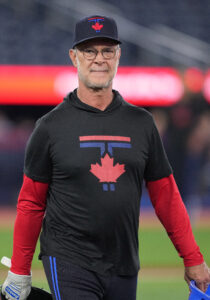
 
Blue Jays Designate Paxton Schultz For Assignment

The Blue Jays announced that right-hander Paxton Schultz has been designated for assignment. The transaction clears a 40-man roster spot for Kazuma Okamoto, whose four-year, $60MM deal with Toronto has now been officially announced.

A 14th-round pick for the Brewers in the 2019 draft, Schultz was traded to the Jays in 2021 and he has posted a 4.47 ERA over 203 1/3 innings of Triple-A ball. A good deal of that damage came when Schultz was being primarily used as a starter in 2023, but his numbers have improved since moving to more or less a full-time relief role. The move to the pen saw Schultz cut back on his walks and increase his strikeouts, as the Jays saw first-hand when Schultz made his MLB debut this past season.

The righty had a 4.38 ERA, 25.5% strikeout rate, and 7.3% walk rate over his first 24 2/3 innings in the Show, working mostly as a multi-inning reliever and making a pair of pseudo-starts during bullpen games. His 3.43 SIERA was markedly better than his 4.38 ERA, as Schultz was hampered by a .333 BABIP and four homers allowed during his small sample size of big league action.

It was an overall respectable debut for Schultz, yet he’ll now get the unwelcome gift of a DFA just a day before his 28th birthday. Despite his solid performance, the Blue Jays have enough other right-handed relief options that Schultz may have been a little expendable. Designating Schultz does run the risk for the Jays that another team could claim Schultz away on waivers, which is a distinct possibility given that Schultz has two minor league option years remaining and plenty of clubs are in need of bullpen help.

Source: https://www.mlbtraderumors.com/2026/01/blue-jays-designate-paxton-schultz-for-assignment.html
 
Phillies Hire Don Mattingly As Bench Coach

The Phillies announced Monday that they’ve hired Don Mattingly as the new bench coach to manager Rob Thomson. President of baseball operations Dave Dombrowski acknowledged last month that he’d spoken to Mattingly about the vacancy. Last year’s bench coach, Mike Calitri, changed roles this offseason and became the team’s major league field coordinator. Mattingly has spent the past three seasons as the Blue Jays’ bench coach but chose not to return in that role for the 2026 season as he instead explored other opportunities.

don-mattingly-coach-210x300.jpg


“I am excited to welcome Don Mattingly to Philadelphia,” Thomson said in this morning’s press release. “Having known Don for years and having worked closely with him in New York, I know that his knowledge of the game and his character make him a great addition to our tremendous coaching staff.”

Notably, Mattingly joins an organization that employs his son, Preston, as its general manager. The younger Mattingly isn’t the top decision-maker in Philadelphia’s front office — Dombrowski still holds hat role as the team’s president — but he’s a key figure in baseball operations who spent several seasons as the team’s director of player development and an assistant general manager before being elevated to his current post.

As Thomson noted in his comment, the two men worked together in the Yankees organization, though they didn’t overlap on the team’s major league coaching staff. Thomson actually succeeded Mattingly as bench coach in 2008, after Mattingly accepted an offer to become Joe Torre’s hitting coach in Los Angeles. He’d been in the running for the managerial vacancy in the Bronx that ultimately went to Joe Girardi, who named Thomson his new bench coach.

Even if they weren’t on the same big league staff, however, Mattingly and Thomson worked together with the Yankees. Mattingly was a minor league instructor prior to being added to the big league staff as hitting coach in 2003. During that time, Thomson worked both as a minor league manager and as a key figure in the Yankees’ player development department, where the two aligned to work with the Yankees’ up-and-coming talent.

In addition to his work as a bench coach and hitting coach between the Bronx and L.A., the now-64-year-old Mattingly spent five years managing the Dodgers and another seven managing the Marlins. He then jumped to the Jays, where he was first hired as bench coach and then had the title “offensive coordinator” added to his position. In that role, Mattingly oversaw the hitting coaches up and down the entire organization.

Now bound for Philadelphia, Mattingly will serve as Thomson’s top lieutenant. There’s been some speculation as to how long Thomson will continue to manage, but he signed a one-year extension through the 2027 season following the 2025 campaign, so he’s locked in for at least two more years. Mattingly is actually two years older than Thomson, so he’s not exactly the prototypical younger heir-apparent in waiting, but if Thomson does step away after his current contract, the Phillies would have an experienced option in the organization already. If not, Mattingly simply adds another seasoned coach to a veteran staff full of several well-regarded names.

Source: https://www.mlbtraderumors.com/2026/01/phillies-hire-don-mattingly-bench-coach.html
 
Poll: Will The Blue Jays Add Another Big Bat?

The Blue Jays have been the most active team of the winter, making splashes in the rotation (Dylan Cease, Cody Ponce), bullpen (Tyler Rogers), and mostly recently the lineup with their signing of third baseman Kazuma Okamoto. While Okamoto has a chance to be an impact bat, given his track record as one of the best hitters in NPB, he’s not on the same level as a few other hitters to whom Toronto has been linked. On one level or another, the Jays have been connected to most of the top free agent hitters this offseason. Most recently, reports have centered around three names: outfielder Kyle Tucker, infielder Bo Bichette, and third baseman Alex Bregman.

Mitch Bannon of The Athletic reported yesterday that while the Blue Jays could add more from here, that might require the team to subtract payroll elsewhere on the roster. Buster Olney and Jesse Rogers of ESPN wrote this morning that the Okamoto signing does not take the Jays out of the running for either Tucker or Bichette.

It’s been relatively quiet on the Tucker front, though Rogers and Olney suggest he has both short- and long-term possibilities in front of him. Whichever route he takes, the annual commitment will be significant. Toronto has expressed a willingness to deal Jose Berrios this winter, but his contract is underwater. They wouldn’t be able to shed the full freight of the $66MM he’s still owed. Anthony Santander is making significant money as well, but he’d be even more difficult to trade coming off of a career-worst season where he was limited to 54 games by injuries; Santander also posted a .175/.271/.294 slash (61 wRC+) when healthy enough to play.

Neither Berrios nor Santander would subtract enough payroll to fully offset the addition of a Tucker, Bichette or Bregman. Berrios is owed $18MM in 2026 and has matching $24MM salaries in 2027-28. Santander is owed $16.5MM in 2026 and ’27, $14.75MM in ’28 and $12.75MM in ’29. A hefty $10MM of his salary is deferred in each of those seasons.

If the Blue Jays are truly nearing maximum capacity when it comes to payroll, it’s hard to imagine them coming out on top for one of those star free agents. The Red Sox, Cubs, Dodgers, and Mets are among the other big market clubs to have been connected to at least one of those free agents in some capacity.

Of course, it’s possible the Jays don’t feel much need to subtract salary at all. Their $279MM payroll and $308MM of luxury tax obligations (according to RosterResource) are franchise records that thrust them into the top bracket of luxury penalization, but the Jays have a great deal of money coming off the books after this season. George Springer, Kevin Gausman, Shane Bieber, Daulton Varsho, Yimi Garcia, and Eric Lauer are all set to reach free agency after 2026. MLBTR contributor Matt Swartz projects Varsho and Lauer for a combined $14.1MM in arbitration this year, while the other four will combine for $70.5MM. That’s nearly $85MM in salary set to come off the books, and declining Myles Straw’s club option for next season would push that figure even higher.

Some of that money would surely need to be re-invested in the roster to replace the departing veterans, but next year’s free agent class doesn’t figure to boast a transformational, middle-of-the-order bat on the level of Tucker or even Bichette. Seiya Suzuki, Randy Arozarena, Nico Hoerner, and Jazz Chisholm Jr. are among the top position players set to reach free agency next winter. While all are talented players in their own rights, none is a surefire perennial All-Star like the top bats of this winter’s class. That could make it prudent for the Jays to throw caution to the wind this year and do some of next offseason’s shopping a year early.

How do MLBTR readers expect the Jays to proceed this winter? Will they come away with another top free agent before Opening Day, or will Okamoto be their top addition on offense? Have your say in the poll below:

Take Our Poll

Source: https://www.mlbtraderumors.com/2026/01/poll-will-the-blue-jays-add-another-big-bat.html
 
Blue Jays Continuing To Pursue Kyle Tucker

The Blue Jays had already been one of the sport’s most aggressive teams before signing NPB star Kazuma Okamoto to a four-year, $60MM contract over the weekend. Okamoto joins Dylan Cease, Cody Ponce and Tyler Rogers as significant free agent acquisitions. They’ve also been one of the clubs most frequently tied to the top two free agent hitters, Kyle Tucker and Bo Bichette.

There has been plenty of speculation that the Jays could be Tucker’s eventual landing spot. Mark Feinsand of MLB.com wrote yesterday that two of his sources pegged Toronto as the favorite for the market’s top player. Meanwhile, Mitch Bannon of The Athletic reports this evening that the Jays are making a stronger push for Tucker than they had earlier in the winter. Ben Nicholson-Smith of Sportsnet adds that the sides have had recent conversations, though he suggests the door remains open to Tucker or Bichette. Toronto’s interest in Tucker stretches back to the beginning of the offseason; he visited the club’s Spring Training facility in Dunedin on December 3.

RosterResource calculates the Jays’ payroll around $280MM, which is already $40MM above where they opened the 2025 season. Their luxury tax estimate sits at $308MM, more than $20MM north of last year’s season-ending tax number. They’re above the $304MM mark that represents the top tier of penalization. That already has them on track to pay around $30MM in luxury taxes, more than all but four teams (the Dodgers, Mets, Yankees and Phillies) paid last season. Any future spending is taxed at a 90% clip on the average annual value. A hypothetical $35MM AAV for Tucker would come with a $31.5MM tax on top of it.

[Related Poll: Will Jays Add Another Bat?]

It’s unclear how much of a deterrent the tax obligations are for the Jays. They’re already into uncharted financial waters after coming a few inches away from their first World Series in three decades. The Rogers ownership group and the front office are clearly committed to a win-now posture. George Springer, Shane Bieber, Kevin Gausman and Daulton Varsho will all be free agents next offseason. That’s a lot of money coming off the books but also four key contributors whom they’re not guaranteed to have back in 2027, which should only increase the motivation to make another run this year.

Tucker, a career .273/.358/.507 hitter, is the best offensive player available. He’d step into an everyday right field role, pushing Anthony Santander to left. The Jays would have Springer as their primary designated hitter. Okamoto and Addison Barger could play either third base or factor into the corner outfield. It wouldn’t leave much playing time for Nathan Lukes, who’d be a speculative trade candidate. Lukes is coming off a solid season (.255/.323/.407 with 12 homers) but isn’t the kind of player who’ll prevent teams from making a run at a star.

General manager Ross Atkins spoke in generalities this morning about the team’s diligence in looking for continued ways to improve (link via Ben Nicholson-Smith of Sportsnet). Atkins noted that any “additions at this point start to cut away playing time from players that we feel are very good major league pieces.” While it’s not a given that they’ll make any moves, that’d seemingly point toward them only strongly pursuing impact talent rather than targeting marginal upgrades over role players.

If the Jays were to land Tucker, that’d almost certainly close the door on a reunion with Bichette. One team signing the top three free agents in an offseason is essentially without precedent, and adding both players would push Toronto’s luxury tax number well above $350MM. Bannon indeed suggests that while the Jays aren’t out of the running for Bichette, a new deal with their longtime shortstop looks less likely after the Okamoto signing.

Playing Okamoto and/or Barger regularly at third base pushes Ernie Clement to second, where Bichette would probably be penciled in if he heads back to Rogers Centre. The bigger deterrent may simply be a reluctance on the team’s part to make a long-term commitment to Bichette. Bannon writes that a reunion could be more likely if the infielder settles for a shorter deal that allows him to opt out after the first season.

Source: https://www.mlbtraderumors.com/2026/01/blue-jays-continuing-to-pursue-kyle-tucker.html
 
MLBTR Podcast: Contracts For Imai And Okamoto, And Thoughts On The Pirates And Giants

The latest episode of the MLB Trade Rumors Podcast is now live on Spotify, Apple Podcasts, and wherever you get your podcasts! Make sure you subscribe as well! You can also use the player at this link to listen, if you don’t use Spotify or Apple for podcasts.

This week, host Darragh McDonald is joined by Steve Adams of MLB Trade Rumors to discuss…


Check out our past episodes!


The podcast intro and outro song “So Long” is provided courtesy of the band Showoff. Check out their Facebook page here!

Photo courtesy of Troy Taormina, Imagn Images

Source: https://www.mlbtraderumors.com/2026...o-and-thoughts-on-the-pirates-and-giants.html
 
OH MAN the Jays are going ALL IN and I am HERE FOR IT!! This is exactly what a franchise should do when they're this close to a championship. You get that close and you SWING FOR THE FENCES.

Look, I know I'm supposed to hate everything Toronto does as a Bills fan watching the Bills Mafia invade that city every year, but credit where credit's due - Ross Atkins is playing chess while half the league is playing checkers. Cease, Okamoto, and now STILL pushing for Tucker?? That's some serious commitment from ownership.

The Schultz DFA is whatever - guy had a decent debut but when you're trying to win NOW you can't be sentimental about fringe bullpen arms. Someone will probably claim him and good for him if they do.

The Mattingly to Philly thing is interesting though - working with his son as GM is gonna be either really smooth or REALLY awkward at Thanksgiving dinner when a move doesn't work out LOL

But back to the main event - if they actually land Tucker on top of everything else?? That lineup would be absolutely STACKED:

- Tucker in RF
- Santander in LF
- Springer at DH
- Okamoto at 3B
- Vlad Jr
- Bo... wait no Bo's gone... or IS HE??

The luxury tax stuff is insane - they're already looking at $30M+ in penalties and every dollar after is taxed at 90%!! But you know what, when you've got $85M coming off the books next year anyway, why NOT go for it now?

As much as it pains me to say anything positive about a Toronto team... this is how you compete. Take notes, rest of the AL East.
 
Blue Jays, Daulton Varsho Avoid Arbitration

The Blue Jays and outfielder Daulton Varsho have avoided arbitration, reports Joel Sherman of The New York Post. Varsho will make $10.75MM this year in his final season of club control. He’s a free agent next winter. That tops the $9.7MM figure projected by the algorithm of MLBTR contributor Matt Swartz by a margin of just under 11%. Varsho is repped by ISE Baseball.

The 29-year-old Varsho came to Toronto in the 2022-23 offseason via a trade sending then-top prospect Gabriel Moreno and Lourdes Gurriel Jr. back to Arizona. A converted catcher, Varsho has been a premier defensive center fielder from the jump and has seen his offense improve on a year-over-year basis in Toronto. After a rough start in ’23 (.220/.285/.389), Varsho hit .214/.293/.407 in 2024.

It was the 2025 season, however, where his bat truly took off. Recovery from offseason surgery delayed his season debut until late April, and he missed nearly two month of the summer due to a hamstring strain. But despite being limited to only 71 games and 271 plate appearances, Varsho belted 20 home runs while batting .238/.284/.548. He chipped in 13 doubles and a pair of triples, and his glovework in center field remained elite. Varsho went on to pop three more round-trippers in 81 postseason plate appearances.

Varsho’s agreement pushes the Blue Jays to a payroll of about $281MM, per RosterResource. Their $309MM worth of luxury tax obligations put them into the top tier of penalization, though Toronto is still reportedly in pursuit of further free agents — including incumbent infielder Bo Bichette and top free agent Kyle Tucker. The Jays will pay a 110% tax on any subsequent additions to the payroll due to that $309MM figure, but franchise-record levels of spending don’t appear to be a deterrent on the heels of Toronto’s run to Game 7 of the World Series in 2025.

Source: https://www.mlbtraderumors.com/2026/01/blue-jays-daulton-varsho-avoid-arbitration.html
 
18 Players Exchange Filing Figures

Teams and arbitration-eligible players had until 7:00 pm Central to agree to terms or exchange filing figures. The vast majority agreed to salaries, either this afternoon or before November’s non-tender deadline to ensure they were offered contracts at all.

There were 18 cases where team and player did not align — none bigger than the record $13MM gap between the Tigers and Tarik Skubal. Nothing formally prevents players and teams from continuing negotiations. However, virtually every team takes a “file-and-trial” approach to the process. Clubs will mostly refuse to continue talks about one-year deals after this date. They’ll often make exceptions for discussions involving multi-year contracts or one-year deals with a club/mutual option. It’s unlikely that all of these players will end up getting to a hearing, but the majority probably will.

If the sides go to a hearing, a three-person arbitration panel will either choose the player’s or the team’s filing figure. (Hearings will run between January 26 and February 13.) The arbitrators cannot pick a midpoint. That’s designed to prevent the parties from anchoring by filing at extremely high or low figures. Teams’ preferences for the file-and-trial approach follows a similar logic. The idea is to deter players from submitting a higher number from which they could continue to negotiate until the hearing begins.

Unless otherwise noted, Mark Feinsand of MLB.com and ESPN’s Jeff Passan reported all filing figures for those who didn’t reach agreements. The list of players who could go to a hearing this winter (service time in parentheses):

Angels

  • Reid Detmers (3.159): Filed at $2.925MM, team filed at $2.625MM

Astros

  • Isaac Paredes (4.160): Filed at $9.95MM, team filed at $8.75MM
  • Yainer Diaz (3.035): Filed at $4.5MM, team filed at $3MM

Blue Jays

  • Eric Lauer (5.091): Filed at $5.75MM, team filed at $4.4MM (first reported by Ben Nicholson-Smith of Sportsnet)

Braves

  • Dylan Lee (3.150): Filed at $2.2MM, team filed at $2MM

Brewers


Marlins


Mariners

  • Bryce Miller (2.153): Filed at $2.625MM, team filed at $2.25MM

Nationals


Orioles

  • Keegan Akin (5.083): Filed at $3.375MM, team filed at $2.975MM
  • Kyle Bradish (3.160): Filed at $3.55MM, team filed at $2.875MM

Rays

  • Edwin Uceta (2.150): Filed at $1.525MM, team filed at $1.2MM

Reds


Royals


Tigers


Twins

  • Joe Ryan (4.033): Filed at $6.35MM, team filed at $5.85MM

Source: https://www.mlbtraderumors.com/2026/01/18-players-exchange-filing-figures.html
 
Nationals Claim Paxton Schultz

The Nationals announced that they have claimed right-hander Paxton Schultz off waivers from the Blue Jays. The Jays designated the righty for assignment recently when they signed Kazuma Okamoto. The Nats opened a 40-man roster spot earlier today by releasing Sauryn Lao.

Schultz, 28, has a limited big league track record. He made his debut with the Jays in 2025, tossing 24 2/3 innings over 13 appearances. His 4.38 earned run average in that small sample wasn’t especially impressive but his 25.5% strikeout rate and 7.3% walk rate were both better than average. His .333 batting average on balls in play and 65.8% strand rate were both a bit to the unlucky side, which is why his 3.43 SIERA was more optimistic than his actual ERA. He averaged around 94 miles per hour with his four-seamer and sinker while also throwing a cutter, slider and changeup.

He also served a multi-inning role on the farm with fairly comparable results. He logged 49 frames over 25 Triple-A appearances last year with a 3.31 ERA. He struck out 23.6% of batters faced at that level with an 8.7% walk rate.

The Nats had the worst bullpen in the majors last year. Their relief corps had a collective 5.59 ERA for the season, last in the majors by a decent amount. The Rockies, who play in the hitters’ haven of Coors Field, were second-worst with a 5.18 ERA. Washington’s group is arguably even weaker now, as they traded Kyle Finnegan, Luis García and Andrew Chafin at the deadline and Jose A. Ferrer this offseason.

Schultz gives them a fresh arm coming off a decent season. He still has a couple of options remaining, meaning he can be sent to Triple-A and back fairly regularly. He also has less than a year of big league service time, meaning he’s still years away from arbitration and even further from free agency.

Photo courtesy of Dan Hamilton, Imagn Images

Source: https://www.mlbtraderumors.com/2026/01/nationals-claim-paxton-schultz.html
 
Blue Jays Re-Sign Eloy Jimenez To Minor League Deal

The Blue Jays have signed Eloy Jimenez to a minor league contract, according to reporter Mike Rodriguez. Jimenez’s latest deal with the Jays includes an invitation to Toronto’s Major League spring camp.

After signing a minors deal with Toronto right at the end of August, Jimenez only got into six games with Triple-A Buffalo, and he had a .508 OPS over 21 trips to the plate. This gave Jimenez an overall .247/.326/.347 slash line in 215 plate appearances in the Jays’ and Rays’ farm systems, without any games played at the Major League level.

Once a feared power bat who signed a six-year, $43MM deal with the White Sox before ever appearing in a big league game, Jimenez somewhat lived up to that potential by hitting .275/.324/.487 with 89 homers over 1777 PA during the 2019-23 seasons. However, Jimenez was set back by a laundry list of injuries, and his 122 games played in 2019 remains his highest game total in a regulation-length season. The 2024 season was a total calamity for Jimenez, as he hit .238/.289/.336 over 349 PA while missing time with an adductor strain and a hamstring strain.

The White Sox gave up on Jimenez by dealing him to the Orioles at the 2024 trade deadline, and Baltimore unsurprisingly declined a $16.5MM club option on the former slugger for the 2025 season. Jimenez then landed in Tampa Bay last winter on a minors deal, but between more injury woes and his uninspiring numbers, the Rays released him last July.

Jimenez is still only 29 years old, and is still posting decent hard-hit ball numbers and exit velocities. Considering his past history, there’s no risk for the Blue Jays in taking a more extended look at Jimenez in camp to see if a late-career turn-around is possible, even if it doesn’t seem likely Jimenez will be able to crack Toronto’s crowded roster. His best-case scenario might be a big Spring Training performance, and then heading to another interested team via trade or an opt-out in his contract at the end of camp.

Source: https://www.mlbtraderumors.com/2026/01/blue-jays-re-sign-eloy-jimenez-to-minor-league-deal.html
 
Yankees Have Shown Interest In Nico Hoerner, Luis Robert Jr.

At the start of the offseason, it felt inevitable that the Yankees and Cody Bellinger would reunite. That may still happen but it seems up in the air at the moment. Talks between the two sides have seemingly stalled out. Jon Heyman of The New York Post reports today that both sides have been exploring alternatives lately. Bellinger has interest from other clubs. Meanwhile, the Yankees have been touching base with free agents Bo Bichette and Kyle Tucker, who they have been connected to previously. They’ve also checked in on trade candidates Luis Robert Jr. of the White Sox and Nico Hoerner of the Cubs. The Yanks’ interest in Hoerner was first reported by Pat Ragazzo of SI.

Bellinger spent 2025 in the Bronx and it seemed to go well. He hit 29 home runs and slashed .27/.334/.480 for a wRC+ 125. He stole 13 bases and played all three outfield slots as well as first base. He appeared to be especially comfortable in Yankee Stadium, slashing .302/.365/.544 there. He opted out of the final season of his contract, taking a $5MM buyout and leaving a $25MM salary on the table. At the start of the offseason, MLBTR predicted Bellinger to have enough juice for a five-year, $140MM deal.

It was reported on New Year’s Day that the Yanks had made an offer to Bellinger. A few days later came reports of a second offer. No details of either offer were initially revealed but further reporting indicated the sides weren’t close to a deal. Subsequent reporting has put the Yankee offer at five years and over $30MM annually, putting the guarantee somewhere in the vicinity of $155MM. That hasn’t been enough to get a deal done with Bellinger hoping to get to seven years.

It seems the two sides have taken a break from the staredown to look elsewhere. Heyman says they continued talking over the weekend but each party is considering alternatives. Heyman mentions the Dodgers, Giants and Mets as clubs believed to have interest in Bellinger. Those clubs have all been tied to Bellinger via rumors earlier this winter but are imperfect fits. All three could use outfield help to varying degrees but they also appear to be trying to avoid long-term commitments at the moment.

Since the hold-up between the Yankees and Bellinger appears to be the length of their offer, it’s hard to envision any of these clubs outbidding the Yankees. Any of the three could perhaps change their stance to take advantage of this opportunity but it also could be more likely that those clubs would prefer to get Bellinger via another short-term, opt-out laden deal. It’s unclear if he would want to do that after going down that road a couple of years ago, but it presumably depends on where things go in the next few weeks.

The Blue Jays have also been connected to Bellinger this winter but it seems they are more focused on Bichette and Tucker with Bellinger perhaps a backup plan. The Cubs were also connected to their old friend Bellinger this winter but signing Alex Bregman is presumably their big splash of the winter.

For the Yankees, they could perhaps increase their offer but are also seeing what else is on the menu. With Hoerner, it’s unclear if the Cubs have any interest in trading him but he has been in rumors and it’s arguable they should consider it. Hoerner is a good player but is a free agent after 2026. With the Cubs recently signing Bregman, their infield is now a bit cluttered. Putting Bregman at third bumps Matt Shaw to the bench.

If they wanted to, the Cubs could trade Hoerner and then move Shaw to second base. That would declutter things a bit and also should bring back something of note. Hoerner’s $12MM salary this year is very affordable considering his production. He doesn’t hit a ton of home runs but rarely strikes out, relying on his contact, speed and defense to provide value. It’s a combination that works, as FanGraphs has credited him with 3.9 wins above replacement or more in each of the past four years.

It could also give the Cubs a bit more breathing room in terms of the competitive balance tax. The Cubs went narrowly above the CBT in 2024 but have otherwise stayed under the line in each season from 2021 to the present.

RosterResource currently estimates them for a CBT number of just over $243MM, putting them less than a million from this year’s line. A team’s CBT number isn’t calculated until the end of the year, so in-season moves can move a club up or down. If the Cubs want to avoid the tax in 2026, creating some space now could be something they consider to give them more ability to make moves at the deadline.

For the Yankees, Hoerner wouldn’t help replace Bellinger in the outfield but he should make the team better. Though he has largely been a second baseman for the Cubs, he is considered good enough to be a shortstop. He has just been on the other side of the bag in deference to Dansby Swanson.

The Yanks have an uncertain shortstop situation at present, hence their previous connection to Bichette. Anthony Volpe is coming off a down year and may not be ready for Opening Day 2026 as he recovers from shoulder surgery. José Caballero currently projects as the top shortstop for the early season, though he has mostly been a utility guy in his career. If the Yanks add a shortstop, then he could return to that role.

The thinking with signing Bichette had a couple of attractions. He could upgrade the shortstop position now, then second base in the future. Jazz Chisholm Jr. is currently the club’s second baseman but he is slated for free agency after the upcoming season. With the Yanks having shortstop prospect George Lombard Jr. waiting in the wings, Bichette could cover short for a year and then slide to the other side of the bag with either Lombard or a resurgent Volpe at short.

Hoener wouldn’t be quite the same acquisition, barring an extension, as he is only signed through 2026. Still, that would likely have appeal for the Yankees in a different way. They could upgrade the middle infield for now without making a huge commitment. After 2026, depending on how things go with Lombard, Volpe, Hoerner and Chisholm, they could then decide about how to invest in the middle infield for the long term.

They would, however, have to give the Cubs something of value in return. As mentioned, it’s unclear if the Cubs have any interest at all in flipping Hoerner. Even if they do, they would presumably be looking for some kind of win-now upgrade, likely on the pitching staff. With the Yanks looking for pitching help themselves, it may be challenging to line up a deal that makes sense for both sides.

As for Robert, he is surely available but also tricky to value. He has shown borderline MVP upside but is coming off two years marred by injuries and underperformance. In 2023, he hit 38 home runs and stole 20 bases, slashed .264/.315/.542 and got strong grades for his center field defense. But since then, he has made a number of trips to the injured list while slashing .223/.288/.372 for a wRC+ of 84.

The White Sox are rebuilding and will surely trade Robert but are seemingly hoping to trade him at peak value. He wasn’t moved in 2025 even though it was the final guaranteed year of his contract. They picked up a $20MM option for 2026. Teams like the Yankees and others might want to buy low but the Sox are likely motivated to wait. After his down year, it would make sense to hold him until the deadline, with the hope of him getting back in form and therefore increasing his trade value.

The Yankee outfield currently projects to include Aaron Judge and Trent Grisham in two spots. If the season started today, Jasson Domínguez and Spencer Jones would battle for a third. Domínguez is coming off a rough year in 2025, with an average bat and poor defense. Jones hit 35 home runs in the minors last year but also struck out 35.4% of the time, creating some doubt about how viable his bat will be in the majors.

Acquiring Hoerner wouldn’t do much to change that picture but perhaps the Yanks would be more comfortable with the uncertainty of the Domínguez/Jones combo with a stronger infield. Bringing back Bellinger, signing Tucker or acquiring Robert would strengthen the outfield group, bumping Domínguez to more of a part-time role and keeping Jones in Triple-A.

There are many moving pieces here as the offseason moves into the final weeks before pitchers and catchers report to spring training. Tucker, Bichette and Bellinger are the top position players still out there, with a lot of overlapping interest. The Jays are seemingly in on all three, considered by some to be the favorites for Tucker but a Bichette reunion also makes sense. Like Bellinger, Bichette is considering other options. He is meeting with the Phillies today, although that is a bit complicated, as Philadelphia would seemingly have to move on from both J.T. Realmuto and Alec Bohm to fit Bichette onto the roster and into the budget. The Red Sox just missed on Bregman and could turn to Bichette but they don’t seem too keen on big long-term investments. The Dodgers, Giants and Mets may be looking to get opportunistic if a nice short-term opportunity becomes possible.

It’s a bit of a game of musical chairs with the Yankees and Bellinger some of the key participants. Bregman just found a seat in Chicago but others will have to sit soon. Pitchers and catchers report to spring training in about a month, so the music is slowing down.

Photo courtesy of Sergio Estrada, Imagn Images

Source: https://www.mlbtraderumors.com/2026...-interest-in-nico-hoerner-luis-robert-jr.html
 
Mets Reportedly Offer Kyle Tucker Short-Term Deal With $50MM AAV; Jays Have Made Long-Term Offer

5:15pm: The Jays have made Tucker a long-term offer, reports Jesse Rogers of ESPN, though no details on that offer have been reported.

1:35pm: The Mets have made Tucker an offer with a $50MM AAV, per reports from John Mincone as well as Robert Murray of FanSided.

11:37am: The top free agent of the offseason is still unsigned with about a month to go until pitchers and catchers report to spring training. Some recent reporting, including from Jim Duquette of MLB Network Radio, has suggested the Blue Jays, Dodgers and Mets are the top suitors for Kyle Tucker at this point. All three have recently met with Tucker, either in person or over Zoom, per Duquette. Will Sammon of The Athletic reports today that the Mets are in the range of offering him $120MM to $140MM on a three-year deal. Sammon says the Mets could go higher and that Tucker could make his decision as soon as this week.

At the start of the offseason, MLBTR predicted Tucker for a $400MM guarantee on an 11-year deal. That would be $36.36MM in terms of average annual value, paying him from his age-29 through age-39 seasons. That would be in line with other big deals for star-caliber position players.

In the past decade, eight position players have signed for nine years or longer: Juan Soto, Shohei Ohtani, Aaron Judge, Bryce Harper, Corey Seager, Manny Machado, Trea Turner and Xander Bogaerts. Ohtani got a $70MM AAV but with significant deferrals, knocking the net present value closer to the $45MM range. Soto got $51MM and Judge $40MM. The others were in the $25-35MM range.

It’s unknown what the Blue Jays or Dodgers are willing to offer Tucker but he remains unsigned into mid-January, meaning he hasn’t yet received an offer compelling enough for him to have put pen to paper.

In recent years, it’s become a standard move for a free agent with an underwhelming market to pivot to a short-term pact with high AAVs and opt-outs. Alex Bregman, Carlos Correa, Cody Bellinger, Matt Chapman and Pete Alonso have gone down this road in recent years. Everyone in that group apart from Alonso took a three-year deal. Bregman’s was technically for $40MM annually but with deferrals knocking the NPV to the $30MM range. Correa had a $35.1MM AAV, Bellinger $26.7MM and Chapman $18MM. Alonso’s two-year deal had a $27MM AAV.

The plan in that case is to bank a decent amount of money before taking another crack at free agency. The hope would be to then have more luck finding a long-term deal with a better platform season and no longer being tied to qualifying offer penalties. A player can only receive a qualifying offer once in his career. Tucker just rejected a QO from the Cubs and whoever signs him now will be subject to the associated penalties.

This doesn’t always work out but has in many cases. Chapman eventually signed a $151MM extension with the Giants just before returning to free agency. Correa was going to get a $325MM deal from the Giants. Concerns about his physical put the kibosh on that but he still got a $200MM guarantee from the Twins. This winter, Alonso got $155MM from the Orioles. Bregman just got $175MM from the Cubs, though with deferrals knocking the NPV to somewhere in the $150MM range.

There’s also appeal for the team. They have to pay a premium salary and usually forfeit a draft pick or two, and maybe some international bonus pool space as well, but they avoid a long-term commitment. Since players generally decline in productivity as they push through their 30s, it’s understandable for a team to look to avoid length.

Sammon doesn’t mention opt-outs in his piece on the Mets’ offer but that would presumably be a component. From Tucker’s perspective, he’s coming off a couple of seasons undercut by injuries but is still relatively young, going into his age-29 season. A three-year deal with no opt-outs would see him return to free agency ahead of his age-32 season, whereas opt-outs would allow him to try the market again quicker.

Whether he and his representatives have any appetite for that kind of path is unknown. It’s perhaps worth mentioning that the five aforementioned guys who took short-term deals were all Boras Corporation clients. He’s also gone down that road with pitchers such as Blake Snell, Carlos Rodón and Jordan Montgomery. Tucker is not a Boras guy, as he’s represented by Excel Sports Management.

Perhaps Tucker would consider a short-term pact but that also depends what the other offers are. It has been speculated that the Dodgers would also prefer a short-term deal. They could use an outfield upgrade but their roster is one of the older ones in the league and they have a batch of top outfield prospects. Those prospects don’t offer immediate help, as most of them have only recently reached the Double-A level or haven’t even hit that run at all. A short-term deal for Tucker could allow them to upgrade on the grass until those younger guys become more viable big leaguers.

It’s been speculated that the Jays would be more willing to go a long-term deal. They recently signed Kazuma Okamoto but it was reported a week ago that they are still aggressively pursuing Tucker even after landing Okamoto. Toronto has spent aggressively this winter after making it to the World Series in 2025. They gave a nine-figure deal to Dylan Cease, then eight-figure deals to Cody Ponce, Tyler Rogers and Okamoto. That has pushed their payroll to new heights but that could be a byproduct of their deep run last year.

They also have a lot of money coming off the books after 2026, as George Springer, Kevin Gausman, Shane Bieber, Yimi García, Daulton Varsho and Eric Lauer are impending free agents. Myles Straw would also depart if his club option is turned down and José Berríos can opt out of his deal. That could prompt the Jays to be doubly aggressive now, while they still have all of that talent on the roster.

Next winter doesn’t really have a Tucker-level talent and is also likely to be disrupted by the lockout. If Tucker were to sign a short-term deal, he could again be the top free agent a year from now but would also throw himself into the lockout winter. A long-term pact would keep him away from whatever disruptions are coming a year from now.

For the Mets, they seemingly prefer to avoid long-term pacts at the moment. Since David Stearns has become president of baseball operations, they made an exception for the 26-year-old Soto but have otherwise not signed any deal longer than three years.

They certainly need help in the outfield though. They traded Brandon Nimmo to the Rangers for Marcus Semien. They currently have Soto in one corner and Tyrone Taylor in center. Prospect Carson Benge could seize an Opening Day job but he can play center. If Tucker were brought in to take one corner with Soto in the other, Benge and Taylor could have a spring battle for the center field gig. If Taylor were to win, Benge could get more Triple-A reps. If Benge were to win, Taylor could become a fourth outfielder.

Financially, there’s no real limit to what they could do. Owner Steve Cohen has shown himself willing to run the Mets up to having the top payroll in the league. They’ve had a fairly modest offseason, defined more by subtraction than addition. They sent out Nimmo and Jeff McNeil while also letting Alonso and Edwin Díaz sign elsewhere.

RosterResource projects them for a payroll of $295MM and a competitive balance tax number of $296MM. Those are big figures but the Mets finished 2025 at $340MM and $337MM in those categories, respectively. Paying Tucker something between $40MM and $47MM annually would get them right back around to last year’s range.

It would also presumably do a lot to quell the fan base, who are currently not thrilled by the familiar faces who have departed in the past few months. It would also prevent them from adding another big salary to the long-term books, as they are already set to pay Soto and Francisco Lindor huge annual sums through 2039 and 2031 respectively.

Photo courtesy of David Banks, Imagn Images

Source: https://www.mlbtraderumors.com/2026...ear-120-140mm-range-in-kyle-tucker-talks.html
 
Rodolfo Castro To Sign With NPB’s Nippon-Ham Fighters

The Blue Jays released infielder Rodolfo Castro from his minor league contract, as first reflected on the MLB.com transaction tracker. Ari Alexander of 7 News Boston reports that Castro is pursuing an opportunity with the Nippon-Ham Fighters in Japan.

Castro had just signed with Toronto a couple months ago. Rather than try to earn his way into a crowded infield picture as a non-roster invitee, he’ll collect a guaranteed salary and head to Asia for the first time in his career. Castro has played parts of four seasons in the big leagues. The majority of that has come with the Pirates, who traded him to Philadelphia at the 2023 deadline. He made just 14 appearances for the Phils down the stretch and has not played in the leagues within the past two years.

The righty-hitting infielder was in Triple-A when he suffered a season-ending thumb injury in 2024. Philadelphia dropped him from the 40-man roster that offseason. Castro played the entire ’25 season with their top affiliate in Lehigh Valley. He hit .235/.324/.421 with 19 homers and 18 stolen bases. Castro qualified for minor league free agency and would likely have been at Triple-A Buffalo had he not gotten the NPB opportunity.

Source: https://www.mlbtraderumors.com/2026/01/rodolfo-castro-to-sign-with-npbs-nippon-ham-fighters.html
 
Blue Jays Sign Rafael Lantigua To Minor League Deal

The Blue Jays brought infielder Rafael Lantigua back to the organization on a minor league contract, the team announced. Toronto also added infielder Carlos Mendoza and confirmed previously reported agreements with Jorge Alcala, Eloy Jiménez and Michael Plassmeyer. All five players receive non-roster invitations to big league camp.

Lantigua, 27, initially signed with the Jays out of the Dominican Republic during the 2016 amateur signing period. The righty-hitting utilityman played his way to Triple-A by the end of the 2022 season. He spent the next two full seasons with their top affiliate in Buffalo before qualifying for minor league free agency. Lantigua signed with the Phillies last winter and again played the majority of the year in the International League.

The 5’7″ infielder batted .230/.356/.330 across 495 plate appearances for Philly’s farm team. Lantigua walked at a 15.6% clip while only striking out 14.7% of the time. While that propped up his on-base percentage, he did very little damage on contact. He hit seven homers and had a .260 average on balls in play. There was probably some poor luck in the latter number, as his BABIP in the previous two seasons was much higher, but he did himself no favors by only making hard contact on a quarter of batted balls.

Lantigua received his first major league call in September thanks to an injury to Edmundo Sosa. The Phils optioned him three days later without getting him into a game. They outrighted him from the roster at the beginning of the offseason. Lantigua has reached the majors but hasn’t gotten an opportunity to debut, which he’ll hope will arise with his original organization at some point in 2026.

Mendoza is also a smaller infielder whose game is built around getting on base. He’s a lefty bat who hit .287/.394/.409 with more walks than strikeouts in the Detroit system last year. The Miami native spent the majority of the season in Double-A. He can play second or third base but has no shortstop experience. Mendoza didn’t crack Detroit’s 40-man roster before qualifying for free agency at the end of his seventh season in the minors.

Source: https://www.mlbtraderumors.com/2026/01/blue-jays-sign-rafael-lantigua-to-minor-league-deal.html
 
Latest On Mets’, Blue Jays’ Pursuit Of Kyle Tucker

8:55am: ESPN’s Jeff Passan was a guest on Sportsnet in Toronto this morning and reported on air that the Blue Jays have been “the only team that has shown the willingness to go as deep as 10 years, potentially” (video link). Passan adds that a decision from Tucker could occur before the end of the week.

7:08am: The Mets have made a four-year offer to star outfielder Kyle Tucker, according to a report from Mike Puma of the New York Post. MLBNetwork Radio’s Jim Duquette suggested yesterday that the Mets were “likely” to extend their offer to four years yesterday. Tyler Ward reported as early as yesterday morning (prior to Duquette’s report) that the Mets had offered $200MM over four years.

Tucker, 29 this weekend, has had an unusually quiet market by the standards set by other recent top free agents like Juan Soto, Shohei Ohtani, and Aaron Judge, each of whom signed in December. Things have begun to ramp up in a big way this past week, however, and all signs have pointed towards a trio of teams emerging as the most likely landing spots for the multi-time All-Star: the Mets, the Blue Jays, and the Dodgers. Previous reporting has indicated that the Blue Jays have a long-term deal on the table for Tucker, while the Mets have preferred a shorter-term arrangement at a premium average annual value. Concrete reporting regarding the Dodgers’ pursuit of Tucker has been minimal, but previous comments by the front office throughout the winter have suggested a hesitance towards adding another long-term deal to their aging roster and blocking elite top outfield prospects like Zyhir Hope and Josue De Paula long-term.

Reporting on the Mets’ offers to Tucker has varied throughout the week. Initial reports suggested the club had made a three-year offer to Tucker within the $120MM to $140MM range, and later reporting indicated that the Mets had offered a $50MM AAV without a specific number of years attached to that report. This latest report of a four-year offer also comes without a specific AAV attached to it. That leaves open the possibility that New York has multiple offers on the table for Tucker, with varying annual salaries and contract structures that all fall under the more general umbrella of short-term with relatively high annual salaries. Of course, it’s also possible that the Mets have simply raised their offer over the past few days.

If owner Steve Cohen and his front office have offered Tucker $200MM or more over the next four seasons, that would surely be a difficult package to turn down without an incredible long-term offer. Tucker would be in line to re-enter free agency ahead of his age-33 season, and while he’d likely need to settle for another shorter-term contract headed into his mid-thirties it’s worth remembering that Kyle Schwarber landed a five-year, $150MM contract with the Phillies as a DH-only slugger headed into his own age-33 season earlier this winter. In that context, it’s not difficult to imagine Tucker earning $350MM or more over the remainder of his playing career if he were to complete a four-year deal at a $50MM AAV and sign another contract or two afterwards. It’s also possible (and perhaps even likely) that a shorter-term arrangement would come with at least one opt-out opportunity somewhere in the deal that would make it even easier for Tucker to return to free agency in search of a more lucrative offer.

On the other hand, it’s not hard to argue that Tucker is worth the exact sort of incredible long-term offer that would be worth passing on $200MM over four years in favor of. An All-Star in four consecutive seasons, Tucker finished fifth in AL MVP voting back in 2023 and since then has posted 9.2 bWAR and 8.7 fWAR in just 214 games with a .274/.388/.507 (152 wRC+) slash line to show for it. A tough second half with the Cubs last year and injuries that have limited him to that relatively light volume of games over the past two years have seemingly caused some level of concern among interested clubs, but the upside of adding a perennial MVP candidate to the middle of the lineup in his prime years is undeniable.

MLBTR’s own prediction for Tucker’s contract at the outset of the offseason was an 11-year, $400MM pact. That sort of contract would be a no-brainer to choose over a shorter-term deal, even at a $50MM AAV. How far below that figure a long-term offer could come in before Tucker would start to more seriously consider a short-term, high-AAV pact would surely depend on Tucker’s own personal tolerance for risk and desire for stability. It would certainly be bold to eschew something even in the range of the $330MM deal Bryce Harper landed in Philadelphia during the 2018-19 offseason, but a fair counterargument to that would be that Harper himself well might have come out ahead financially had he instead signed the reported short-term, $45MM AAV offer he received from the Dodgers that winter and returned to the market in a few years’ time.

Wherever Tucker will ultimately land, and whatever contract structure he will ultimately settle on, it’s increasingly likely his free agency is hurtling towards a conclusion in the coming days. The New York Post’s Jon Heyman reported earlier this morning that a decision from Tucker’s camp could come as soon as today, and given the frenzy of reporting over the past few days it seems likely that the parties involved are all in the process of making their top offers as Tucker nears a decision.

Source: https://www.mlbtraderumors.com/2026/01/mets-make-four-year-offer-to-kyle-tucker.html
 
Dodgers To Sign Kyle Tucker

The two-time defending champions have done it again. The Dodgers are reportedly in agreement with Kyle Tucker on a four-year, $240MM contract. The deal includes $30MM in deferrals and will come with an approximate $57.1MM annual value for luxury tax purposes. Tucker, a client of Excel Sports Management, receives a $64MM signing bonus — all but $10MM of which is paid upfront — and can opt out after the second or third seasons. The team has not officially announced the signing, which is pending a physical, and will need to create a 40-man roster spot once it’s official.

Tucker, who turns 29 on Saturday, is the latest superstar addition to what was already MLB’s most feared offense. He slots into a lineup alongside Shohei Ohtani, Freddie Freeman, Mookie Betts, Will Smith, Max Muncy, Teoscar Hernández and Tommy Edman. He’ll join Hernández and Andy Pages as the primary outfielders, with Edman capable of logging center field action when he’s not at second base.

Los Angeles has four outfield prospects who rank prominently near the top of their farm system. They reportedly wanted to avoid locking in long-term commitments as a result. They’ve accomplished that with arguably the biggest annual value in the sport’s history.

It’s a $60MM average on the surface. Without adjusting for deferrals, Tucker’s deal would be the second-highest AAV ever. Ohtani landed a $70MM AAV on his 10-year, $700MM guarantee, though the massive deferrals meant it had a “true” annual value closer to $46MM. One should therefore view the $51MM annual salary on Juan Soto’s 15-year, $765M deal as the more accurate record holder until tonight. Tucker’s adjusted AAV beats that by more than $6MM.

Although Tucker was this offseason’s top free agent, he’s a clear step below the likes of Aaron Judge, Ohtani and Soto of the previous three winters. Tucker has been a consistent All-Star who’s a little outside the top tier of superstars. The fifth overall pick by the Astros in 2015, he broke out in the shortened 2020 season after logging limited big league action in the two preceding years. He connected on 29 or 30 home runs in each of his first three full campaigns, improving his approach along the way.

Tucker was already a great hitter and seemed to be on his way to pulling closer to Judge, Soto and Ohtani with a monster start to the 2024 season. He was out to a .266/.395/.584 slash with more walks than strikeouts through the first two months. He fouled a ball off his right leg and was placed on the injured list with what the Astros initially termed a shin contusion. It turned out to be more serious, as subsequent testing revealed a fracture that kept him out for three months.

The four-time All-Star returned no worse for wear and had a fantastic September. The Astros nevertheless decided to field trade calls after the season. They were never going to meet Tucker’s asking price on an extension and felt they could cash him in for help elsewhere on the roster. They lined up a deal with the Cubs around the Winter Meetings that sent Isaac Paredes, Hayden Wesneski, and prospect Cam Smith to Houston for Tucker’s final year of arbitration.

Tucker’s lone season in Chicago had its ups and downs. He got out to another blistering start, running a .284/.359/.524 slash with 12 homers through the first day of June. He jammed his right thumb diving into second on a stolen base attempt that day. He avoided the injured list, but subsequent testing revealed that he sustained a tiny fracture at the top of his hand between his ring finger and pinky.

The hand injury wasn’t viewed as a serious issue until Tucker’s performance began to suffer. That didn’t occur right away. His next few weeks were the finest of the season, in fact. Tucker slashed .311/.404/.578 across 25 games that month. Things went off the rails in July, as he batted .189/.325/.235 with just one home run over the next six weeks.

The existence of the hairline fracture wasn’t reported until the middle of August. Cubs officials acknowledged that Tucker had been injured in June but said that he was fully healthy by the time the injury was revealed publicly. Maybe the thumb became a retroactive explanation for what was actually a simple slump, though it’s possible he developed some subtle bad habits in June as he tried to mitigate the pain of hitting through the break. Manager Craig Counsell gave Tucker a three-game mental reset towards the end of August before plugging him back into the middle of the order.

USATSI_26969693-200x300.jpg


Tucker appeared to be getting back into a groove when he hit another speed bump. He strained his left calf in early September and landed on the injured list, costing him three weeks in the season’s final month. He finished the regular season with a .266/.377/.464 slash line in a little under 600 trips to the plate. He hit .259 with one homer in eight postseason games as the Cubs advanced to the NL Division Series.

The uneven second half soured some Cubs fans on the Tucker acquisition. His overall numbers were in line with his career marks. The offense was 36 percentage points better than league average by wRC+. His lifetime .273/.358/.507 batting line is 38 points above par. Tucker has been in that range in four of the past five seasons. The only exception is his .289/.408/.585 showing over 78 games two years ago.

The ’24 season is probably an outlier, but the Dodgers should feel they’re adding one of the top 10-15 hitters in MLB. He doesn’t expand the strike zone and has a rare blend of plus contact skills and above-average power. Tucker has no issue hitting pitchers of either handedness. He doesn’t have the huge exit velocities of the sport’s premier sluggers, yet he’s a safe bet for 25-30 homers in a healthy season.

Tucker’s glove isn’t as strong at this stage of his career. He won a Gold Glove with Houston in 2022. His defensive grades and sprint speed have declined as he’s gotten into his late-20s. That presumably gave teams pause when considering a long-term investment. Tucker’s defense should remain serviceable in the short term. The Dodgers can comfortably plug him into right field and kick Hernández over to left if they don’t trade him.

The Cubs issued Tucker a qualifying offer but made little effort to retain him. The bidding seemingly came down to the Dodgers, Mets and Blue Jays. New York was similarly hesitant to make a long-term commitment, as they reportedly offered a four-year deal at $55MM per season. Toronto was seemingly willing to entertain a longer term at a lower annual value.

Tucker is L.A.’s second qualified free agent signing of the offseason. They added Edwin Díaz on a three-year, $69MM deal around the Winter Meetings. They surrendered their second- and fifth-round draft choices this summer, plus $1MM from their 2027 international bonus pool, to sign Díaz. They’ll forfeit their third- and sixth-round picks for Tucker. The Cubs receive a compensatory pick between Competitive Balance Round B and the start of the third round (currently slated to land 77th overall).

MLBTR had predicted an 11-year, $400MM deal for Tucker at the beginning of the offseason. It’s unclear if any team would have been willing to go to those lengths. He’s giving up some measure of long-term security in exchange for massive salaries over the next couple seasons and the chance to return to free agency at the tail end of his prime.

He’ll have the option of retesting the market before his age-31 and age-32 campaigns — and without being attached to draft compensation barring a change to the qualifying offer rules in the intervening CBA. A five- or six-year guarantee could be well within range at that point. He’ll collect a huge signing bonus, essentially shatter the record for average annual value, and join the team with the best chance to win the World Series in the interim.

While the specific salary breakdown hasn’t been reported, the Dodgers are reportedly paying $54MM of the signing bonus right away. RosterResource estimates their cash payroll obligations close to $428MM for the upcoming season. Tucker’s $57.1MM AAV will push their competitive balance tax projection north of $395MM.

They’re taxed at a 110% rate on spending above $304MM, so Tucker’s deal comes with a staggering $62.81MM tax hit in the first season. The Dodgers are essentially valuing Tucker’s 2026 season alone at $120MM. L.A. ended last season with a luxury tax payroll of $417MM, costing them another $169.4MM in taxes. Their tax bill alone was higher than the final payroll calculations of 12 teams. They’re trending towards a similar or potentially even greater amount in 2026 depending on what else they do this offseason and at the trade deadline. The aggressiveness continues as they aim for the first three-peat in MLB since the 1998-2000 Yankees.

Tucker’s deal is going to be the latest example for many fans and smaller-market owners who will argue for a salary cap in the upcoming round of collective bargaining negotiations. This level of spending also reaffirms why the MLB Players Association has steadfastly maintained that a cap is a non-starter. Next offseason’s CBA talks are expected to be similarly or even more contentious than those that froze the sport for 99 days during the 2022-23 lockout.

That’s not the concern of the Dodgers or their fans, who’ll be thrilled to add another star as they try to cement their dynastic run. They’ll be heavy favorites in the NL West, and it’s difficult to imagine a scenario in which this team doesn’t make the playoffs. A championship is far from guaranteed, however. The Jays were one swing away from beating them in Games 6 and 7 of last year’s World Series. An extra quarter-second on Isiah Kiner-Falefa’s dash home or another few feet on Ernie Clement’s fly ball in the bottom of the ninth would have flipped the outcome. L.A. ownership and the front office aren’t getting complacent.

After missing on Tucker, the Jays seem likely to reengage with Bo Bichette. Their longtime shortstop is now the top unsigned player. He has reportedly had a productive meeting with the Phillies, but the Jays and Bichette have long expressed mutual interest in a reunion. Bichette wouldn’t be a great fit for the Mets, but they could conceivably pivot to challenging the Yankees for Cody Bellinger. The Mets still don’t have a left fielder after swapping Brandon Nimmo for Marcus Semien. Their reported offer to Tucker demonstrates there’s plenty of room for short-term spending, but president of baseball operations David Stearns has shied away from lengthy commitments this winter.

Jeff Passan of ESPN first reported that Tucker was signing with the Dodgers. Jon Heyman of the New York Post had it as a short-term contract, while Robert Murray of FanSided was first on the four-year, $240MM guarantee. Murray reported the opt-out after the second season, and Passan had the third-year out. Heyman reported the $30MM in deferrals. Ari Alexander of Boston 7 News was first on the $57.1MM post-deferral AAV. ESPN’s Jesse Rogers had the signing bonus details.

Image courtesy of Christopher Hanewinckel, Imagn Images.

Source: https://www.mlbtraderumors.com/2026/01/dodgers-to-sign-kyle-tucker.html
 
Phillies Reportedly Made Seven-Year Offer To Bo Bichette

The Mets and Bo Bichette reportedly have a deal in place, a three-year deal with a huge average annual value and opt-outs after each season. It seems he almost went the more traditional route. Bob Nightengale of USA Today reports that the Phillies thought they were going to land Bichette with a $200MM deal over seven years until the Mets swooped in with their offer after losing Kyle Tucker to the Dodgers last night. Matt Gelb of The Athletic says the offer was between $190MM and $200MM.

The full breakdown of the offer from Philly isn’t known, so it’s hard to fully compare the two paths. For instance, the Philly offer may or may not have contained deferred money or opt-outs, which could change the perception of its value.

But the basic structure is more in line with expectations from the beginning of the offseason. Back in November, MLBTR predicted Bichette for a $208MM deal over eight years, an average annual value of $26MM. Philly’s offer, assuming no deferrals were involved, would have been a slightly lower guarantee but at a higher AAV of $28.6MM.

That kind of deal would have been in line with other deals received by All-Star middle infielders in recent years. Willy Adames, Dansby Swanson, Marcus Semien, Javier Báez and Trevor Story all received guarantees between $140MM and $182MM in recent years, on deals of either six or seven years in length.

Bichette has decided to go a different route and it’s understandable why he would. He is still quite young, only 27 years old, turning 28 in March. With this Mets deal, the specific structure hasn’t yet been reported, but it’s a $42MM average annual value. If he stays healthy and productive, he can bank more than 20% of what the Phils offered him in one year, then return to the open market in search of another long-term offer. If he has an injury-shortened season or his performance takes a downturn, he can decline his opt-out and continue earning at a high rate. Even if he plays out all three years of his deal with the Mets, he will have earned almost two thirds of the Philly offer. He’ll be going into his age-31 season and could look to make up the difference then.

He can also re-evaluate the spending environment more generally. The current collective bargaining agreement expires next winter. The industry is expecting a lockout, just as there was the last time a CBA expired, but that lockout resulted in gains for free agents. The competitive balance tax thresholds went up, which helped spur spending over the past few years. The owners are expected to push for a salary cap next winter but that’s nothing new for them. They’ve pushed for that before without the players agreeing to it, so it’s entirely possible the players make gains in the CBT area again.

Both Tucker and Bichette decided to go the short-term, high-AAV route. Usually, top free agents go out looking for the security of a long-term deal but pivot to these kinds of arrangements when they don’t find what they’re looking for. In at least Bichette’s case, it appears he didn’t have to go this way but chose to. It’s possible Tucker did as well. Jesse Rogers of ESPN reports that he had long-term offers, getting up to even ten years. No specifics have been reported on those offers but they may have come from the Blue Jays. Recent reporting has suggested they were more willing to go long-term than the Mets or Dodgers.

It’s difficult to say if this is indicative of some sort of trend from the team perspective. Ultimately, we’re talking about two data points here with Tucker and Bichette. It’s understandable why the teams would want to avoid long-term commitments. Signing a top free agent often involves offering him a longer deal than other teams are willing to do. Those later years can be painful as a player pushes into his late 30s and his production declines.

But convincing a player to go the short-term route usually means cranking up the AAV levels. The teams who can most afford to do that usually have high payrolls to begin with, and therefore high tax bills. With the Tucker deal, the Dodgers are not going only to pay him a $57.1MM AAV, factoring in deferrals. They’re also going to pay a 110% tax on that AAV, leading to a tax bill of almost $63MM. That means they’re valuing Tucker’s 2026 campaign around $120MM. Unless they dip below the top tax bracket in 2027, the same will be true for that season.

The Dodgers seemingly preferred this route due to various circumstances. They have a relatively old roster, with many of their core players in their mid-30s. They presumably know that they can’t field a successful team like that forever and need younger players to step up. Many of their top prospects are outfielders who have not yet reached Triple-A and are therefore still a bit over the horizon. Tucker’s short-term deal is therefore a perfect bridge to that next era.

For the Mets, president of baseball operations David Stearns got his job with the club already having a lot of money on the books and he seemingly has a reluctance to adding to it. Despite having access to Steve Cohen’s checkbook, he has mostly capped the club at three-year deals. An exception was made for Juan Soto’s epic deal, though he was a special case as a free agent going into his age-26 season.

Apart from Soto, Stearns hasn’t given anyone a deal longer than three years. They reportedly stretched a bit by offering Tucker four years, though he took a very similar offer from the Dodgers. The Mets then pivoted to give a strong three-year deal to Bichette. It seems the club would rather spend more money now, both in terms of salary and taxes, in order to not bog down the long-term picture with deals for aging players. The full details of the Bichette deal with the Mets haven’t been released but the Mets will probably pay more than $40MM in annual taxes, on top of what Bichette will receive.

That’s consistent with some of their other pursuits. They swapped out the five years remaining on Brandon Nimmo’s deal for Marcus Semien, signed for three years but at a higher rate. They seemed unwilling to go beyond three years for either Pete Alonso or Edwin Díaz, who both signed elsewhere. The Mets have also been on the lookout for starting pitching but reportedly have a preference to avoid long-term deals there as well.

It’s unclear if these kinds of preferences are going to be fairly permanent or if they’re due to current circumstances. TheMets have a decent veteran contingent on the roster but are waiting for younger guys like Nolan McLean, Jonah Tong, Brandon Sproat, Carson Benge, Jett Williams and others to form a new young core. Perhaps as those players become established at the big league level, and big-money contracts expire, the front office will be more willing to make long-term investments.

Whether or not this is a trend will surely depend on the upcoming collective bargaining agreement. The current CBA, negotiated during the 2021-22 lockout, saw the tax brackets get pushed up noticeably. That has seemingly worked out fairly well for players, as spending has stayed robust since that CBA was signed. Some teams will argue that this kind of spending is why a salary cap is necessary but they benefit from the current arrangement. Half of the tax money collected from big-spending clubs gets redistributed to other teams, alongside other revenue-sharing payments.

The players seem unlikely to agree to a salary cap regardless. They would also likely point out that a cap system would probably still see marquee free agents paid well, whereas the middle tier and lower free agents would be more likely squeezed out.

If this does turn out to be a trend, it will be notable to watch it play out in the long run. Perhaps onerous deals like those for Kris Bryant or Anthony Rendon will become less common but players who stay productive could earn far more by continually commanding premium salaries.

The Phillies were less keen on the Dodgers/Mets path. Gelb reports they were not willing to offer Bichette a short-term, high-AAV deal because of their tax situation. Like the Dodgers and Mets, they are repeat tax payors in the top CBT bracket, which means a 110% tax on additional spending. They therefore preferred to make a longer offer, signing Bichette into his mid-30s at a lower annual rate.

It seems they’ve already pivoted and spent the money that Bichette didn’t take. They reportedly have a three-year, $45MM agreement in place to bring back J.T. Realmuto. The $15MM AAV on that deal is well south of what they offered Bichette, but the Bichette deal was likely going to lead to a trade of third baseman Alec Bohm, who is going to make $10.2MM this year. The Phils will be sticking with Realmuto and Bohm for roughly the same annual price as they would have paid to Bichette.

It would have been an interesting alternate path for the Phils. A seven-year commitment would have added another long-term deal for a club that already has a number of those. But on the other hand, Bichette would have been a welcome infusion of youth. Most of the core players on the Phillies are both in their mid-30s and signed long term. Tagging in the 28-year-old Bichette would have counteracted that but he has gone a different path, leaving the Phils to stick with Realmuto and a very similar club to last year’s.

Photo courtesy of Dan Hamilton, Imagn Images

Source: https://www.mlbtraderumors.com/2026/01/phillies-reportedly-made-seven-year-offer-to-bo-bichette.html
 
Blue Jays Reportedly Offered 10-Year, $350MM Deal To Kyle Tucker

Kyle Tucker’s four-year, $240MM contract with the Dodgers ended an intriguing trip through free agency for the outfielder, as Tucker opted for a shorter-term deal with an extremely high average annual value and some built-in flexibility (opt-outs after the 2027 and 2028 seasons) over a longer-term pact. Multiple reports suggested that Tucker’s only true long-term offer on the table came from the Blue Jays, and the New York Post’s Jon Heyman writes that the terms of Toronto’s offer were $350MM over ten years.

This is more in line with the 11-year, $400MM projection that MLB Trade Rumors predicted for Tucker at the start of the offseason. That price tag was naturally going to keep many teams out of the bidding from the onset, but even among the larger-market teams, there seemed to be a reluctance to give Tucker a long-term commitment — perhaps due to the injuries that cost him time over the last two seasons, and contributed to his second-half slump with the Cubs last year. The Mets were Tucker’s other primary suitor but New York was reportedly only willing to offer a frontloaded four-year deal worth $220MM with multiple opt-outs.

In terms of pure dollars, the $350MM would’ve tied for the seventh-priciest deal in baseball history, and only 15 contracts have ever topped a $35MM average annual value. It would’ve been the largest free agent deal in Blue Jays history but not their largest contract altogether, as Vladimir Guerrero Jr.’s 14-year, $500MM extension from last spring takes that title. The Jays have gone bigger in the past, however, as they made Shohei Ohtani an offer similar to the heavily-deferred ten-year, $700MM pact that the superstar took from the Dodgers during the 2023-24 offseason.

This now marks the fourth time in three offseasons that the Jays have made a huge push for a player who eventually signed with the Dodgers, between Tucker, Ohtani, Yoshinobu Yamamoto, and Roki Sasaki. Given how the latter three played major roles in Los Angeles’ World Series triumph over Toronto last fall, missing out on Tucker as well adds some sting to the Blue Jays’ unsuccessful pursuit. It also didn’t help that longtime shortstop Bo Bichette then signed with the Mets on a three-year, $126MM deal that also included two opt-outs, leaving Toronto coming up short on seemingly their top two position-player targets of the offseason.

That being said, the Kazuma Okamoto signing filled a hole in the Blue Jays’ infield, and led to some speculation that signing Tucker for the outfield was more of priority for the Jays than reuniting with Bichette. There’s also the fact that Toronto had years to discuss long-term extensions with Bichette when he was under team control, and the acquisition of Andres Gimenez from the Guardians last winter seemed to hint that the Jays were preparing for a post-Bichette era at shortstop.

Had Tucker accepted the Blue Jays’ offer, he would’ve joined Guerrero as the team’s lineup cornerstones for the next decade. He also would’ve solidified a Jays outfield that has George Springer and Daulton Varsho both scheduled to hit free agency next winter, even though Springer primarily worked as a DH in 2025. The Jays are certainly hoping that Anthony Santander (their biggest signing from last offseason) can rebound from what was essentially a lost 2025 campaign, and Okamoto’s signing probably means that breakout star Addison Barger may be utilized more as a right fielder than as a third baseman.

For now, Toronto’s regular outfield looks pretty similar to their 2025 plan — Varsho in center field, Springer and Santander perhaps splitting time between DH and one corner slot, and some combination of Barger, Nathan Lukes, and Davis Schneider all getting time in the other corner spot. Barger figures to play some third base and Schneider can play second base, further aiding manager John Schneider’s ability to find at-bats for everyone.

Of course, it is also possible that the Blue Jays might still bolster their outfield picture with another new face. Cody Bellinger has been on the Jays’ radar both this winter and in past offseasons, and he is reportedly looking for a longer-term deal than the five-year deal in the $155MM range the Yankees have apparently put on the table. The Mets have also been linked to Bellinger’s market, though that could change now that the Amazins have splurged on Bichette. The Jays’ willingness to offer Tucker 10 years obviously doesn’t mean they’ll readily offer Bellinger anything beyond five years, but Toronto has been so aggressive in free agency that it wouldn’t be a surprise if the team pivoted to the best outfielder remaining on the open market.

Landing Tucker would’ve been another coup in what has already been an expensive offseason in Toronto. Dylan Cease’s seven-year, $210MM contract is the biggest free agent deal in franchise history, and the Jays have also invested heavily in Okamoto (four years/$60MM), Tyler Rogers (three years/$37MM), and Cody Ponce (three years/$30MM). The Blue Jays’ payroll has already soared to record heights, with RosterResource’s projection of a $310.5MM luxury tax number already putting the Jays over the maximum penalty line of $304MM. This comes with a 90 percent surcharge for the Jays as a penalty for their second consecutive year as tax payors, so Tucker’s $35MM AAV for 2026 would’ve come with a big tax hit of $31.5MM.

As much as ownership is clearly willing to spend in pursuit of a championship, one wonders if Tucker (or Bichette) represented a special circumstance, and the Jays aren’t willing to spend to such a huge extent for Bellinger or any other prominent free agents remaining. Toronto could look to lower-cost free agents or to the trade market to address any other roster holes.

Source: https://www.mlbtraderumors.com/2026...ffered-10-year-350mm-deal-to-kyle-tucker.html
 
Blue Jays Met With Framber Valdez In November

Fresh off a run to the World Series, the Blue Jays have been very active on the free agent market. They signed top free agent starter Dylan Cease to a seven-year deal and also brought in Kazuma Okamoto, Tyler Rogers, and Cody Ponce. The past few days have not gone in their favor, though. Toronto was one of the top suitors for Kyle Tucker and offered him $350MM over ten years before he signed with the Dodgers. They also hoped to re-sign Bo Bichette, but he opted for a short-term, high-AAV deal with the Mets yesterday.

After coming up short on Tucker and Bichette, it’s plausible the team could shift their focus back to adding more pitching. Lefty Framber Valdez remains available, and Ben Nicholson-Smith of Sportsnet reports that the Blue Jays met with him at the GM meetings back in November. Nicholson-Smith clarifies that the meeting was before Cease’s signing, but there was mutual interest between the two sides at the time.

Valdez has so far been publicly linked to the Orioles, Giants, Mets, and Red Sox. The Orioles’ interest was reported even after they signed Pete Alonso for $155MM over five years. The Giants are more interested in a short-term deal, while the Mets reportedly prefer to add pitching via trade. The Red Sox also Met with Valdez in November, but they may no longer be a fit after signing Ranger Suarez and trading for Sonny Gray and Johan Oviedo.

As for the Blue Jays, their current interest in Valdez is unclear, as is their ability to fit him into the payroll. RosterResource has their 2026 payroll at $282MM and their CBT payroll at $310.5MM, which puts them over the maximum luxury tax line of $304MM. While their offer for Tucker would have carried a $35MM AAV plus a $31.5MM luxury tax bill, he may have been a special case as the clear top hitter on the market.

Meanwhile, Valdez is older than all three of Tucker, Bichette, and Cease. He was predicted to land a five-year, $150MM deal on MLBTR’s Top 50 Free Agents list. As a second-year luxury tax payor, the Jays would owe $27MM in tax penalties on that $30MM AAV, making Valdez a $57MM total cost in 2026 if they were to sign him. He also rejected a qualifying offer from the Astros, so he would cost the Jays their second- and fifth-highest draft picks in 2026. With a projected rotation of Cease, Trey Yesavage, Kevin Gausman, Shane Bieber, and Ponce, it’s possible that Valdez is both too expensive and more of a want than a need for Toronto.

Of course, none of that takes away from Valdez’s track record. From 2022-25, he was worth 16.5 fWAR, which was fifth-best among qualified starters between Gausman and Cease. A lot of that success has come from Valdez’s suppression of home runs and exceptional groundball rates. In those four seasons, his 0.68 HR/9 is tied for fifth-best among qualified starters. His groundball rate of 60.0% is tops among starters with at least 500 innings. For Valdez, that number has never dipped below 54.2% in a full season.

He has also built a reputation for durability. Valdez’s 767 2/3 innings since the start of 2022 are second-most in the majors behind only Giants ace Logan Webb. This past year was more of the same. In 31 starts with the Astros, Valdez pitched 192 innings with a 3.66 ERA, a 58.6% groundball rate, and an above-average 14.8% K-BB rate.

He did show some signs of wear as the season went on, posting a 5.20 ERA in 71 innings in the second half. The last two months were especially rough. In August, Valdez only struck out 12.8% of hitters. In September and October, he became uncharacteristically homer-prone, allowing six long balls in 27 2/3 innings (1.95 HR/9). On the positive side, his sinker remained a dominant pitch, with a run value of 15 according to Statcast as well as above-average vertical break. While a long-term deal would take Valdez into his mid-30s, he should at least maintain a strong floor thanks to his durability and extreme groundball tendencies.

The market has been solid for pitchers looking for long-term deals. Cease was coming off an uneven walk year with the Padres and still got seven years from the Jays. Suarez just got five years and $130MM from Boston, matching our contract prediction in length and outdoing it by $15MM in value. Tatsuya Imai is perhaps the only starter expected to get a long-term deal who settled for a shorter pact (three years, $54MM with the Astros). Age aside, Valdez has a lengthy track record and should do better than Imai, at least in terms of AAV.

Photo courtesy of Troy Taormina, Imagn Images

Source: https://www.mlbtraderumors.com/2026/01/blue-jays-met-with-framber-valdez-in-november.html
 
Back
Top