Poll: Will The Braves Add A Starter This Winter?

The Braves have been very aggressive to this point in free agency. They kicked off their offseason by re-upping with closer Raisel Iglesias on a one-year deal ahead of his age-36 season. From there, they bolstered their bullpen further by bringing in veteran flamethrower Robert Suarez on a three-year deal. In addition to those moves, the offense has been tweaked in some significant ways. Mike Yastrzemski was brought in to shore up the team’s outfield depth following Marcell Ozuna’s departure in free agency. Ha-Seong Kim re-signed with the club to become the everyday shortstop in 2026, and the team even brought in Mauricio Dubon to offer depth in a utility capacity.

Coming off a 76-86 season, it’s understandable for Atlanta to be aggressive as they look to get back into contention and make the most of Ronald Acuna Jr.’s remaining years under club control. Bringing back Iglesias and adding Suarez to a bullpen that already had Dylan Lee and Aaron Bummer in the late-inning mix is sure to give Atlanta one of the more intimidating bullpens in the league, and a full season from Kim should also be very impactful given that the Braves relied on Nick Allen as their shortstop for most of the 2025 season. That could be enough of a facelift for the offense by itself if Austin Riley, Michael Harris II, and Ozzie Albies play closer to their potential than they did last year, but the additions of Yastrzemski and Dubon should be able to to offer more established backup plans than the team had last year to keep the offense afloat.

Strong as the bullpen and offense appear to be at this point, they weren’t the part of the team that most significantly hampered the Braves last year. It’s hard to argue against the team’s biggest weakness last year being the starting rotation, despite the elite talent it boasts on paper. Chris Sale won a Cy Young award in 2024 and spent much of 2025 looking poised to repeat. Spencer Strider was widely considered perhaps the game’s most exciting young arm just a couple of years ago. Spencer Schwellenbach has done nothing but deliver since making his big league debut, and Reynaldo Lopez has been brilliant since returning to the rotation after years in the bullpen.

Unfortunately, each of those pitchers spent significant time on the injured list last year. Lopez made just one start, while Schwellenbach and Sale combined for a measly 37 more. Strider made 24 starts but didn’t look quite like himself in his return from UCL surgery, with a below-average 4.45 ERA and a 24.3% strikeout rate far below his usual norms. That middling production still made Strider one of the more reliable pitchers in the Atlanta rotation for much of the year, as injuries required more and more starts be afforded to depth arms like Bryce Elder, Grant Holmes, and Joey Wentz.

That’s a lot to go wrong for one rotation in a single year. With as much talent loaded into that rotation as the Braves have, it wouldn’t be a shock if their starters were among the best in baseball next year. Sale remains a likely future Hall of Famer who should be elite when healthy. Schwellenbach has a career 3.23 ERA with peripherals to match. Strider could easily regain his Cy Young caliber form as he moves further away from surgery, and Lopez received Cy Young votes himself in 2024 for his work as a starter. At the same time, the health of starting pitchers is less reliable than ever, and assuming any of those players will make 30 starts could prove foolhardy. It hardly seems like a coincidence that Atlanta’s starting rotation lacked consistency in its first year after losing Max Fried, one of the most reliable top-of-the-rotation innings eaters in the entire sport. While depth types like Holmes and Elder remain on the roster to pick up the slack, they certainly weren’t enough last year.

That makes the addition of a quality, reliable starter seem like an obvious choice. The market for starters has been fairly quiet so far outside of a big signing for Dylan Cease back in November, and plenty of options remain on the market. Someone like Framber Valdez or Ranger Suarez could provide a reasonable facsimile to the stability Fried offered for years at the top of the Braves’ rotation, but Atlanta needn’t necessarily aim that high. Even adding an arm like Zac Gallen or Lucas Giolito would go a very long way to providing reliable innings to the rotation, and that sort of deal could be more affordable than the nine-figure contracts players like Valdez and Suarez figure to command.

While signing a starter would make plenty of sense, there’s some opportunity cost to doing so. That’s because right-hander Hurston Waldrep has the chance to be a major x-factor if given the opportunity to start. After a rocky debut in 2024, the team’s top pitching prospect enjoyed a strong run of ten appearances in 2025 where he pitched to a 2.88 ERA across 56 1/3 innings of work. Waldrep won’t turn 24 until March and could be an exciting addition to the rotation if given the chance, but that opportunity may only be available to him if the team doesn’t sign a starter. Of course, the team’s uncertain health outlooks in the rest of the rotation provide a reasonable counterargument to that; Waldrep may not need to wait very long to grab a rotation spot even if he’s pushed out of the team’s starting five on paper.

Perhaps the biggest obstacle to the team bringing in a reliable starter is payroll. Atlanta is currently projected for a $256MM luxury tax payroll, according to RosterResource. That’s a jump of around $40MM relative to last year, though it’s actually around $20MM less than Atlanta put forward in 2024. If the Braves are willing to stay aggressive and spend to that 2024 level, perhaps adding someone like Giolito to the mix could be feasible. Failing that, however, the Braves would likely have to turn to the trade market to add an impactful starter. Doing so would likely mean surrendering young talent (such as Waldrep or infielder Nacho Alvarez Jr.) that the team appears reluctant to part with. Lower-tier starters like Jose Quintana and Zack Littell could be options as well, but it’s an open question whether they’d be substantially more effective than internal options like Waldrep or even Holmes.

How do MLBTR readers think Atlanta will put their rotation together headed into the 2026 season? Will they make a surefire addition like Valdez or Giolito, or will they instead go into the season with more or less the same group they have now? Have your say in the poll below:

Take Our Poll

Source: https://www.mlbtraderumors.com/2026/01/poll-will-the-braves-add-a-starter-this-winter.html
 
Man the Braves have been BUSY this offseason haven't they? Gotta respect the hustle even if I'm a Bills/Sabres guy who couldn't care less about NL East baseball drama most days.

Look, here's my take on all this: they're throwing a lot of spaghetti at the wall hoping something sticks with these bullpen arms. Hamilton is a classic "high upside, higher risk" guy - that 13.3% walk rate is UGLY but when his slider is working he can be nasty. The problem is they've got like 47 pitchers with no options left fighting for maybe 3 spots. Someone's getting DFA'd before Opening Day, guaranteed.

The Bido claim and subsequent loss to Tampa is hilarious timing. Claimed him, signed Kim, had to DFA him, Rays snag him immediately. Circle of life in MLB roster management right there.

The REAL question everyone should be focused on is that rotation. Sale, Strider, Schwellenbach, Lopez - ON PAPER that's absolutely filthy. But we all saw what happened last year when the injury bug hit. You simply cannot go into a season banking on all those guys staying healthy. That's just asking for trouble.

I voted yes on adding a starter. Doesn't have to be Valdez money, but someone like Giolito or even a reclamation project with upside would give them actual insurance instead of hoping Bryce Elder can eat 150 innings again. Waldrep is exciting but counting on a 23-year-old as your safety net is bold strategy Cotton.

What do you guys think - is the current group enough if they stay healthy, or is that too big of an "if"?
 
Braves Sign DaShawn Keirsey Jr. To Minors Deal

The Braves signed DaShawn Keirsey Jr. to a minor league contract in December, according to the outfielder’s MLB.com profile page. Keirsey became a free agent after the Twins designated him for assignment and then non-tendered him in November.

After making his MLB debut in the form of six games with Minnesota in 2024, Keirsey got a longer look in the Show last year, appearing in 74 games. This still translated to only 88 plate appearances, as Keirsey was used almost exclusively as a late-game defensive substitute, or as a pinch-runner or pinch-hitter. Keirsey hit only .107/.138/.179 with two home runs over his 88 PA, and he stole 10 bases in 13 attempts.

The 28-year-old Keirsey has shown a lot more at the plate in the minors, including a .284/.363/.448 slash line, 19 homers, and 51 steals (in 58 attempts) over 186 games and 818 PA at the Triple-A level. Keirsey has also backed up this offense and speed with his ability to play all three outfield spots, with much of his minor league work coming in center field. Mitigating this skillset is the fact that Keirsey has been prone to strikeouts, and at age 28, he would be a late bloomer if he did emerge as a quality contributor to a big league roster.

A fourth-round pick for Minnesota in the 2018 draft, Keirsey will now change teams for the first time in his career and look to compete for a backup role on Atlanta’s Opening Day roster. There’s no downside for the Braves in taking a flier on Keirsey, even if the club is becoming increasingly deep in outfield options. Besides the regulars like Ronald Acuna Jr., Michael Harris II, Jurickson Profar, and the newly-signed Mike Yastrzemski, the Braves also have Eli White and utilityman Mauricio Dubon lined up for bench duty, and Ben Gamel and Brewer Hicklen will also be in camp on minors deals.

Source: https://www.mlbtraderumors.com/2026/01/braves-sign-dashawn-keirsey-jr-to-minors-deal.html
 
Dodgers, Braves Among Teams To Show Interest In Freddy Peralta

Though the Brewers have continually downplayed the possibility of actually trading him, ace right-hander Freddy Peralta continues to draw a wide array of interest. Ken Rosenthal and Will Sammon of The Athletic include the Dodgers and Braves among a list of teams to inquire with the Brewers, joining a group of previously reported clubs that includes the Yankees, Mets and Red Sox. All of those clubs are still believed to have interest in the righty.

Peralta’s appeal is obvious. He’s a durable 29-year-old righty with a 3.30 ERA over his past five seasons, including a career-low 2.70 earned run average this past season (albeit with rate stats and fielding-independent marks that suggest it’s more reasonable to expect a low-3.00s ERA than another sub-3.00 mark). Peralta averages nearly 95 mph on his heater, misses bats at a high level, has only slightly worse-than-average command and, crucially, is earning just $8MM next season. That’s his final year before free agency, but even as a one-year rental, a team surrendering young talent to acquire Peralta would know that he’ll likely net a 2027 draft pick, as he’s a virtual lock to receive and reject a qualifying offer.

For luxury-paying clubs, Peralta’s modest salary is particularly enticing. That’s all the truer for teams like the Yankees, Mets and Dodgers, who figure to be in the top penalty tier for at least a third consecutive season. Those clubs are effectively paying double for any subsequent additions to the payroll. The Dodgers are already in the top tax bracket and thus would pay a 110% tax on any new additions to the payroll. The two New York clubs are just shy of the top tax bracket, but even while sitting in the third penalty tier, they’d be subject to a 95% tax. And both are close enough to the fourth-tier threshold that Peralta would put them right up against it or push them over.

For the Braves and Red Sox, the penalties would be far less severe. Atlanta didn’t pay the tax at all last year and is currently in the first penalty tier. They’d receive only a 20% ($1.6MM) slap on the wrist for adding Peralta’s salary to the ledger. The Red Sox would be crossing the tax line for just the second straight season, as they were under the threshold in 2024. They’re currently about $3MM shy of the tax cutoff, per RosterResource. As a second-time offender they’d pay a 30% tax on the first $20MM by which they exceed the limit. For Peralta, that’d be only a hair over $1.5MM.

In terms of roster fit, it’s pretty easy to see how Peralta would fit onto any of the listed clubs. Atlanta currently has Chris Sale, Spencer Strider, Spencer Schwellenbach, Reynaldo Lopez and Hurston Waldrep lined up as its likely top five. Each of Sale, Strider, Schwellenbach and Lopez missed time with injuries in 2025. Lopez started only one game. Sale missed more than two months with fractures in his ribcage. Schwellenbach’s season ended in late June when he suffered a fracture in his right elbow. Strider posted a 4.45 ERA in his first season back from UCL surgery. Waldrep was impressive as a rookie but tossed only 56 1/3 innings in the majors.

The Dodgers certainly don’t “need” more starting pitching, but the old “no such thing as too much pitching” adage applies to veritably any club. Adding Peralta would be about further deepening the club’s October options. Yoshinobu Yamamoto, Blake Snell, Shohei Ohtani, Tyler Glasnow, Roki Sasaki, Emmet Sheehan and Justin Wrobleski give the Dodgers an embarrassment of riches, and high-upside younger arms like River Ryan, Gavin Stone and Kyle Hurt are all on the mend from 2024 surgeries. Top prospect Jackson Ferris isn’t far from MLB readiness. It’s a deep group, but the Dodgers probably don’t want to simply presume that all of their more established arms will be healthy for the postseason. Bringing in another top-tier arm to join the group would further bolster their choices as they pursue an elusive threepeat.

The Yankees have yet to make an addition to the big league roster, beyond re-signing Ryan Yarbrough on a cheap one-year deal and selecting righty Cade Winquest from the Cardinals in the Rule 5 Draft. With Carlos Rodon, Gerrit Cole and Clarke Schmidt all ticketed to open the season on the injured list, they could use some rotation help. The Mets, meanwhile, have subtracted more big names than they’ve added this winter. President of baseball ops David Stearns knows Peralta well from his Milwaukee days. The current Mets rotation is heavily reliant on rebounds from Kodai Senga and Sean Manaea as well as notable steps forward from prospects like Jonah Tong and Brandon Sproat. The Red Sox have added Sonny Gray and Johan Oviedo to what was already a pretty deep mix, but Peralta would be a clearer No. 2 option behind ace Garrett Crochet than Gray or right-hander Brayan Bello.

Other teams have surely shown interest in Peralta. Earlier in the offseason, it was reported that the Astros had looked into him, but they’ve since added Mike Burrows in a trade and Tatsuya Imai in free agency. The Orioles have shown interest as well, though Baltimore acquired Shane Baz and re-signed Zach Eflin, at least reducing some urgency. (Peralta would still be a notable and needed upgrade to the top end of the staff.) The Athletic’s report notes that some lower-payroll clubs are also looking into Peralta, given that his $8MM price point is affordable for any team.

Broadly speaking, it stands to reason that any 2026 postseason hopeful in the sport has probably at least gauged the asking price on Peralta. Rosenthal and Sammon suggest that a major league-ready starting pitcher is very likely to be a starting point in any talks regarding Peralta. Milwaukee won an MLB-best 97 games in 2025 and is seen as a favorite in the NL Central as a result. The Brewers know they could also get a compensatory pick in the 2027 draft if and when Peralta departs via free agency. They’re a revenue sharing recipient who doesn’t pay the luxury tax, so that pick would come at the end of the first round. That establishes a pretty reasonable base line that needs to be exceeded in any trade talks, and targeting MLB-ready help for a win-now club is only natural.

A Peralta trade shouldn’t be seen as likely. Milwaukee brass has publicly downplayed the possibility, but the Brewers will never fully close themselves off to trades of any notable stars as they approach free agency. Milwaukee traded Corbin Burnes, Devin Williams and Josh Hader near the end of their original windows of club control, after all. However, the Brewers also held onto Willy Adames for the 2024 season, knowing he’d likely reject a qualifying offer and depart via free agency, which is precisely how things played out. Keeping Peralta would give Milwaukee a deep and talented rotation, as he’d be joined by Brandon Woodruff, Jacob Misiorowski, Quinn Priester and Chad Patrick, with depth options including Logan Henderson, Tobias Myers and former top prospect Robert Gasser, who’ll be returning from Tommy John surgery.

Source: https://www.mlbtraderumors.com/2026/01/freddy-peralta-trade-rumors-mets-dodgers-braves-brewers.html
 
Braves Claim Ken Waldichuk, Designate Vidal Brujan

The Braves have claimed left-hander Ken Waldichuk off the Athletics’ waiver wire, as announced by both teams. Infielder Vidal Brujan was designated for assignment to clear space on Atlanta’s 40-man roster.

The A’s designated Waldichuk for assignment on December 22 in a corresponding move for the Jeff McNeil trade, and Waldichuk then had an extended stay in DFA limbo through the unofficial holiday roster freeze. The southpaw’s situation has now finally been resolved (by coincidence) on Waldichuk’s 28th birthday, and he’ll celebrate by heading to Atlanta looking for a fresh start to his career.

Once a top-100 ranked prospect, Waldichuk posted a 5.28 ERA over 175 2/3 innings for the then-Oakland team during the 2022-23 seasons. While the results didn’t stand out, there was hope Waldichuk could continue to develop into a rotation piece for the Athletics, but a Tommy John surgery then interrupted the lefty’s career. The May 2024 procedure kept Waldichuk from pitching at all in 2024, and he returned to toss 54 innings of minor league ball last season. There was clearly still some rust, as Waldichuk had an 8.65 ERA and a 15.9% walk rate over 51 Triple-A frames.

Waldichuk is entering the first of four arbitration-eligible seasons as a Super Two player, and he had already agreed to a $825K salary for the 2026 season. The Braves would therefore have plenty of control over Waldichuk if he can develop into a late bloomer as a starter or reliever on Atlanta’s pitching staff, and it makes for a low-cost risk on the team’s part.

Atlanta president of baseball operations Alex Anthopoulos is traditionally aggressive in taking fliers on former top prospects, and Waldichuk will take the roster space of another such player in Brujan. The payroll impact is basically even, as Brujan had avoided arbitration (in the first of three arb years) by agreeing to a split contract worth $825K for time spent in the majors.

Brujan was a regular on top-100 lists during his time in the Rays’ farm system, but he simply hasn’t hit at the MLB level. Over 645 plate appearances in the Show, Brujan has batted only .199/.267/.276 with five home runs, and his career has taken a journeyman’s path. Since Tampa Bay dealt Brujan to Miami in November 2023, Brujan has suited up for four different teams — the Marlins in 2024, and then the Cubs, Orioles, and Braves all during the 2025 campaign. Atlanta claimed him off Baltimore’s waiver wire in August, and Brujan’s .268/.362/.317 slash line over 47 PA for the Braves represents one of the better offensive stretches of his career.

Now entering his age-28 season, Brujan could still appeal to yet another team intrigued by his past blue-chip status, though is out of minor league options. Initially a middle infielder, Brujan has experience at second base, shortstop, third base, and all three outfield positions as he has tried to increase his marketability by becoming a utilityman. With over three years of MLB service time, Brujan would have the ability to reject an outright assignment if he clears waivers, though he would have to surrender his 2026 salary in re-entering free agency.

Source: https://www.mlbtraderumors.com/2026/01/braves-claim-ken-waldichuk-designate-vidal-brujan.html
 
18 Players Exchange Filing Figures

Teams and arbitration-eligible players had until 7:00 pm Central to agree to terms or exchange filing figures. The vast majority agreed to salaries, either this afternoon or before November’s non-tender deadline to ensure they were offered contracts at all.

There were 18 cases where team and player did not align — none bigger than the record $13MM gap between the Tigers and Tarik Skubal. Nothing formally prevents players and teams from continuing negotiations. However, virtually every team takes a “file-and-trial” approach to the process. Clubs will mostly refuse to continue talks about one-year deals after this date. They’ll often make exceptions for discussions involving multi-year contracts or one-year deals with a club/mutual option. It’s unlikely that all of these players will end up getting to a hearing, but the majority probably will.

If the sides go to a hearing, a three-person arbitration panel will either choose the player’s or the team’s filing figure. (Hearings will run between January 26 and February 13.) The arbitrators cannot pick a midpoint. That’s designed to prevent the parties from anchoring by filing at extremely high or low figures. Teams’ preferences for the file-and-trial approach follows a similar logic. The idea is to deter players from submitting a higher number from which they could continue to negotiate until the hearing begins.

Unless otherwise noted, Mark Feinsand of MLB.com and ESPN’s Jeff Passan reported all filing figures for those who didn’t reach agreements. The list of players who could go to a hearing this winter (service time in parentheses):

Angels

  • Reid Detmers (3.159): Filed at $2.925MM, team filed at $2.625MM

Astros

  • Isaac Paredes (4.160): Filed at $9.95MM, team filed at $8.75MM
  • Yainer Diaz (3.035): Filed at $4.5MM, team filed at $3MM

Blue Jays

  • Eric Lauer (5.091): Filed at $5.75MM, team filed at $4.4MM (first reported by Ben Nicholson-Smith of Sportsnet)

Braves

  • Dylan Lee (3.150): Filed at $2.2MM, team filed at $2MM

Brewers


Marlins


Mariners

  • Bryce Miller (2.153): Filed at $2.625MM, team filed at $2.25MM

Nationals


Orioles

  • Keegan Akin (5.083): Filed at $3.375MM, team filed at $2.975MM
  • Kyle Bradish (3.160): Filed at $3.55MM, team filed at $2.875MM

Rays

  • Edwin Uceta (2.150): Filed at $1.525MM, team filed at $1.2MM

Reds


Royals


Tigers


Twins

  • Joe Ryan (4.033): Filed at $6.35MM, team filed at $5.85MM

Source: https://www.mlbtraderumors.com/2026/01/18-players-exchange-filing-figures.html
 
Braves Claim George Soriano, Designate Brett Wisely For Assignment

The Braves have claimed right-hander George Soriano off waivers from the Orioles, according to announcements from both clubs. Baltimore designated him for assignment earlier this week. To open a 40-man spot, Atlanta designated infielder Brett Wisely for assignment.

Soriano, 27 in March, spent his entire career with the Marlins until recently. The Orioles claimed him off waivers in November. Baltimore loves to claim players from the wire and then put them back out there later, hoping the player clears waivers and can stay in the Orioles’ system. They recently designated Soriano for assignment when they claimed outfielder Jhonkensy Noel. They later designated Noel for assignment when they claimed Marco Luciano.

In this case, Baltimore’s attempt to get Soriano through waivers has not worked, with Atlanta scooping him up. Atlanta has surely gotten some decent looks at the righty, as he has been playing within their division. He logged 118 innings for the Marlins over the past three years, allowing 5.95 earned runs per nine. His 22% strikeout rate and 10.3% walk rate were both a bit worse than average.

Teams like Baltimore and Atlanta are likely intrigued by his minor league numbers. He tossed 42 2/3 innings in Triple-A last year with a 2.32 ERA. He struck out 28.8% of batters faced and also kept batted balls on the ground at a 55.7% rate. He also held his walk rate to a more reasonable 8.8% rate at that level.

Soriano exhausted his final option season in 2025, which has pushed him to a fringe roster area. He’s now twice been put on waivers but twice been claimed. It wouldn’t be a surprise if he loses his roster spot yet again before the winter is out. For now, he has a spot with Atlanta. He has a bit more than a year of big league service time. That means he can be controlled for five full seasons and is still two years away from qualifying for arbitration.

Wisely, 27 in May, is in a somewhat similar position. He’s an infielder and not a pitcher but he has exhausted his options, giving him a tenuous hold on a roster spot thanks to tepid big league results. The Giants designated him for assignment in September, which led to Atlanta claiming him off waivers.

In 466 big league plate appearances, he has a line of just .214/.265/.319. But over the past three years, he has a .276/.375/.436 line and 113 wRC+ at the Triple-A level. He has also racked up a bunch of stolen bases in the minors and provides defensive versatility. He has experience at all four infield spots and all three outfield slots as well.

Like Soriano, he can be affordably controlled for five more seasons if he latches on somewhere. Given his multi-positional abilities and speed, perhaps he will find interest from a club looking to deepen its bench. If he passes through waivers unclaimed, Atlanta can keep him in a non-roster capacity. He can be in DFA limbo for a week at most. The waiver process takes 48 hours, so Atlanta could take five days to field trade interest, but they could also place him on the wire quicker than that.

Photo courtesy of Jerome Miron, Imagn Images

Source: https://www.mlbtraderumors.com/2026...no-designate-brett-wisely-for-assignment.html
 
Nine Teams Terminate Contracts With Main Street Sports

The nine MLB teams who had contracts with Main Street Sports have terminated those contracts with the company. It’s possible that some of them eventually work out new deals with the broadcaster, which operates channels under the FanDuel Sports Network banner. The teams are the Braves, Reds, Tigers, Royals, Angels, Marlins, Brewers, Cardinals and Rays. Talks between the company and the teams are ongoing. Various elements of this developing story were reported by Evan Drellich of The Athletic, Alden González of ESPN, Ronald Blum of the Associated Press, Tom Friend of the Sports Business Journal and Barry Jackson of The Miami Herald.

The issue is due to the poor financial state of the company. They have recently missed payments to several teams, including the Cardinals and Marlins, but possibly others. The nine teams have cut ties with the company for now to keep them away from potential bankruptcy proceedings and explore other options, but it’s possible some teams will eventually sign new pacts with the company. Main Street is trying to find a buyer, though the reporting indicates talks with DAZN have fizzled out. Fubo TV might have stepped into the bidding but there are conflicting reports about that.

This is just the latest chapter in a saga that goes back quite a while, with cord cutting and streaming having chipped away the regional sports network (RSN) model. The company was previously known as Diamond Sports Group with channels marketed as Bally Sports. Going into 2023, 14 MLB clubs and many teams in other sports leagues had RSN deals with the company. But trouble emerged early that year when the company missed some payments. They filed for bankruptcy in March of 2023.

The company eventually emerged from bankruptcy in November of 2024 and then rebranded. Along the way, many of their deals with MLB clubs fell apart. In some cases, new deals were worked out. In other cases, the league took over broadcasting duties. The Rangers went a different route and launched their own RSN. Coming into 2026, Main Street has 29 deals with teams across MLB, the NBA and NHL.

The path of MLB handling the broadcasts will be available for all the clubs involved here. “No matter what happens, whether it’s Main Street, a third party or MLB media, fans are going to have the games,” commissioner Rob Manfred said Thursday, per Blum.

The MLB path is largely inconsequential for fans. If anything, it’s a better arrangement. MLB still puts the games on cable. For cord-cutters, they have the option of streaming the club by paying the league directly, with no local blackouts.

For the teams, however, it’s not a great situation. RSN deals have been a big source of revenue over the years. The bankruptcy of Diamond/Main Street put many of them in a tough position. Renegotiating with the company meant accepting lower fees than they had been receiving on their previous deals. Going with MLB would allow them to potentially reach more fans but the revenue in that path is both lesser and not guaranteed, as the money is contingent on how many people sign up to stream.

MLB handled the broadcasts of five clubs in 2025: the Padres, Diamondbacks, Rockies, Twins and Guardians. It was reported in September that the Mariners would go down this route in 2026. This week’s reporting suggests the Nationals will likely leave MASN and join with the league as well.

In the cases of at least a few of these teams, the situation seems to had on-field implications by reducing the club’s spending capacity when it comes to player payroll. The Padres and Twins, for instance, have been trying to strike a delicate balance of staying in contention while having less to spend on players than the front office may have once anticipated.

That’s obviously a disadvantage compared to some big-market clubs, many of whom are co-owners in RSNs which are relatively healthy in larger population areas. In July of 2024, it was reported that the league and the MLB Players Association had agreed to redirect some competitive balance tax money to teams impacted by the television situation. This week’s reporting indicates that arrangement was for 2024 alone. There was no such deal in place for 2025 and there’s currently nothing lined up for 2026 either.

“The clubs have control over the timing,” Manfred said this week. “They can make a decision to move to MLB Media because of the contractual status now. I think that what’s happening right now clubs are evaluating their alternatives. Obviously they’ve made significant payroll commitments already and they’re evaluating the alternatives to find the best revenue source for the year and the best outlet in terms of providing quality broadcasts to their fans.”

With this situation and other disruptive developments in terms of MLB’s broadcast landscape, the league’s preference has been to not sign any new contracts that go beyond the 2028 season. It has been reported that many of MLB’s broadcast deals expire after that season. Manfred hopes to put together a league-wide streaming service with no blackouts and/or have a big auction of rights to various games, with multiple broadcasters bidding against each other.

A mini version of this happened recently when MLB’s deal with ESPN fell apart. The league then split up ESPN’s previous package, selling some of it back to ESPN along with other elements. Netflix bought the rights to Opening Day, the Home Run Derby and some other special events. NBC/Peacock bought Sunday Night Baseball and the Wild Card round from 2026 to 2028, as well as other events. ESPN acquired the local rights for the Padres, Diamondbacks, Rockies, Guardians and Twins as part of their new deal.

All of this figures to hang over the upcoming collective bargaining agreement negotiations. The current CBA expires after the 2026 season. Another lockout, like the one in 2021-22, is widely expected. Manfred has essentially admitted that one will occur by speaking positively about the lockout process.

Whether that lockout extends long enough to cancel games in 2027 remains to be seen. The players and the union are already concerned by a lack of spending from some clubs and the RSN situation will likely only exacerbate that. Some of the impacted clubs would likely welcome more revenue sharing but the bigger clubs wouldn’t be as keen on that. The owners are expected to push for a salary cap but the players are strongly opposed to that.

Manfred has made plenty of unpopular moves in his time as commissioner but he can currently point to a legacy that includes no games missed due to labor strife. Baseball’s popularity is also on the rise, despite the aforementioned TV disruption. Game Seven of the 2025 World Series was the most-watched game around the world since 1991. The uptick in ratings and attendance has been attributed by many to recent rule changes, particularly the pitch clock.

Disrupting the 2027 season would impact that legacy and also cut into baseball’s recent surge, which would be inopportune timing with the aforementioned future broadcast plans. Manfred is signed through 2029 and does not plan to seek another term after that.

Photo courtesy of Ron Chenoy, Imagn Images

Source: https://www.mlbtraderumors.com/2026/01/nine-teams-terminate-contracts-with-main-street-sports.html
 
Braves Re-Sign Tyler Kinley

The Braves are bringing back right-hander Tyler Kinley on a one-year contract worth $4.25MM in guaranteed money, according to The Athletic’s Will Sammon and Ken Rosenthal. The deal breaks down as a $3MM salary for the 2026 season, and there is a $1.25MM buyout on a $5.5MM club option for the 2027 season. Kinley is represented by Paragon Sports International.

Atlanta declined its $5.5MM option on Kinley shortly after the season ended, opting to hand him a $750K buyout. The move was a bit of an eyebrow raiser at the time, considering the righty’s strong work once he joined the team, but it makes more sense now. The Braves get Kinley at a cheaper number while adding the ability to retain him in 2027.

The deal is indicative of Kinley’s impressive turnaround last season. The 34-year-old had an ugly 5.66 ERA in the first half with Colorado. It continued a troubling trend, as Kinley was coming off back-to-back seasons with an ERA over 6.00. Atlanta scooped him up at the trade deadline for a Double-A reliever. The Braves weren’t in contention, so acquiring Kinley was more about giving him an audition for 2026. The gambit paid off, as the veteran allowed just two earned runs in 24 appearances with the team.

Kinley often worked in high-leverage spots during his Rockies tenure. The role was given to him more out of necessity, not performance. Despite a 6.19 ERA in 2024, Kinley led the team with a dozen saves. He wrapped up his five-plus seasons in Colorado with a 5.05 ERA. Pitching half your games at Coors Field is no easy task, and Kinley’s underlying metrics were routinely better than his standard run prevention numbers. He had a SIERA close to or below 4.00 in each of his five full campaigns with the team. Kinley’s xERA was more than a run lower than his actual ERA on three occasions.

The Braves have already made several additions in the bullpen this offseason. The club re-signed Raisel Iglesias in mid-November, then doubled down by grabbing Robert Suarez in early December. Atlanta also brought back Joel Payamps and picked up veterans Ian Hamilton and Danny Young. Iglesias and Suarez are the clear 1-2 punch in the late innings, which likely leaves Kinley to pick up opportunities in the middle frames.

Source: https://www.mlbtraderumors.com/2026/01/braves-re-sign-tyler-kinley.html
 
Rays Acquire Ken Waldichuk, Brett Wisely

The Rays have acquired left-hander Ken Waldichuk and infielder Brett Wisely from the Braves, according to announcements from both clubs. Atlanta receives cash considerations or a player to be named later in return. Tampa designated right-hander Osvaldo Bido and infielder Tsung-Che Cheng for assignment to open 40-man spots for their new acquisitions.

All four players involved here have been riding the DFA carousel in recent months, to varying extents. Wisely was put on waivers by the Giants in September. Atlanta claimed him at that time but designated him for assignment last week when they claimed right-hander George Soriano. Waldichuk was DFA’d by the Athletics when they acquired Jeff McNeil and then claimed by Atlanta, then DFA’d again recently when Atlanta re-signed Tyler Kinley. Now Atlanta will convert those two players, who were already off the roster, into some cash or perhaps another player down the line.

The Rays will take advantage of Atlanta’s roster crunch to upgrade their pitching staff and infield. They are losing some cash, or maybe a PTBNL, as well as potentially losing Bido and Cheng. However, those two players were only recently acquired. The A’s put Bido on waivers in December, with Atlanta claiming him at that time, but he went to Tampa a couple of weeks later on another waiver claim. Cheng was claimed off waivers from the Pirates last month.

Waldichuk, 28, is coming off some recent struggles but was once a notable prospect with the Yankees. They traded him to the A’s as part of the 2022 deadline deal which saw them acquire Frankie Montas and Lou Trivino. Waldichuk made his major league debut with the A’s in 2022 and showed a bit of promise. His 4.93 earned run average was a bit on the high side but his 22.6% strikeout rate was around average and his 6.8% walk rate was strong.

But in 2023, he posted a 5.36 ERA in 141 frames. Tommy John surgery in May of 2024 put him out of action for a long time. He got back on the mound in 2025 but was optioned to the minors. He walked 15.9% of batters he faced on the farm last year, which led to an ugly 8.17 ERA. He qualified for arbitration as a Super Two player. He and the A’s avoided arbitration by agreeing to a salary of $825K for 2026, a bit above the $780K league minimum.

His poor 2025 season and slight salary bump haven’t dissuaded teams from being interested. Tampa could use some cheap rotation help. They always have some budgetary concerns and have subtracted some notable starting pitchers in the past year. They sent Taj Bradley to the Twins at last year’s deadline and Shane Baz to the Orioles this offseason. They currently project to have Drew Rasmussen, Ryan Pepiot, Shane McClanahan, Steven Matz, Joe Boyle and Yoendrys Gómez in the season-opening rotation mix, health permitting.

Waldichuk still has options, so the Rays could send him to Triple-A and try to get him back on track. If it works out, there would be a long-term payoff. He can still be retained via arbitration for another four seasons. It’s also possible they try to pass him through waivers later in the offseason, which would allow him to stick around without taking up a roster spot.

Wisely should help in the middle infield, a clear area of weakness for the Rays. They traded second baseman Brandon Lowe to the Pirates this winter, which led to Cheng losing his roster spot in Pittsburgh. The Rays also moved on from Ha-Seong Kim last year.

Tampa has Taylor Walls, Carson Williams and Richie Palacios in their middle infield mix, though that group doesn’t provide much certainty. Walls has some chops with the glove but has been a poor hitter in his career. Williams was and is a notable prospect but he struck out in 41.5% of his plate appearances in his first taste of the big leagues last year. Palacios has been on the injured list for much of the past two years.

Claiming Cheng gave the Rays some optionable middle infield depth. Wisely is out of options but has a bit more big league experience. While Cheng has only appeared in three big league contests, Wisely has 168 games under his belt, with solid defense at all four infield spots and some experience in the outfield as well. He has only hit .214/.265/.319 in his big league career but has a more impressive .276/.375/.436 line at Triple-A over the past three seasons.

Wisely jumps into Tampa’s infield group for now but it’s also possible they put him back on waivers between now and the start of the season in an attempt to retain him as non-roster depth, depending on what other moves they have in store. If he holds onto his roster spot, he comes with five full seasons of club control.

Cheng, 24, has shown some abilities as a low-power, high-contact hitter who has a solid floor in terms of speed and defense. In 2023, between High-A and Double-A, he stole 26 bases with a 9.7% walk rate and 18.7% strikeout rate. He slashed .278/.352/.456 for a 116 wRC+. That got him a 40-man roster spot with Pittsburgh going into the 2024 season but his offense tailed off in the past two seasons. He slashed just .217/.319/.312 in the minors in that time.

The Rays will have five days to either trade him or put him on waivers. He does still have an option remaining, which could appeal to clubs in need of infield depth. If he goes unclaimed on waivers, Tampa could keep him around.

Bido, 30, showed a bit of promise with the A’s in 2024. He posted a 3.41 ERA in 63 1/3 innings. His 10% walk rate was a bit high but he struck out 24.3% of batters faced. He regressed last year, finishing the season with a 5.87 ERA, 18.7% strikeout rate and 9.6% walk rate.

He’s now out of options, which is making it tougher for him to cling to a roster spot. He has five years of club control, so there’s still enough interest for him to have been claimed off waivers twice this winter. Like Cheng, he’ll have to be back on the wire or be traded in the next five days.

Photo courtesy of Kiyoshi Mio, Imagn Images.

Source: https://www.mlbtraderumors.com/2026/01/rays-acquire-ken-waldichuk-brett-wisely.html
 
The Braves Need To Make A Rotation Splash

The Braves have been aggressive this offseason, signing four free agents (Raisel Iglesias, Ha-Seong Kim, Robert Suarez and Mike Yastrzemski) to deals that pay eight figures annually. They also bolstered their infield depth with the Mauricio Dubón trade, taking on nearly $5MM for the difference in arbitration salaries between Dubón and Nick Allen.

Their free agent activity has already been out of character compared to Alex Anthopolous' previous offseasons. They love to re-sign their players, so it wasn't a huge surprise they brought Kim and Iglesias back, yet they hadn't given out more than one free agent deal with a $10MM+ annual value in an offseason since 2020. Their four such contracts this offseason are more than they'd dished out in the previous four winters combined.

It's still not enough. They've ticked off shortstop and late-inning relief. Those were indeed key needs, but neither was as worrisome as the rotation. Injuries exposed Atlanta's lack of starting pitching depth in 2025. They haven't done anything to address that thus far, and they should be as motivated as any team in MLB to add a mid-rotation arm before Opening Day.

The Braves will enter the season with a rotation that'd line up as Chris Sale, Spencer Schwellenbach, Spencer Strider, Hurston Waldrep and one of Reynaldo López or Grant Holmes. If they could push a "turn off injuries" button, they'd be in excellent shape. Every team wishes they could keep pitchers healthy, of course, but the Braves look particularly vulnerable. AJ Smith-Shawver underwent Tommy John surgery in June and isn't coming back until the second half at the earliest. Their other six starters have limited track records or durability questions, and no one behind that group should be starting games at the MLB level.

landing-logo.png

Unlock Subscriber-Exclusive Articles Like This One With a Trade Rumors Front Office Subscription​

BENEFITS
  • Access weekly subscriber-only articles by Tim Dierkes, Steve Adams, and Anthony Franco.
  • Join exclusive weekly live chats with Anthony.
  • Remove ads and support our writers.
  • Access GM-caliber tools like our MLB Contract Tracker

Source: https://www.mlbtraderumors.com/2026/01/the-braves-need-to-make-a-rotation-splash.html
 
Braves Hire Johnny Washington As Hitting Coordinator

The Braves are hiring Johnny Washington as minor league hitting coordinator, reports Sam Blum of The Athletic. The 41-year-old has spent the last two seasons as MLB hitting coach with the Angels.

Washington is an experienced instructor who has three seasons as a big league hitting coach on his résumé. He held that role for one year in San Diego (2019) amidst four seasons in various roles with the Padres. Washington then spent a season coaching hitters in Korea with the Hanwha Eagles before returning to affiliated ball as an assistant with the Cubs. He made the jump to Los Angeles two years later under skipper Ron Washington (no relation).

The Angels ranked 27th in scoring over the last two seasons. They were one of the better power-hitting teams in MLB, finishing fourth with 226 home runs a year ago. The team’s approach didn’t progress as needed, as they’re one of three teams — alongside the White Sox and Rockies — that had an on-base percentage below .300 between 2024-25. No team had a higher strikeout rate last season, and only Colorado fanned more often within the past two years.

It’s difficult to parse a coach’s performance from the roster with which they’re working. The Halos have a lineup mostly stacked with right-handed power hitters. Zach Neto has developed into a quality hitter, while Jo Adell has become a potent power bat even if his OBP still leaves much to be desired. On the other end, Logan O’Hoppe went backwards last year after showing offensive promise during his first two seasons.

The Halos moved on from Ron Washington at the end of the season. New skipper Kurt Suzuki overhauled the staff, including a fascinating hitting coach hire. They tabbed three-time All-Star Brady Anderson, who hasn’t worked in affiliated ball since 2020.

Source: https://www.mlbtraderumors.com/2026/01/braves-hire-johnny-washington-as-hitting-coordinator.html
 
Orioles Claim José Suarez, DFA Marco Luciano

The Orioles announced they have claimed left-hander José Suarez off waivers from the Braves. It wasn’t previously reported that Atlanta had bumped Suarez from their roster but they apparently tried to quietly sneak him through waivers. The Orioles have swooped in to claim him and have designated outfielder Marco Luciano for assignment as the corresponding move. Atlanta’s 40-man count drops to 39.

Suarez avoided arbitration with Atlanta on a $900K deal in November. The 28-year-old southpaw had seemed a non-tender candidate after spending the majority of the season in Triple-A. Acquired from the Angels in a Spring Training swap for former third overall pick Ian Anderson, Suarez made just seven MLB appearances for the Braves. He pitched 19 1/3 innings and surrendered five runs (four earned), albeit with a middling 16:10 strikeout-to-walk ratio.

Injuries hampered Suarez for much of the season, but he pitched well when healthy at Triple-A Gwinnett. He posted a 3.53 ERA over nine appearances, fanning 28% of opponents against a 5% walk rate. Suarez is out of options, however, meaning the O’s cannot send him to Triple-A without exposing him to waivers.

There’s a decent chance they’ll do that eventually. Baltimore is the most active team in MLB in claiming depth players only to look to run them through waivers themselves. Suarez has a little over four years of MLB service time. That means he could refuse a minor league assignment if he clears, but he’d forfeit his salary to do so. If the O’s keep him on the roster into Spring Training, he’d compete for a long relief role.

Luciano has found himself amidst the aforementioned waiver churn. The one-time top prospect has gone from the Giants to Pittsburgh to Baltimore this offseason. He’ll very likely be waived again within the next five days. Luciano once ranked among the sport’s top 15 minor league talents at Baseball America. He was then a teenage shortstop with massive raw power upside in a 6’1″ frame. His bat has stalled against higher level pitching and he has moved to left field after struggling with errors on the dirt.

San Francisco gave Luciano limited looks in 2023 and ’24. He hit .217/.286/.304 while striking out 45 times in 126 trips to the plate. The Giants kept him in Triple-A for the entire 2025 season. Luciano connected on 23 home runs while walking more than 15% of the time, but he struck out at a near-31% rate. He whiffed on more than 35% of his swings against Triple-A pitching. While Luciano hits the ball hard when he makes contact, the swing-and-miss and limited defensive profile have dropped his stock. He’s also out of minor league options, so he’ll need to stick on an MLB roster or continue bouncing around via DFA limbo.

Source: https://www.mlbtraderumors.com/2026...luciano-for-assignment-claim-jose-suarez.html
 
Twins Claim Vidal Brujan, Designate Mickey Gasper

The Twins announced Wednesday that they’ve claimed infielder/outfielder Vidal Brujan off waivers from the Braves, who’d designated him for assignment last week. In a corresponding move, Minnesota designated catcher/infielder Mickey Gasper for assignment. The Twins’ 40-man roster remains at capacity.

Originally signed by the Rays as an amateur out of the Dominican Republic, Brujan spent four years (2019-22) holding a spot on Baseball America’s top-100 prospect list. He’s now 28 years old, out of minor league options, and has yet to hit at the major league level, however.

Brujan split the 2025 campaign between the Cubs, Orioles (one plate appearance) and Braves. The switch-hitter came to the plate 95 times overall and slashed .253/.305/.310 in that time. He’s now logged MLB action in each of the past five seasons — suiting up for the Rays and Marlins in addition to that 2025 trio of clubs — but mustered only a tepid .199/.267/.276 batting line in 645 turns at the plate.

Brujan’s once-plus speed has fallen off considerably. Statcast pegged him in the 37th percentile of big leaguers last season in terms of average sprint speed. He has decent contact skills (21.6% strikeout rate since ’22), draws walks at a nearly average clip (7.8% in that same span) and has experience at every position on the diamond other than catcher (including 3 2/3 innings of mop-up relief).

Though he hasn’t hit in the majors, Brujan has a solid track record in Triple-A, where he’s slashed .273/.356/.450 with a 10.6% walk rate and just a 16.5% strikeout rate in a little over 1000 plate appearances. Since he’s out of minor league options, the Twins won’t be able to send him to Triple-A unless he first clears waivers.

That presents something of a “logjam” of fringe-y, out-of-options players in the Twins’ bench mix. Backup catcher Alex Jackson was acquired in a trade and signed to a $1.35MM contract for the upcoming season. His spot is presumably safe. Brujan will compete with outfielder James Outman (acquired from the Dodgers in exchange for Brock Stewart this past July), former top prospect Edouard Julien and utilityman Kody Clemens — all out of options themselves — for a spot on Minnesota’s bench. It’s also plausible that the Twins simply hope to stash him as depth in Triple-A and will try to run Brujan through waivers themselves in the weeks ahead.

The 30-year-old Gasper, acquired from the Red Sox in a Dec. 2024 trade that sent left-hander Jovani Moran to Boston, loses his 40-man spot in the wake of today’s claim. He appeared in 45 games for the Twins and took 110 plate appearances, batting .158/.257/.232 with a pair of homers. Like Brujan, he’s a switch-hitter with a strong Triple-A track record but no MLB success of which to speak. Gasper raked at a .285/.385/.531 clip with the Twins’ Triple-A affiliate in St. Paul this past season and carries a lifetime .303/.406/.512 batting line at the top minor league level.

Gasper’s minor league track record, unique defensive versatility and pair of remaining minor league options could net him a look from another club, whether via waiver claim or perhaps a small trade. He’s not considered a good defensive catcher, but he’s an interesting third option at the position and is a switch-hitter to boot. Gasper has spent more time at first base than behind the plate in his pro career, and he’s also logged nearly 400 innings at second base in addition to cameos at the hot corner and in left field.

Source: https://www.mlbtraderumors.com/2026...-brujan-waivers-braves-dfa-mickey-gasper.html
 
Busy offseason for the Braves, though it feels like they're mostly churning through fringe roster pieces while the real need - rotation depth - remains unaddressed. The Waldichuk/Wisely deal to Tampa is pretty much a nothing move for Atlanta since both guys were already off the 40-man anyway. Getting something back rather than just losing them for nothing is fine, I guess.

The Suarez claim by Baltimore stings a little more than it should. He wasn't going to be a difference maker, but sneaking a lefty reliever through waivers would've been nice depth. O's are relentless with those waiver claims.

What's interesting to me is the disconnect between their free agent spending (Iglesias, Kim, Suarez, Yastrzemski) and the lack of any rotation addition. Sale is Sale, but Strider's workload needs to be managed carefully, Schwellenbach is still relatively unproven over a full season, and Waldrep is a wild card. López or Holmes as your fifth starter isn't terrible, but one injury and things get dicey fast.

The Johnny Washington hire as minor league hitting coordinator is a quiet move that could pay dividends down the road. His MLB results in Anaheim weren't great, but that roster was a mess. Developing hitters in the system is where you'd hope to see his impact.

Feels like they're still one move away from being truly set for the season. Hopefully AA has something cooking on the pitching front.
 
Ha-Seong Kim Out Four To Five Months Following Hand Surgery

The Braves announced this afternoon that infielder Ha-Seong Kim suffered a hand injury while in South Korea and underwent surgery to repair a torn tendon in his right middle finger. The procedure was performed today in Atlanta and the expected recovery time is 4 to 5 months, per the announcement. MLB.com’s Mark Bowman reports that Kim suffered the injury after falling on ice.

It’s a brutal revelation for the Braves, who claimed Kim off waivers from the Rays back in September in hopes of luring him to Atlanta for the 2026 season as well. While he opted out of his player option for the 2026 campaign, he eventually re-signed with the Braves on a one-year, $20MM deal back in December. Bringing Kim back into the fold was one of their biggest splashes this winter, alongside the addition of Robert Suarez to the back of the bullpen. Kim also figured to address perhaps the biggest weakness of their entire roster; the team’s 54 wRC+ at shortstop last year was dead last in the majors, and their 0.4 fWAR at the position bested only the Guardians and Rockies. When healthy, Kim is a reliable three-to-four win player thanks to his roughly league average bat and phenomenal defense.

Unfortunately, “when healthy” is becoming an increasingly key phrase when discussing Kim’s career. He suffered a torn labrum in his right shoulder in August of 2024 that brought his time with the Padres to an abrupt end, leaving him sidelined for the stretch run and the Padres’ efforts to get past the eventual World Champion Dodgers in a hotly contested NLDS that San Diego ultimately lost in five. The Rays had enough faith in his talent to sign Kim to a two-year guarantee last winter, even knowing that he would miss the first few months of the season while rehabbing from surgery on his aforementioned torn labrum. That gamble did not pay off. Kim didn’t make his Rays debut until after the All-Star break last year as recovery from surgery took longer than expected, and and wound up heading back to the injured list multiple times due to back and calf injuries.

Kim seemed like a lock to pick up his 2026 player option when he was claimed off waivers by Atlanta, but a solid showing in 24 September games with the Braves convinced him to test the market. That proved to be a savvy decision, as the Braves ultimately brought him back on a higher salary than he would’ve made had he simply accepted his $16MM option. While the deal cost Atlanta an extra $4MM, it was easy to see why they’d be willing to make that bet on a player with Kim’s talent, particularly given their needs at shortstop and the thin market around the rest of the roster. Kim could certainly help to rejuvenate what was a sluggish offense last year by providing a massive upgrade over incumbent shortstop Nick Allen, who was traded to Houston earlier this winter.

They’ll now have to wait to feel that impact until near the end of the first half, at the earliest. The early end of Kim’s recovery timeline would put him back on the field in mid-May, but he well might need extra time to ramp up after missing all of Spring Training and spending much of last year on the injured list as well. In the meantime, the Braves have utility man Mauricio Dubon to turn to as their everyday shortstop. Dubon is miscast as an everyday regular but should be a decent enough fill-in option. Losing his versatile glove from the bench puts pressure on the rest of the roster, and an Atlanta offense that looked generally complete this morning could now clearly use another addition, even if that player is just a depth option.

Bringing someone like Isiah Kiner-Falefa into the fold would certainly help stabilize things, but after the Braves scaled their payroll up by nearly $50MM this winter (according to RosterResource) with the additions of Kim, Suarez, and Mike Yastrzemski it’s hard to say if there’s room in the budget for even that sort of mid-level signing. The market for shortstop help is exceedingly thin at this point, but perhaps a depth signing like Jorge Mateo could help fill out the roster until Kim returns. Of course, president of baseball operations Alex Anthopoulos is known for his creativity and could look to explore the trade market for help. Cubs second baseman Nico Hoerner has been widely discussed in trade rumors this winter, particularly after the club’s recent signing of Alex Bregman, and has played shortstop well in the past. The Mets have a cadre of infield talent that’s been squeezed out by the Bo Bichette deal, but it’s unclear if the team would be willing to trade someone like Ronny Mauricio or Luisangel Acuna within the division.

Source: https://www.mlbtraderumors.com/2026...ur-to-five-months-following-hand-surgery.html
 
Braves Sign Jorge Mateo

The Braves announced today that they have signed utility player Jorge Mateo to a one-year deal. The Movement Baseball client gets a $1MM guarantee, reports Francys Romero of BeisbolFR. Atlanta opened a 40-man roster last week when José Suarez was put on waivers and claimed by the Orioles. This move gets them back to a full 40-man roster.

It is probably not a coincidence that Atlanta is signing a shortstop-capable player one day after the unfortunate Ha-Seong Kim news. Atlanta announced yesterday that Kim hurt his hand, reportedly from slipping on ice, in South Korea. He underwent surgery in Atlanta to repair a torn tendon in his right middle finger. He is expected to miss four to five months, meaning he will be out for a decent chunk of the first half of the upcoming season.

Kim was previously slated to be the club’s everyday shortstop, with Mauricio Dubón in a multi-positional bench role. Kim’s injury suddenly vaulted Dubón up to being the club’s everyday shortstop, which would be a bit of a stretch for him. He has played the position in 107 games in his career, logging 721 innings, but last year’s 33 contests were a career high. He’s been credited with 13 Outs Above Average at the spot in his career but Defensive Runs Saved has him one below par.

The depth behind him was also lacking. Nacho Alvarez Jr. is on the roster and has shortstop experience in the minors but Atlanta kept him at second and third base last year. Even if he were a viable shortstop, he hasn’t hit much in his big league career yet. Aaron Schunk was signed to a minor league deal but his shortstop experience is also fairly limited and his offensive numbers are even worse than Alvarez’s to this point.

Going into the season with that kind of group would have been unacceptable for a team hoping to contend, so responding in some way was inevitable. Mateo isn’t a guarantee to help, as he is coming off a couple of injury-marred seasons, but there also wasn’t much else out there on the market. With Bo Bichette heading to the Mets, the top shortstop free agents are veteran utility types like Isiah Kiner-Falefa and Ramón Urías.

Atlanta is taking a cheap bounce-back flier on Mateo, with a deal barely above next year’s $780K minimum salary. As mentioned, Mateo is coming off a few challenging seasons. In July of 2024, he was playing second base for the Orioles when he and Gunnar Henderson both slid for a ground ball. They collided and Mateo suffered a subluxation of his left elbow. He underwent surgery in August, prematurely ending his season.

Inflammation in that elbow put him back on the injured list in June of 2025. While on a rehab assignment, he suffered a hamstring strain which kept him on the shelf for July and August. Due to all those injury challenges, Mateo only played 111 games over the past two years combined. He also produced a lowly .214/.253/.362 line in that time. Baltimore made a fairly easy call to turn down a $5.5MM club option for 2026, sending Mateo to free agency.

Atlanta probably isn’t expecting much from Mateo offensively, as that has never been his forte. His career batting line is just .221/.266/.363, which translates to a wRC+ of 75, indicating he’s been 25% below league average overall. If healthy, he will surely provide value from a speed-and-defense perspective. He topped 30 steals in both 2022 and 2023. Over the past two years, despite the injury absences, he still swiped 28 bags. In 2025, he stole 15 bases even though he only got into 43 games.

With the glove, Mateo has 2,320 1/3 innings at shortstop, more than three times as many as Dubón. Mateo has been credited with 13 Defensive Runs Saved and six Outs Above Average in those. He also has experience at second base, third base and all three outfield positions.

Adding Mateo gives Atlanta a bit more depth and flexibility to cover for Kim’s absence. Dubón is a better hitter than Mateo, though he’s not exactly a slugger. His career .257/.295/.374 batting line translates to an 85 wRC+, ten points ahead of Mateo but 15 below par. Mateo has the edge in terms of speed. Defensively, OAA likes Dubón but DRS leans to the more-experienced Mateo.

Both players hit from the right side and have traditional splits, with better career numbers against lefties, so a platoon isn’t likely. Atlanta can perhaps have the two battle for shortstop playing time in spring training. Both have extensive experience at other positions as well, so a utility role is possible for either or both. Once Kim returns, he should push them both to the bench, though it’s entirely possible other injuries pop up around the roster between now and then.

Photo courtesy of Daniel Kucin Jr., Imagn Images

Source: https://www.mlbtraderumors.com/2026/01/braves-sign-jorge-mateo.html
 
Carlos Beltran, Andruw Jones Elected To Hall Of Fame

The Baseball Writers Association of America announced that Carlos Beltrán and Andruw Jones have been elected to the Hall of Fame. They’ll be inducted into Cooperstown alongside Jeff Kent, who was elected by the Era Committee, on July 26. Beltrán appeared on 84.2% of ballots, while Jones got to a 78.4% vote share.

Beltrán gets the honor in his fourth year. The switch-hitting outfielder was the only player who fell between 70% and 75% on last year’s ballot. His positive trend lines made it a near lock that he’d surpass the 75% threshold this winter.

The Royals drafted Beltrán, a native of Puerto Rico, in the second round in 1995. He reached the big leagues as a September call-up three years later and ranked as one of the sport’s top prospects going into his first full season in 1999. Scouting reports projected him as a potential five-tool center fielder, and Beltrán lived up to that billing immediately.

He hit .293/.337/.454 with 22 homers and 27 stolen bases during his debut campaign. Beltrán was the runaway choice for American League Rookie of the Year, the first of many accolades he’d accrue over the next two decades. Injuries and a sophomore slump limited his playing time in 2000, but Beltrán reestablished himself as one of the sport’s best outfielders the following year. He’d hit above .300 in two of the next three seasons, earning his first top 10 MVP finish behind a .307/.389/.522 showing in 2003.

The roster around Beltrán was not nearly as strong. A small-market Kansas City franchise was unlikely to re-sign him, making him a top trade chip as he entered his final season of club control. The Royals dealt Beltrán, a first-time All-Star, to the Astros midway through the ’04 season. He appeared on the National League roster — Houston was then an NL team — and finished 12th in MVP balloting despite spending the first three months in the American League. Beltrán hit .258/.368/.559 with 23 homers in 90 regular season games for Houston.

USATSI_23624114-227x300.jpg


His introduction to the postseason couldn’t have gone any better. Beltrán batted .435 with eight homers in 12 playoff games, helping Houston to within one game of a trip to the World Series. The Astros would go on to win the pennant one year later, but Beltrán had moved on in free agency by that point. He signed what was then a franchise-record deal with the Mets: seven years and $119MM.

Beltrán’s first season in Queens was a bit of a disappointment, but he rebounded with arguably the best season of his career in 2006. He hit a career-best 41 home runs and drove in a personal-high 116 runs with a .275/.388/.594 slash line. Beltrán won his first Gold Glove and Silver Slugger awards while finishing fourth in MVP voting. Baseball Reference credited him with eight wins above replacement, the best mark of his career. He remained a force into the playoffs, batting .278 with a .422 on-base percentage over 10 games.

For the second time in three years, Beltrán’s team lost the seventh game of an NLCS battle with the Cardinals. The ’07 Mets famously melted down in September to squander the NL East title to the Phillies. They wouldn’t return to the playoffs during Beltrán’s tenure, yet there’s no doubt they got their money’s worth from the free agent investment. Beltrán played in 839 games while hitting .280/.369/.500 with 149 homers over six and a half seasons in a Mets uniform.

The club also netted a top pitching prospect named Zack Wheeler when they traded the impending free agent to the Giants in 2011. He raked down the stretch with San Francisco, but they narrowly missed the postseason between their World Series wins in 2010 and ’12. Beltrán signed a two-year deal with the Cardinals the following year. He hit .282/.343/.493 over his time in St. Louis, but his impact again was brightest in the postseason. Beltrán was a stellar playoff performer in both years.

Beltrán signed a three-year contract with the Yankees over the 2013-14 offseason. He remained an above-average hitter over his time in the Bronx, albeit without the defensive value he’d had for the majority of his career. He made it back to the playoffs in 2016 after being dealt to the Rangers at the deadline. Beltrán finished his career on a one-year contract to return to the Astros.

The final season in Houston wound up leaving Beltrán with a complicated legacy. He was an integral part of the team’s sign-stealing operation that wasn’t publicly revealed until a few seasons thereafter. Beltrán wasn’t much of an on-field contributor at age 40, but he collected his first World Series ring when the Astros won their first title in franchise history.

Beltrán’s role in the sign-stealing scandal became public over the 2019-20 offseason. He had just been hired by the Mets as manager a few months earlier. He stepped down and forfeited his salary once the operation became public. Beltrán has remained involved in the game in less prominent roles, working as a television analyst with the YES Network and spending the past few seasons as a special assistant in the Mets’ front office. He’s also in charge of building the roster for the Puerto Rican national team at the upcoming World Baseball Classic.

The sign-stealing scandal probably delayed Beltrán’s entry to Cooperstown. His statistical résumé made him a very strong candidate to get in on the first ballot. He finished his playing days with a .279/.350/.486 batting line. He hit 435 home runs, stole 312 bases, and drove in nearly 1600. Baseball Reference valued his career at 70 WAR, which doesn’t even account for his playoff excellence. Jay Jaffe’s JAWS metric has him as a top 10 center fielder of all time. Whatever trepidation some voters may have had about honoring him within the first couple years on the ballot, the end result is that he’s headed to Cooperstown to cement his legacy as one of the best center fielders to play the game.

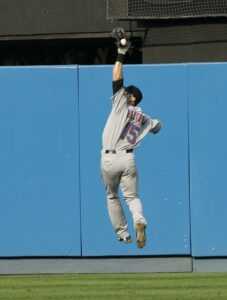
That’s also the case for Jones, who ranks 11th among center fielders by the same JAWS calculation. He gets in on his ninth year on the ballot, one season after receiving 66% of the vote. A native of Curacao, Jones signed with the Braves as an international amateur and flew through the minor leagues. He was the #1 prospect in the game when he reached the majors in the second half of the 1996 season. Jones stepped seamlessly onto a loaded Atlanta roster that was midway through their run of dominance in the National League. They were coming off a championship and would head back to the Fall Classic in ’96.

A 19-year-old Jones embraced the big stage, hitting .345 with a trio of home runs in October. That included a two-homer showing in Game 1 against the Yankees, and he remains the youngest player ever to hit a World Series home run. The Braves won the first game but wound up dropping the series in six.

Jones played mostly right field during his first full season. He hit .231 with 18 homers in 153 games and finished fifth in NL Rookie of the Year balloting. He really took off the following year, kicking off a decade-long run as the sport’s best defensive outfielder and a premier power threat. Jones hit 31 homers while batting .271/.321/.515 and earning his first Gold Glove in 1998. That was his first of seven 30-homer campaigns and, more remarkably, the start of a streak of 10 consecutive Gold Glove awards.

USATSI_8484016-208x300.jpg


He’d start all 162 games for the Braves in 1999, playing elite defense while batting .275/.365/.483 with 26 homers and 35 doubles. The Braves made it back to the World Series after losing the NLCS in the prior two seasons. They were again knocked off by the Yankees, this time in a sweep. Jones didn’t have great playoff numbers over that stretch but remained one of the league’s best players in the regular season. He hit 36 homers in a 2000 season which Baseball Reference valued at eight wins above replacement, a career high that ranked fourth in MLB among position players.

Jones earned an eighth-place MVP finish in 2000 and very likely would have finished higher had today’s defensive metrics been around at the time. He reeled off another three 30-plus homer seasons after that, narrowly dropping below that cutoff with a 29-homer showing in 2004. He rebounded with his most impressive offensive performance in ’05, as he slugged an MLB-best 51 longballs and led the National League with 128 runs batted in. Jones won a Silver Slugger for the first and only time and finished as the MVP runner-up behind Albert Pujols. It was a narrow split, as Pujols received 18 first-place votes against Jones’ 13. (Third-place finisher Derrek Lee received the other one.)

The righty hitter remained an impact run producer the following season, as he slugged 41 more home runs with a career-high 129 RBI. That was his last impact season, as his rate stats dropped in 2007. The Braves let him depart in free agency at season’s end, and he was essentially finished as an everyday player at age 31. Jones played parts of five more seasons between the Dodgers, Rangers, White Sox and Yankees. He didn’t record more than 64 hits in any of his final five campaigns.

While it was a precipitous decline, Jones had one of the more impressive peaks in baseball history. He hit 368 home runs with a .263/.342/.497 batting line between his debut and the end of his age-30 season. Retroactive defensive metrics come with significant error bars, but FanGraphs estimates he was roughly 134 runs better than an average defender during that stretch. That’s 25 runs clear of the second-place finisher at any position (Adrian Beltré) and certainly aligns with both his impressive accolades and scouting evaluations that consider him among the best outfield defenders in MLB history. Jones is one of six outfielders to win 10 Gold Gloves. He’s alongside Roberto Clemente, Willie Mays, Ken Griffey Jr., Al Kaline and Ichiro in that company and now, in Cooperstown.

Jones finished his career as a .254/.337/.486 hitter. His 434 homers place him one behind Beltrán for sixth among center fielders and tied with Juan González for 49th regardless of position. He nevertheless had a lengthy stay on the ballot as some voters struggled with his lack of production after he left Atlanta. Others may have withheld a vote on moral grounds, as Jones pleaded guilty to domestic battery charges and paid a fine after his wife alleged that he put his hands around her neck in December 2012. That came after the end of Jones’ MLB career, though he subsequently played two seasons in Japan to finish his professional playing days.

While Jones will certainly go into the Hall as a Brave, Beltrán had a nomadic enough career to consider a few options for his plaque. The Hall of Fame has final say but works with the player to choose which cap they’ll don. Beltrán tells Bob Nightengale of USA Today that while no decision has been finalized, he’s likely to go into Cooperstown as a Met.

Looking further down the ballot, Chase Utley’s 59% vote share was the highest among the candidates who were not elected. That’s up 20 points relative to last winter. It puts Utley, who has been on the ballot for three years, on track for eventual enshrinement — with an outside chance that he gets in as soon as next year. No other candidate appeared on more than half the ballots.

Of this year’s first-time candidates, only Cole Hamels (23.8%) received more than the 5% necessary to remain under consideration. All but one player who fell off the ballot was up for consideration for the first time. The lone exception is Manny Ramírez, who drops off after coming up short in his 10th year. Ramírez’s history of performance-enhancing drug use (including a failed test) made him a non-starter for many voters, and he appeared on fewer than 40% of ballots in his final year. His only path to enshrinement is via the Era Committees, and their decision last month on Barry Bonds and Roger Clemens makes it difficult to see a scenario where Ramírez ever gets in.

Next year will be the final consideration for Omar Vizquel, who has no chance of jumping from 18% to induction. Buster Posey and Jon Lester headline a class of first-time candidates that’ll also include Ryan Zimmerman, Kyle Seager, Brett Gardner and Jake Arrieta. Posey seems likely to get serious consideration for first-ballot induction, while Lester should easily have enough support to get more than 5% and remain on the ballot for future seasons.

Full voter breakdown courtesy of BBWAA. Respective images via USA Today Sports.

Source: https://www.mlbtraderumors.com/2026/01/carlos-beltran-andruw-jones-elected-to-hall-of-fame.html
 
Braves Sign Tayler Scott, Tristin English To Minor League Deals

The Braves signed right-handers Javy Guerra and Blayne Enlow to minor league contracts (h/t to Baseball America’s Matt Eddy). They also added first baseman Tristin English and reliever Tayler Scott on minor league deals last month, according to the MLB.com transaction log.

Scott, 33, is a well-traveled righty who made 24 appearances between the Astros and Diamondbacks last year. He struggled to a 7.90 earned run average over 27 1/3 innings. The South Africa-born pitcher is only a year removed from firing 68 2/3 frames of 2.23 ERA ball with Houston. He carries a 5.51 mark with a 21.2% strikeout percentage and 12.2% walk rate over parts of five MLB campaigns.

Guerra returns to affiliated ball after two seasons in Japan. The 30-year-old infielder turned reliever was employed by the Hanshin Tigers from 2024-25. Guerra pitched to a 1.55 ERA across 59 appearances two seasons ago. He nevertheless spent most of last year with the Tigers’ minor league affiliate, only pitching 4 2/3 innings at the NPB level. The Panamanian-born Guerra has a big arm but has struggled to throw strikes since making the mid-career move to pitching.

English, a 28-year-old first baseman, played seven games for the Diamondbacks last year. He went 2-22 with a walk and eight strikeouts. English had a good season for Arizona’s Triple-A affiliate, batting .324/.368/.524 with 16 homers across 428 plate appearances. That was better than average production even at a hitter’s paradise in Reno. English has good contact skills and reasonable power, but he’s prone to expanding the strike zone. The deal with the Braves is a homecoming for the Georgia Tech product, who’ll likely open the season at Triple-A Gwinnett.

Enlow, 27 in March, is a former third-round pick who was once a well-regarded prospect in the Minnesota system. The 6’3″ righty pitched well through Double-A but hit a wall at the Triple-A level. Enlow signed a minor league deal with the Giants going into 2024 but suffered a season-ending injury after two starts, then missed all of last season. He’s a pure depth add for the rotation who is still looking to reach the majors for the first time.

Source: https://www.mlbtraderumors.com/2026...tt-tristin-english-to-minor-league-deals.html
 
Braves Sign Sean Reid-Foley To Minor League Deal

The Braves have signed right-hander Sean Reid-Foley to a minor league contract, as first indicated on the MLB.com transaction log. There’s no invitation to major league camp on the righty’s deal.

The 30-year-old Reid-Foley was a second-round pick by the Blue Jays back in 2014 and ranked as a well-regarded pitching prospect for a couple years early in his pro career. He’s shown huge swing-and-miss ability but also persistent command troubles — all amid ongoing injury problems. Most notably, he underwent Tommy John surgery in 2022, which wiped out more than a calendar year. Reid-Foley also had multiple stints on the injured list due to a shoulder impingement in 2024.

In 131 2/3 innings at the major league level, Reid-Foley has posted a 4.10 earned run average while punching out 25.6% of his opponents. His strikeout numbers spiked in 2023-24, in particular, as he fanned nearly one-third of his opponents (backed by a 13.5% swinging-strike rate) — albeit in a small sample of 29 1/3 innings. His workload during those two seasons was cut short by that Tommy John rehab and the subsequent shoulder impingement.

Reid-Foley split the 2025 season between the D-backs and Mets organizations, pitching exactly 14 innings for each club’s Triple-A affiliate. He struggled considerably. In last year’s 28 frames, Reid-Foley was roughed up for a 7.07 ERA thanks to a glut of both home runs and walks.

Command has long been an issue for Reid-Foley. Even as he’s piled up big strikeout totals and rates in prior seasons, he’s struggled to keep runners off base due to his lack of precision. The 6’3″, 230-pound righty has walked a bloated 14.2% of his major league opponents and had similar struggles in parts of six seasons at Triple-A, where his career 13.7% walk rate is only marginally better than his major league rate.

With Atlanta, Reid-Foley doesn’t have a clear path to the majors — and wouldn’t even if he had a big league invite on his deal — given the Braves’ crowded, very veteran bullpen. He’ll be slated to open the season with Triple-A Gwinnett and could emerge as an option later in the year if the Braves incur injuries in the majors and/or if he can bounce back from last year’s dismal Triple-A results.

Source: https://www.mlbtraderumors.com/2026/01/braves-sign-sean-reid-foley-to-minor-league-deal.html
 
Back
Top